Afghanistan Earthquake Kills 8, Tremors Felt in Chandigarh Mohali Ludhiana Punjab
Afghanistan Earthquake Kills 8, Tremors Felt in North India
North Desk Bureau
Chandigarh, April 4
It was just past dinner time on Friday when North India shook.
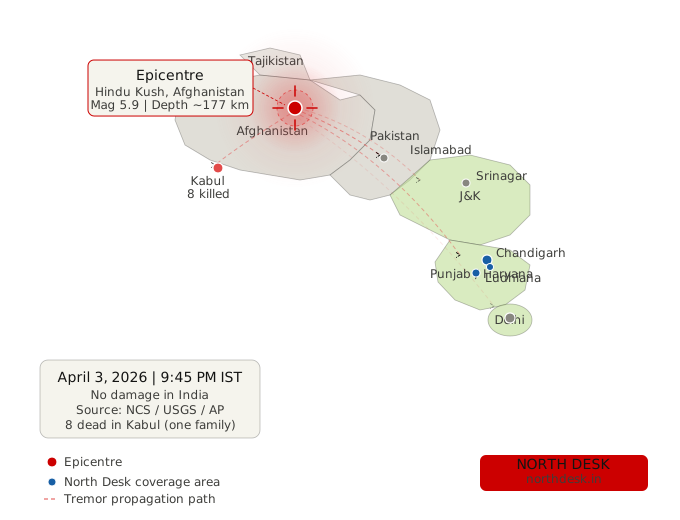
At 9:45 pm on April 3, a 5.9-magnitude earthquake originating in Afghanistan’s Hindu Kush mountains sent tremors rippling across a vast swathe of the subcontinent — from Kabul to Chandigarh, Mohali to Delhi, Srinagar to Ludhiana. For a few tense seconds, fans swayed, walls rattled and residents in high-rise buildings rushed for the stairs.
The Mohali moment
Sushma Rani was at the dining table in her fourth-floor apartment in Mohali (Punjab) when it happened. “I was having food and I noticed the fan was shaking,” she said. “Then I started feeling the tremors.” She immediately called her children down from the upper floors and made her way to the ground level. She wasn’t the only one. “Many other residents had also come down,” she said. “Everyone was worried.”
Her account mirrors what was playing out simultaneously across Chandigarh, Zirakpur and Ludhiana — and hundreds of kilometres away, in far deadlier fashion, on the outskirts of Kabul.
Eight killed in Kabul
At least eight people were killed and a child was injured when a house collapsed on the outskirts of the Afghan capital. Hafizullah Basharat, a spokesman for the Kabul governor, confirmed all the victims were members of the same family. There were no immediate reports of damage or casualties from areas closer to the epicentre — the terrain is remote, and it can often take several hours before local authorities relay information back to Kabul.
Afghanistan’s Health Ministry placed Kabul and provincial health authorities on alert.
The epicentre: Hindu Kush
The epicentre was in the Hindu Kush mountain range, roughly 150 kilometres east of the Afghan city of Kunduz. The quake was at a depth of approximately 177 km — a deep-focus event, which is precisely why it was felt so far from its source. Deep earthquakes lose intensity more slowly over distance than shallow ones, allowing them to travel thousands of kilometres.
Afghanistan’s vulnerability to earthquakes is linked to its location along the collision zone between the Indian and Eurasian tectonic plates. The Hindu Kush region lies in a highly active seismic zone, and quakes have caused thousands of deaths in recent years. Many homes in rural and outlying areas of Afghanistan are built from mud bricks and wood — poorly constructed and highly vulnerable to collapse.
The human cost in Afghanistan has been staggering in recent years. Last August, a 6.0 earthquake in eastern Afghanistan killed more than 2,200 people, levelling villages and trapping residents under rubble. In November, a 6.3 quake struck Samangan province, killing at least 27 people and injuring more than 950, while also damaging the famed Blue Mosque in Mazar-e-Sharif.
North India: Panic, but no damage
Tremors were reported from multiple cities including Delhi, Noida, Chandigarh, Ludhiana, Poonch, Srinagar and Udhampur. Residents in high-rise buildings across Chandigarh, Mohali and Zirakpur described strong jolts lasting several seconds — enough to send families scrambling toward exits. There were no reports of casualties or structural damage anywhere in India.
North India sits in Seismic Zones IV and V — the two highest-risk categories under the national hazard map — making tremors from the Hindu Kush a recurring, if infrequent, reality for the region.