Dhurandhar: The Revenge Propaganda Row: Dhruv Rathee, Akhilesh Yadav, BJP and the Political Storm Around India's Biggest Film
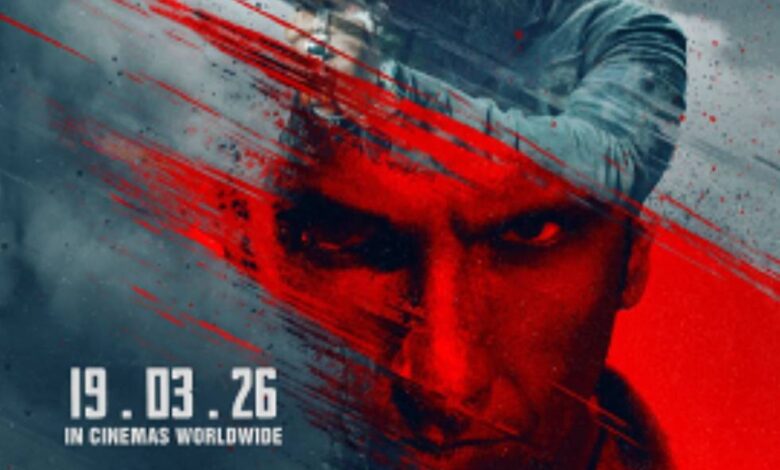
India’s blockbuster Dhurandhar: The Revenge has sparked discussion both for its box-office success and its depiction of real-life political events. North Desk breaks down the movie’s plot, the controversies surrounding its portrayal of historical events, and reactions from critics, political figures, and social media personalities. .
North Desk Bureau
Chandigarh, March 29
Q: Why is Dhurandhar: The Revenge in the news beyond box-office numbers?
Dhurandhar: The Revenge is the second and final installment of a spy-action duology written and directed by Aditya Dhar. The film stars Ranveer Singh, Arjun Rampal, Sanjay Dutt, R. Madhavan, and Sara Arjun. It follows an undercover Indian intelligence agent who infiltrates Karachi’s criminal syndicates and Pakistani politics while avenging the 26/11 attacks and confronting bigger threats.
Released on 19 March 2026, it smashed records at the box office. The film clocked a record ₹236 crore worldwide on its opening day. It has since become the eighth-highest grossing Indian film of all time, the highest-grossing Indian film of 2026, and the tenth-highest grossing film of 2026 globally.
The political storm erupted because the film’s storyline directly references — and dramatises — real events and real political decisions: the 2014 Indian general election, the 2016 demonetisation, and various geopolitical conflicts in South Asia. Critics argue this is not entertainment but electioneering disguised as cinema.
Q: What specific political elements in the film have triggered the controversy?
Several narrative choices have drawn fire.
Demonetisation reframed as an anti-terror operation: The film describes the demonetisation announcement as ‘Operation Green Leaf’ aimed to destroy terror funding and fake currency networks, showing it as a hard blow against ISI-linked counterfeit currency that caused the instant collapse of villainous financial networks. Critics say this is a deliberate attempt to whitewash a policy some allege was an economic disaster.
Opposition politicians drawn as Pakistani pawns: Critics note the film basically says that if you belong to a political party opposed to the BJP, you are being funded by Pakistan, and that anyone in India who opposed Hindutva and the BJP is being funded by Pakistani NGOs.
The ‘Atif Ahmad’ character: The film features a character named ‘Atif Ahmad’ who bears a striking resemblance to slain gangster-politician Atiq Ahmed — from his attire and mannerisms to his rise as a mafia figure. The character hails from Chakia, Prayagraj, and is depicted as having links with Pakistan’s ISI and terror outfit Lashkar-e-Taiba. Atiq Ahmed was a former Samajwadi Party MP — making this portrayal politically explosive.
Pre-2014 India depicted as weak: Critics note the film hides the fact that incidents such as the Kandahar hijack, the Parliament attack, the Pulwama attack, and the Pahalgam attack all took place during earlier BJP regimes, and makes the audience believe that decisive action against Pakistan-sponsored terrorism started only after Modi came to power.
Q: What did Dhruv Rathee say, and why did it cause a backlash?
YouTuber Dhruv Rathee alleged the film functions less as entertainment and more as a high-budget political campaign aligned with the BJP. He argued that the narrative presents selective interpretations of events, particularly portraying the 2016 demonetisation as a security-driven move while downplaying its broader economic consequences. He also argued the film relies heavily on emotional storytelling techniques that shape audience perception.
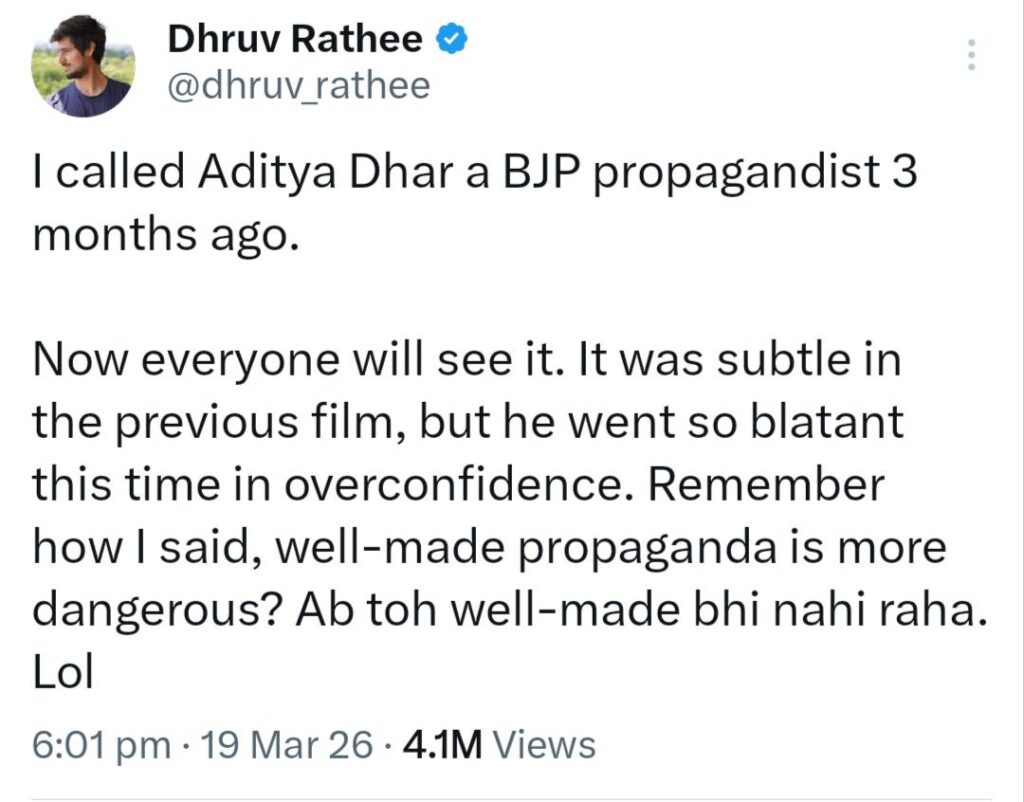
Rathee posted on X: “I called Aditya Dhar a BJP propagandist 3 months ago. Now everyone will see it. It was subtle in the previous film, but he went so blatant this time in overconfidence. Remember how I said, well-made propaganda is more dangerous? Ab toh well-made bhi nahi raha.”
He also criticised the use of real names and actual footage while presenting the story as fictional, describing this as a “legal cheat code” used to confuse viewers. The criticism triggered heavy trolling, with many users questioning Rathee’s own credibility and alleging he selectively targets the BJP.
Q: What has Akhilesh Yadav said?
Samajwadi Party chief Akhilesh Yadav called Dhurandhar 2: The Revenge “paid propaganda” designed to defame opposition parties ahead of crucial state elections. Speaking at a party event in Lucknow, Yadav said: “You’re making films by spending money to defame other parties. I think too much money has reached these people.”
Yadav’s specific grievance relates to the fictional character Atif Ahmed, whose physical appearance, criminal history, and political journey closely resemble those of the late Atiq Ahmed, a former SP-backed Lok Sabha member turned mafia don.
Party leaders privately acknowledge that the timing and tone of the portrayal could have implications as Uttar Pradesh moves toward the 2027 Assembly elections. The concern is that repeated visual references linking a figure resembling Atiq to terror networks may harden voter perceptions.
SP MP Rajeev Rai also countered that the BJP “operates a mechanism that generates films based on its invented tales” to forge a particular image among citizens.
Q: How have BJP leaders responded? Did any of them effectively admit the film serves their political interests?
Yes — and the candour was remarkable. Assam Chief Minister Himanta Biswa Sarma told reporters: “Just look at how many people are going to watch it. It means that there are several BJP-RSS people around the world… People are going to watch it in large numbers. That means those who are going to watch ‘Dhurandhar’ are going to vote for the BJP. It is good for us.”
This statement — made in response to Congress calling the film a “BJP-RSS agenda” — was widely seen as inadvertently confirming the opposition’s argument. Sarma also tweeted that ever since Congress labelled it an “RSS film,” public curiosity had driven even larger crowds to theatres.
Former Jammu & Kashmir DGP S.P. Vaid defended the film’s content, saying: “The truth is harsh. Atiq Ahmed was a gangster. The whole world knows that he received illegal weapons, and his links with Pakistan are known to the world. What has been shown is based on the truth.”
Q: What has the Congress said?
Congress MP Tariq Anwar condemned the film as aimed at spreading hatred nationwide. He alleged that its depiction of violence is designed to create hostility against a particular community, calling the filmmakers “basically hatemongers.” He also warned that the film’s messaging could inadvertently benefit Pakistan’s narrative and undermine India’s social fabric.
Q: What do prominent media reviews say — does the film have a BJP bias or not?
The critical consensus on the two parts of Dhurandhar is split down ideological lines, but several mainstream publications have been pointed in their assessments.
Reviews flagging BJP/propaganda backing:
Uday Bhatia, writing in Mint, was unambiguous: “Dhurandhar offers sadism and expert bad vibes… it’s propaganda in service of a hawkish India, designed to flatter the ruling BJP leadership.”
The Federal found the movie used “the wish-fulfilment framework to play defence for the BJP in general and the Narendra Modi government in particular,” adding that the film “basically says that if you belong to a political party opposed to the BJP, you are being funded by Pakistan.”
IGN’s reviewer called the movie one “in favor of naked political propaganda.” Agnivo Niyogi of The Telegraph wrote that it “has more gore, more violence and brazen propaganda.”
Anuj Kumar of The Hindu wrote that the “ambitious but overstretched and chest-thumping espionage saga serves political interests.”
Reviews defending the film or disputing the propaganda label:
Open Magazine argued that calling the film propaganda “reveals an inability to come up with more convincing arguments,” comparing it to Saving Private Ryan and Zero Dark Thirty, both of which could be read as ideologically tilted but are not dismissed as propaganda.
Rishabh Suri of Hindustan Times rated it 4/5, calling it “a roller-coaster thriller… elevated by Ranveer Singh’s powerful performance and a gripping second half.” Radhika Sharma of NDTV rated it 3/5, describing it as “an out-and-out Ranveer Singh show.”
Q: Is there any irony in the film’s reception in the South — states that typically reject the BJP?
Perhaps the sharpest irony around Dhurandhar 2‘s run is how a film widely described as glorifying the Modi government’s policy record, including demonetisation, found an enthusiastic audience in Tamil Nadu and Kerala — states that have consistently resisted the BJP’s political expansion.
Rajinikanth’s public endorsement of the film on social media, combined with a ban controversy triggered by a petition before the Madras High Court, gave Dhurandhar 2 a level of visibility that marketing budgets alone cannot buy.
Q: Has the film been banned anywhere?
Like its predecessor, Dhurandhar: The Revenge was banned across countries of the Gulf Cooperation Council. The first film was also banned in GCC countries because of its anti-Muslim content — a criticism that has followed the sequel as well.
Q: What is the broader political significance of all this?
What is clear is that Dhurandhar 2 has done something rare: it has made a commercial entertainer inseparable from the country’s active political discourse, compressing questions about intelligence, crime, political patronage, and national security into a spy thriller that the opposition cannot ignore and the ruling party has no interest in distancing itself from. In an election season, that is not an accident.
Dhurandhar is just the latest in a wave of films that have promoted nationalist messaging since Narendra Modi came to power in 2014. Director Aditya Dhar also wrote Article 370 and directed Uri: The Surgical Strike, both of which were criticised as propaganda by some people.
The film has, inadvertently or otherwise, become a referendum on what Indian audiences — and voters — want from their cinema.
Story compiled and reported by North Desk | northdesk.in