Punjab Police charges Rs 80 fee to download FIR from SAANJH portal; PIL in Punjab and Haryana High Court calls it illegal

North Desk Correspondent
Chandigarh, March 25
A public interest litigation filed in the Punjab and Haryana High Court on Wednesday has challenged Punjab Police’s recent decision to charge citizens Rs 80 to download copies of First Information Reports from its official online portal, calling the levy illegal, arbitrary and violative of the Constitution.
The petition, filed by Sharwan Singh, a resident of Zirakpur, targets the “SAANJH” citizen service portal operated by Punjab Police, which requires users to pay the fee and click a “Pay and Get FIR” button before they can access an FIR — a document that courts have repeatedly held to be a public record.
SC order circumvented?
The legal foundation of the petition rests on a 2016 Supreme Court ruling that Punjab Police has, in effect, turned on its head.
In Youth Bar Association of India vs Union of India (2016), the Supreme Court directed that FIRs must be uploaded on official police websites within 24 hours of registration and made freely accessible to the public, subject only to limited exceptions in sensitive cases such as sexual offences, terrorism and insurgency-related matters.
Punjab Police subsequently built SAANJH — presented as an e-governance initiative to promote transparency, accountability and ease of citizen access to public services. FIR downloads were listed as one of its core features.
From Tuesday, Punjab Police introduced a payment mechanism. Citizens must now pay Rs 80 per FIR before they can download it.
The petition, filed by lawyers Vasu Ranjan Shandilya and Abhishek Malhotra, has annexed a screenshot of the SAANJH portal showing the “Pay and Get FIR” interface as evidence.
The police defence: server costs and frivolous downloads
Punjab Police have justified the move, saying they were acting on government orders in levying the charges. Officials have also been at pains to clarify that the accused and the complainant in any case will continue to receive a free copy of the FIR directly from the police station and that the paywall applies only to third-party downloads through the portal.
A police official, speaking to a newspaper, offered a more operational rationale. The SAANJH server is integrated with the Crime and Criminal Tracking Network Systems (CCTNS), and over time, a surge in downloads — mostly by third parties without genuine need, the official said — had begun causing technical strain on the network. The fee, in this reading, is less about revenue and more about discouraging unnecessary downloads and protecting server stability.
It is an argument that the petitioner’s counsel is likely to contest in court. The Supreme Court’s 2016 directions made no distinction between categories of citizens seeking FIR access, and placed no ceiling on the number of downloads permissible.
Who it hurts
The petition makes a pointed humanitarian argument. An FIR is not an administrative convenience — it is the foundational document that sets the criminal justice system in motion. Access to it is often the first step toward bail, anticipatory bail, quashing petitions and other legal remedies.
Victims of crime need FIR copies to pursue their cases. Accused persons — who are presumed innocent — need them urgently for bail applications and legal consultations. Families scrambling to get a relative out of custody cannot afford procedural or financial delays.
Journalists, lawyers and researchers who track crime and the justice system routinely access FIRs as part of their work. The paywall affects this category of users most directly, since the police station exemption applies only to parties named in the FIR.
The petition argues that the Rs 80 charge disproportionately burdens daily wage earners, rural citizens and economically weaker sections who may lack both the digital literacy and the financial means to navigate a paid online portal. The petition contends that the fee creates an unconstitutional two-tier system — one where access to essential legal documents depends on the ability to pay — and is therefore violative of Article 14 (equality before law) and Article 21 (right to life and personal liberty, which courts have interpreted to include fair trial and due process) of the Constitution.
Opposition attacks AAP government
The move has drawn sharp criticism from the lawyer community and political opposition, who have framed it as an attempt by the Bhagwant Mann government to restrict scrutiny of its functioning.
It’s an absurd decision, said High Court lawyer Ranjan Lakhanpal, adding that this was being unfair to all residents of the state who would have to pay for something they should get free.
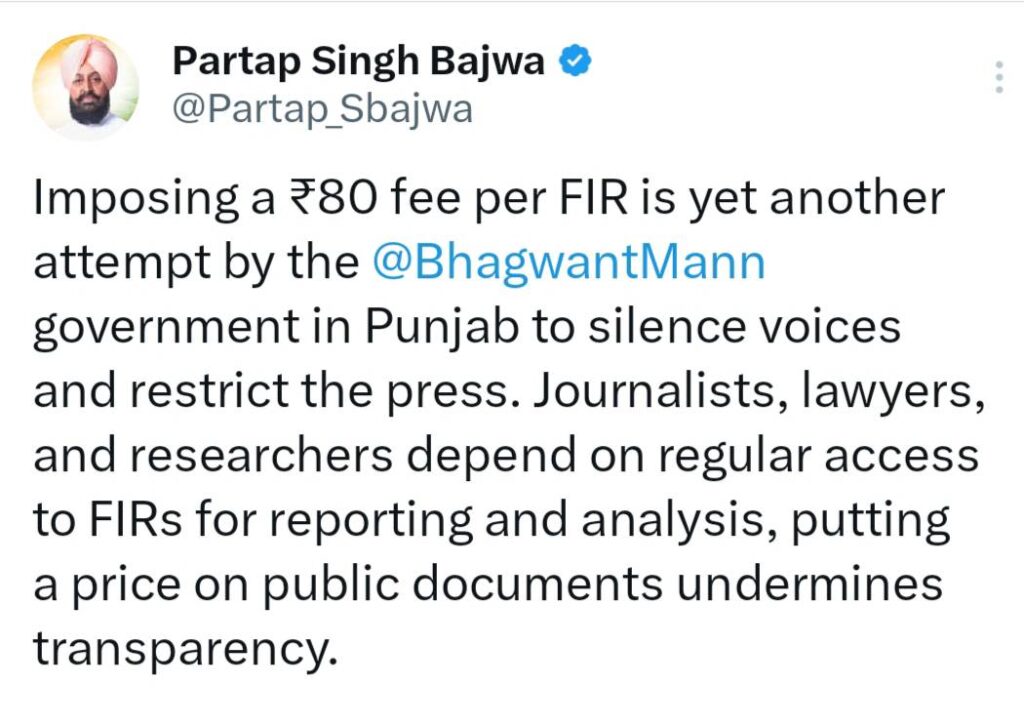
Leader of Opposition Partap Singh Bajwa took to X to attack the decision. Journalists, lawyers and researchers depend on regular access to FIRs for reporting and analysis, he said, and putting a price on public documents undermines transparency. He suggested the charge was designed to discourage deeper scrutiny and push critical inquiry behind a paywall, signing off with a barb: “Manish Sisodia’s suggestions being implemented.”
The AAP government has not issued a formal response to the criticism.