Punjab Police Wants X (Twitter) to Delete 22 Posts: What Are They and Why It Matters
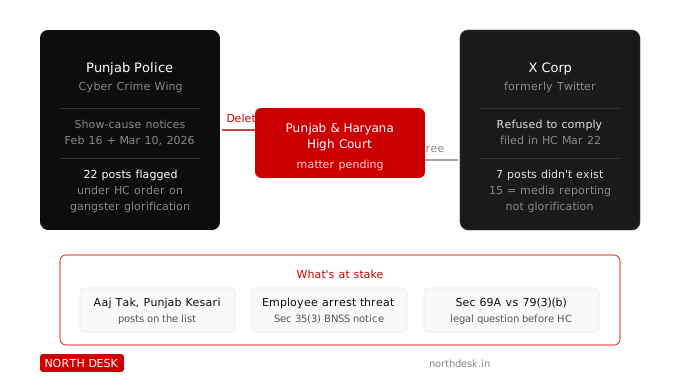
Punjab Police sent show-cause notices to X (formerly Twitter) demanding removal of 22 posts, citing a High Court order on gangster glorification. But X Corp has pushed back. The matter is now before the Punjab and Haryana High Court.
Arvind Chhabra
Chandigarh, April 2
Punjab Police has sent show-cause notices to X, formerly known as Twitter, demanding the removal of 22 posts from its platform — posts that the police say glorify gangsters and criminals. X Corp has refused, challenged the demand before the Punjab and Haryana High Court, and accused Punjab Police of misreading a court order to suppress legitimate journalism. Here is everything you need to know.
What is the background to this case?
The Punjab and Haryana High Court has been hearing a public interest litigation (PIL) on the rise of organised crime in Punjab, including targeted killings and extortion. On January 28, 2026, the court directed the Director General of Police, Punjab, to identify websites and social media platforms where videos and posts that tend to glorify crime and criminals are being shared, and to take immediate steps to remove them.
Punjab Police’s Social Media Analysis Centre (SMAC), operating under the Cyber Crime Division, was tasked with acting on this direction. It began scanning platforms and sending notices to social media intermediaries — including X — for removal of content it identified as falling within the scope of the court’s order.
What exactly did Punjab Police ask X to remove?
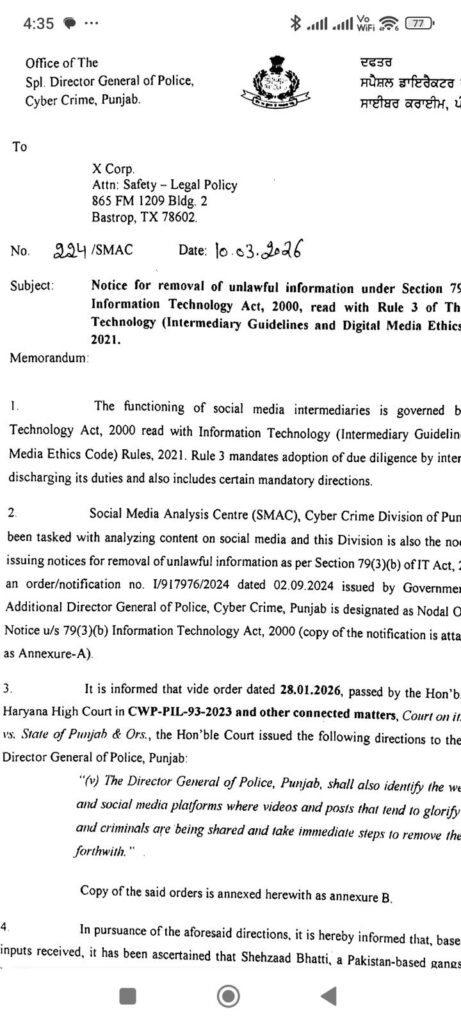
Between January and March 2026, Punjab Police sent two show-cause notices to X — on February 16 and March 10 — demanding the removal of 22 posts. The notices warned of criminal consequences against X and its employees if the posts were not taken down across all of India.
The content of these 22 posts broadly falls into the following categories:
— Posts reporting on or carrying an audio clip purportedly from Canada-based gangster Goldy Brar, which surfaced after the arrest of his parents by Punjab Police in Muktsar in January 2026.
— Posts carrying or discussing a viral video of jailed gangster Lawrence Bishnoi making a video call from Gujrat Central Jail in India to Pakistan-based criminal Shahzad Bhatti — the two are seen exchanging Eid greetings, raising serious questions about jail security.
— Posts reporting on threats made by Pakistan-based don Shahzad Bhatti — including a threat to Bihar Chief Minister Nitish Kumar in the context of a hijab controversy.
— A post claiming that a very senior Punjab political leader personally telephoned gangster Jaggu Bhagwanpuria. North Desk cannot independently verify this claim; it is one of the posts Punjab Police has sought to have removed.
Significantly, several of these posts were published or shared by major established media organisations. Aaj Tak, Live Times, and Punjab Kesari are among the outlets whose content was flagged by Punjab Police for removal from X.
Did X comply?
No — not fully. X had earlier complied with a separate, narrower Magistrate court order from SAS Nagar (Mohali) dated January 31, 2026, which directed removal of specific posts relating to false claims about Punjab Police killing one lakh youth. X withheld those specific posts and stated it was fully compliant with that order.
However, when Punjab Police went further — sending show-cause notices demanding removal of the 22 additional posts — X pushed back. Through its legal representatives, X told Punjab Police that the demands went beyond what the High Court order contemplated, and that it would approach the court for clarification.
What is X’s argument?
X Corp, through its counsel, has made several pointed arguments before the Punjab and Haryana High Court:
First, X says Punjab Police has fundamentally misread the January 28 High Court order. The order permitted police to identify platforms hosting content that glorifies crime — it did not authorise police to directly order takedowns bypassing established legal procedure.
Second, X argues that the correct legal route for blocking content across India is Section 69A of the Information Technology Act, 2000 — not Section 79(3)(b), which Punjab Police has been invoking. This distinction matters: Section 69A orders come with procedural safeguards, whereas Section 79(3)(b) notices, X argues, are not a valid source of power to block content. X has pointed out that this very question is being challenged in at least five writ petitions before High Courts across India.
Third — and this is the detail that escalates the matter significantly — X has told the High Court that Punjab Police threatened criminal action against X’s own employees in India for the company’s failure to remove the posts. A pre-arrest notice was issued against an X employee under Section 35(3) of the Bharatiya Nagarik Suraksha Sanhita.
Fourth, X has highlighted that of the 22 posts flagged, seven were not even available on the platform at the time of the notices — they had either been deleted or never existed in the accessible form claimed by police.
Fifth, X has argued that as an intermediary, it cannot perform a judicial function — it cannot determine whether a piece of content glorifies crime. That determination, X says, must be made by a court. It has cited the Supreme Court’s landmark judgment in Shreya Singhal vs Union of India (2015) in support.
What has the High Court said so far?
The matter is currently pending before the Punjab and Haryana High Court. X Corp has filed applications seeking to be impleaded as a respondent in the PIL, and has simultaneously sought urgent protection for its employees against coercive action by Punjab Police. The Magistrate at SAS Nagar had directed Punjab Police not to take any coercive action in the interim. The High Court is yet to rule on X’s applications. It has issued notice to the respondents, the Punjab Police
Why does this matter beyond the posts themselves?
Because of what it reveals about how the state can use court orders to pressure platforms into removing content including those published by mainstream media. Several of the 22 posts flagged by Punjab Police are news reports published by established media organisations covering matters such as a gangster’s threats, jail security lapses, and a politician’s alleged contact with a criminal.
The case also puts a spotlight on a legal grey zone in India’s intermediary liability framework — specifically, whether state police can use Section 79(3)(b) notices as a shortcut to compel content removal without going through the more rigorous Section 69A process that the Supreme Court has endorsed.
For journalists and news organisations operating in Punjab and beyond, the answer to that question will matter for a long time to come.