Cocaine, LSD, a Dead Russian DJ and Rs 16,000 Entry: Inside the KASOL RAVE PARTY That Officials Let Happen
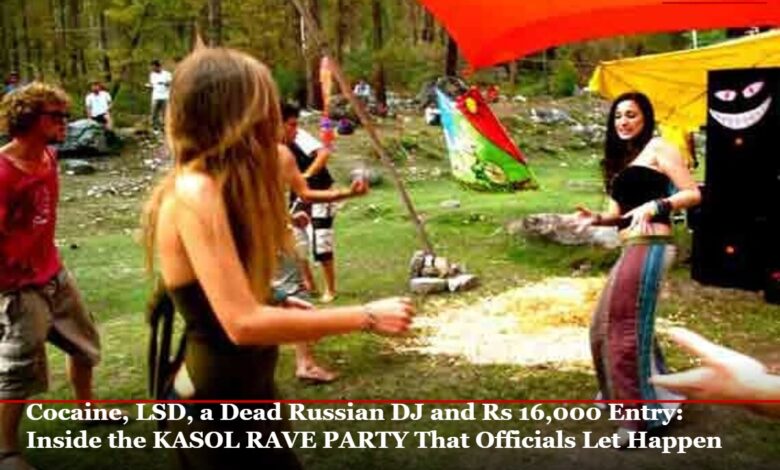
Kasol rave party: Documents from the District Legal Services Authority and the Himachal Pradesh police reveal for the first time what was happening inside the forest grounds near Kasol — and how the administration looked away. (The above photo is only a symbolic picture for representational purposes).
Arvind Chhabra
Shimla/Chandigarh, June 29
A Forest, 5,000 Revellers, and No Way Out
Six kilometres from Kasol market, accessible only by a kaccha road that only four-wheel-drive vehicles can negotiate, two adjoining grounds — Green Forest-I and Green Forest-II — had been quietly prepared for what was being promoted across social media as a major music event.
According to official enquiry report accessed by North Desk, the venue could accommodate between 4,000 and 5,000 people. Green Forest-I alone had a capacity of 2,500 to 3,000, Green Forest-II another 2,000. Fifty camping tents had been arranged for guests who would stay overnight. A massive stage with a dedicated DJ console and a high-decibel sound system dominated the grounds. Eight to ten temporary toilets had been installed. Large refrigerators stocked with beer bottles and ice cubes lined an exclusive liquor stall. CCTV cameras had been mounted around the perimeter.
From June 7 to 11, 2026, thousands of revellers poured in — from Bangalore, Hyderabad, Goa, Delhi, Chandigarh, and overseas destinations including Israel — paying between Rs 10,000 and Rs 16,000 per person for entry.
The Parvati Valley, long known on the global backpacker circuit for its association with charas and its “Mini Israel” identity, had a full-scale commercial rave operation running in its forests.
Kasol rave party: What the DLSA Inspector Found
On June 9, 2026, the Secretary of the District Legal Services Authority (DLSA), Kullu, visited the site as directed by the Himachal Pradesh High Court, which had taken cognizance of newspaper reports about the event. What the inspection team found is documented in detail in the DLSA report, subsequently placed before the High Court.
The team found large quantities of empty liquor bottles — beer bottles and whiskey bottles — scattered across the venue. Crucially, the organisers had produced only a sound permission when asked for documents. They had no permit to serve liquor. The refrigerators full of beer and the empty bottles established beyond doubt that alcohol had been served illegally throughout the event.
More significantly, the inspection team recovered cigarette butts, rolling papers, and “perfect rolls” — the DLSA report explicitly notes these are used for preparing and consuming a mixture of cannabis and tobacco. The report concluded that psychotropic substances had been consumed at the venue on a large scale.
The DLSA Secretary directed that the DVR of the CCTV system — containing recordings of everything that had happened at the venue — be seized and preserved. It was handed over to ASI Param Chand of Police Station Manikaran, who accompanied the inspection team.
Two FIRs were registered by local police against two tourists caught at the spot in possession of cocaine and LSD.
A Russian DJ Dies
Kasol rave party: The most chilling detail in the DLSA report concerns a foreign national identified as Daria Kuzminykh, a resident of Russia, who had been performing as a DJ at the event. According to the report, Kuzminykh is suspected to have died due to a drug overdose. A post-mortem examination was recommended. The final cause-of-death report was still awaited.
The Chief Medical Officer, Kullu, confirmed to the DLSA that no patient had been brought for treatment at any establishment in Kasol — suggesting that whatever happened to Kuzminykh, it did not result in a medical emergency being reported through official channels before her death.
The Warning That Was Ignored
Kasol rave party: What makes the Kasol case more than a drugs story is the documented chain of official failure that allowed it to happen.
As far back as June 5, 2026 — two days before the events began — the Deputy Superintendent of Police, Headquarters, Kullu, had submitted a field inquiry report that was unambiguous. The report stated that given the nature and location of the event, the possibility of consumption and trafficking of narcotic drugs and psychotropic substances could not be ruled out. It noted that Police Station Manikaran had limited manpower and could not maintain effective surveillance over thousands of attendees in an isolated forest location accessible only by kaccha road.
Despite this report, the SDM concerned granted sound permission to the organisers — identified as Yashpal and Ishwar Singh — on June 6, the very next day.
The events ran from June 7. Music played till 11 pm — an hour beyond the 10 pm limit specified in the permission itself. Nobody stopped it.
It was only when the High Court Bench intervened on June 9, directing inspection and checks, that police reached the venue. Most attendees found there were intoxicated and had to be evacuated to Kasol. The sound permission was cancelled. But by then, Daria Kuzminykh was dead.
Political Patronage and Big Money
Kasol rave party: The PIL before the High Court — filed by the Himalayan Environment Protection Society, Kullu — had flagged something that goes beyond individual administrative failure. It pointed out that events of this scale, with entry tickets ranging from Rs 5,000 to Rs 7 lakh, cannot be organised without the shelter of influential people and political patronage. Videos of such parties, it noted, circulate openly on websites, and drugs are available at them without concealment.
The High Court itself, in its order, found it difficult to accept that commercial ventures drawing 4,000 to 5,000 paying participants could be organised in isolated forest locations without the connivance of the local administration.
Underlining the commercial scale involved: the Superintendent of Police sought additional personnel via letter dated June 12 — after the event was already over — even though the adverse DSP report had been in his hands since June 5.
A Decade of Court Orders, Nothing Changed
Kasol rave party: This is not the first time the HP High Court has been forced to intervene on rave parties in Kullu and Mandi. The PIL in which the June 24 order was passed is clubbed with petitions going back to a PIL of 2015. For over a decade, the court has been seized of the drug and rave party problem in these districts. Affidavits have been filed, SOPs issued, helpline apps launched. The State even projected a “Drug-Free Himachal App” and the Nasha Nivaran Helpline 1908 as evidence of its commitment.
None of it stopped Green Forest-I and Green Forest-II from operating earlier this month.
What the Court Has Now Ordered
Kasol rave party: In its last week’s order, the division bench headed by Chief Justice G.S. Sandhawalia directed the State to transfer all three officials — the Deputy Commissioner of Kullu, and the Superintendents of Police of Kullu and Mandi — within one week.
It further directed registration of an FIR against the organisers, constitution of a Special Investigating Team to be headed by an IPS-cadre officer posted at Kullu, and initiation of departmental proceedings against the three officials. The investigation is to be conducted by an officer not below the rank of Deputy Inspector General of Police, examining whether there was tacit permission or collusion between officials and the organisers. The matter comes up next on August 6, 2026.
The Deputy Commissioner’s compliance affidavit had argued that tourism is the mainstay of Kullu’s economy and that excessive restrictions on tourism stakeholders would adversely affect the sector. The court was, however, unmoved.
Follow North Desk on WhatsApp for the latest from Punjab, Haryana and Himachal Pradesh: https://whatsapp.com/channel/0029Vb7ccdxJENy2H87DBG3E
READ ALSO: Who Is Jagman Samra? The Canada-Based NRI at the Centre of the Bhagwant Mann Video Row

One Comment