Punjab Congress: Manish Tewari Cryptic Post Decoded: What ‘Giddar Singhi’ Really Means
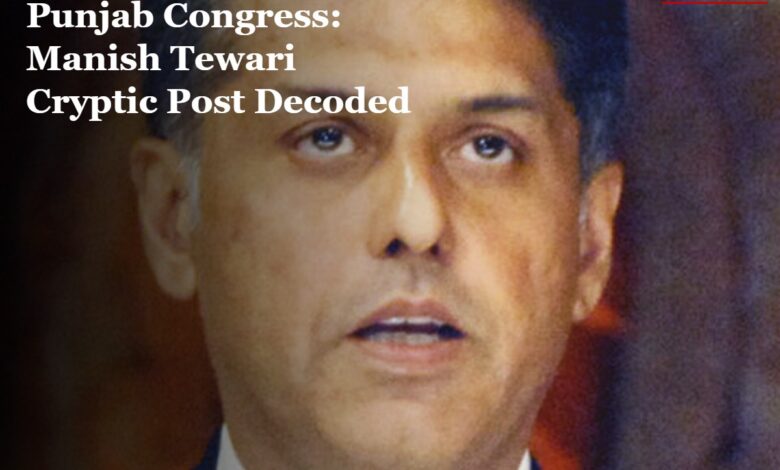
Punjab Congress: Manish Tewari’s, Chandigarh MP, veiled X post after being left out of Congress’s Punjab reshuffle carries a pointed subtext — a close reading of his words and the politics behind them.
North Desk Correspondent
Chandigarh, July 2
When the Congress high command rolled out its organisational architecture for the 2027 Punjab Assembly election on Wednesday, one name was conspicuously absent from every list. Manish Tewari — three-term Lok Sabha MP, former Union Information & Broadcasting Minister, and the sitting representative from Chandigarh — found no place on any of the campaign, core, election management, or manifesto committees announced by AICC general secretary (organisation) K.C. Venugopal.
His response, posted hours later, was not a statement. It was a riddle.
What he actually said
Punjab Congress: Manish Tewari Cryptic Post Decoded: Tewari opened with a Hindi couplet: है बड़ा कोई अवगुण उसमे जिसे कोई हुनर आवे. Roughly, it means that a talented person will always find some fault pinned on them, because talent breeds insecurity in those around it. He then wrote that he wished he had an antidote for “the insecurities of individuals and institutions,” adding in brackets a specific Punjabi term: ਗਿੱਦੜ ਸਿੰਙੀ, or giddar singhi.
The phrase refers to the jackal’s horn of North Indian and Punjabi folklore — a rare bony growth folk belief holds occasionally appears on a jackal’s skull, prized as a near-magical talisman said to bring luck, protection, and victory over enemies. It is, notably, believed to be almost impossible to actually obtain; most sold as genuine are understood to be deer antler passed off to the credulous.
By naming his hoped-for “antidote” as something that folklore itself treats as mythical, Tewari was making a sharper point than a simple complaint: the cure he’s describing doesn’t exist. There is no fixing the insecurity he’s pointing to — not with logic, not with loyalty, not with 45 years of service to the party, which he invoked in the same post before signing off with “Que sera sera, whatever will be, will be.”
Why Gidderbaha is hard to ignore
There is a detail in that word choice that a Punjab-focused readership will catch faster than a national one. Gidderbaha is the assembly seat Amrinder Singh Raja Warring has represented three times over — in 2012, 2017, and 2022 — and the base from which he built his rise to Punjab Congress president, a post Wednesday’s announcement confirmed he will continue to hold through the 2027 campaign.
Tewari is a careful writer who reaches for classical and folk references deliberately, not by accident. Placing a word that echoes Warring’s home constituency directly beside a line about the “insecurities of individuals” is, at minimum, a striking coincidence — and for a Punjab political audience reading between the lines, it is difficult not to read it as a name he chose not to write.
That should be stated as a reading, not a fact — Tewari has not confirmed any such intent, and a simpler explanation is that ‘giddar singhi’ is simply the natural Punjabi idiom for an elusive cure, used without the constituency in mind at all. But given the timing and the target, the layered reading is the more interesting story.
The committee math
Punjab Congress: Manish Tewari Cryptic Post Decoded: Set the wordplay aside and the roster itself tells its own story. Charanjit Singh Channi chairs the campaign committee. Vijay Inder Singla heads election management. Sukhjinder Singh Randhawa runs the core committee. Amar Singh leads the manifesto committee. Warring continues as PPCC president, Pratap Singh Bajwa as CLP leader. Co-chair slots went to a wide spread of leaders — Sukhpal Singh Khaira, Rana Gurjeet Singh, O.P. Soni, Razia Sultana, Pargat Singh, and others — covering nearly every regional and community base the party needs to hold for a rural-heavy state election.
Tewari, an urban Chandigarh MP without a rural Punjab base of his own, doesn’t fit neatly into that arithmetic. But he is also not a marginal figure — a former Union minister and one of the party’s more recognisable national faces from the region — which is precisely what makes a zero-role outcome notable enough to draw a public reaction at all.
Not his first exile
Punjab Congress: Manish Tewari Cryptic Post Decoded: This is not new territory for Tewari within his own party’s Punjab unit. He had moved off from the Ludhiana ticket in 2014 following ill health, was shifted to Anandpur Sahib in 2019 where he lost, and only found his footing again in 2024 by winning Chandigarh. For over a decade, his positioning within Congress’s Punjab organisation has been unsettled in a way few other senior leaders of his stature have experienced.
What to watch
Punjab Congress: Manish Tewari Cryptic Post Decoded: The open question is whether this is a one-off committee-math casualty or an early signal that Tewari is being steered toward a purely parliamentary role while state-level Punjab politics consolidates around Warring and the Channi-Randhawa axis ahead of 2027. Tewari’s own post offers no resolution — deliberately so. He closes on resignation, not revolt, leaving the “whatever will be, will be” to do the work of both protest and plausible loyalty.
For now, that ambiguity is the story.
READ ALSO: Who Is Jagman Samra? The Canada-Based NRI at the Centre of the Bhagwant Mann Video Row
READ: Akal Takht 7 Objections to Punjab’s Anti-Sacrilege Law — Explained
Follow North Desk on WhatsApp for the latest from Punjab, Haryana and Himachal Pradesh: https://whatsapp.com/channel/0029Vb7ccdxJENy2H87DBG3E