Punjab SIR: 20 Lakh Voters Excluded. Full Breakdown Explained
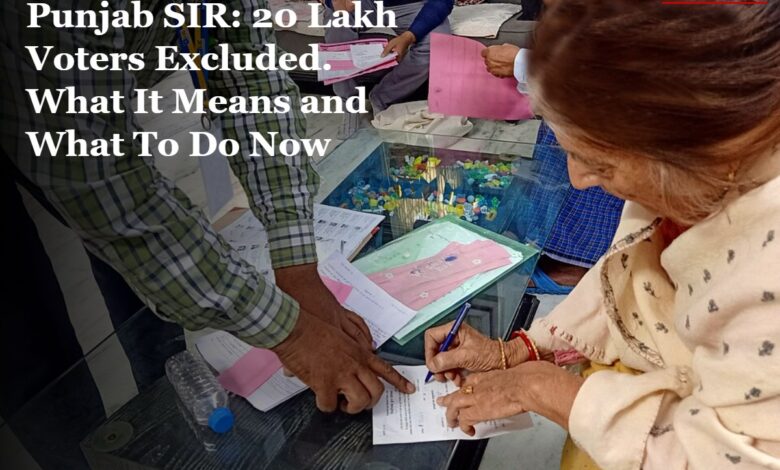
Punjab SIR has 20.66 lakh voters excluded from the draft roll: dead, shifted, absent, duplicate. Full category breakdown, district data, and what to do before September 12.
By North Desk Bureau
Q: Punjab SIR: How many Punjab voters are affected, exactly?
READ ALSO: SIR Punjab Explainer: What Is the Special Intensive Revision of Voter Rolls
In Punjab SIR, 20,66,635 electors — 9.63% of Punjab’s total 2,14,61,043 registered voters — have been marked “uncollectable” during the House-to-House Enumeration phase of SIR 2026, which ran from June 25 to August 3. That means roughly 1 in every 10 Punjab voters will not appear in the draft electoral roll publishing August 13, unless corrected.
Q: What does “uncollectable” actually mean?
It’s the Election Commission’s term for any registered elector whose Enumeration Form could not be gathered during the exercise. It’s not one category: it’s four distinct reasons bundled together, and they carry very different weight.
Q: What’s the full breakdown?
Permanently Shifted — 9,44,131 electors (4.40%) — the single largest group, nearly half of all exclusions
Death — 5,74,568 electors (2.68%)
Untraceable/Absent — 4,12,715 electors (1.92%)
Already Enrolled (duplicate entries) — 1,19,145 electors (0.56%)
Q: Who counts as “Permanently Shifted,” and how is that decided?
Punjab SIR: This is a judgment call, not a hard fact. A Booth Level Officer visits the registered address, and if the elector isn’t found after repeat visits — the process specifies at least three — the BLO can classify them as permanently relocated. Unlike a death record, which draws on an external, verifiable fact, this category depends on the BLO’s on-ground assessment. It doesn’t distinguish between someone who has genuinely moved for good and someone who was simply travelling, working elsewhere temporarily, or living abroad with family still at the address.
Q: What about the “Death” category — is that reliable?
Punjab SIR: This is the most straightforward of the four categories, since it draws on an external record rather than a field judgment call. At 5.74 lakh, it’s the second-largest category but the one least likely to involve wrongful exclusion.
ALSO: If Your Family Has NRIs, Their Vote May Not Survive Punjab’s SIR. Here’s Why
Q: What does “Untraceable/Absent” mean, and how is it different from “Permanently Shifted”?
Punjab SIR: The CEO brief doesn’t spell out a clear line between the two categories, which is itself worth noting — both stem from the elector not being found at home during BLO visits. In practice, “Absent” likely covers people who weren’t tracked down but whose relocation status is uncertain, while “Permanently Shifted” is used when the BLO has reason to believe the move is final. Given both categories rely on the same three-visit process, some misclassification between the two is inevitable.
Q: What’s the “Already Enrolled” category?
This covers electors found registered more than once — commonly, someone who moved and re-registered at a new address without their old entry being removed. At 1.19 lakh, it’s the smallest category, and removing genuine duplicates is uncontroversial.
Q: Is exclusion the same across Punjab, or are some areas hit harder?
It varies sharply by district. Rural Malwa districts did best — Mansa collected 96.31% of forms, Malerkotla 94.23%, Sangrur 94.17%. The worst-hit districts are SAS Nagar/Mohali (82.01% collected, nearly 18% uncollectable), Ludhiana (84.50% collected, 4.16 lakh uncollectable — the largest single number in the state), Amritsar (87.70%), Kapurthala (87.21%), and Jalandhar (88.79%). These are largely urban migration hubs and NRI-heavy Doaba districts, where floating populations and overseas family members are harder for a fixed-address, three-visit process to verify.
Q: If someone is wrongly excluded, is that final?
No — but the window to fix it is narrow. Punjab’s draft electoral roll publishes August 13. Anyone left out can file Form 6, either online or physically at their local ERO office, during the Claims and Objections period: August 13 to September 12. After that, the Election Commission disposes of claims through October 8, and the final electoral roll is published October 12.
Q: Will excluded electors be notified automatically?
Partially. The CEO’s office has said that from August 13, notices will go out to electors who couldn’t be mapped to the 2003 electoral roll or previous SIR — 6.6% of enumerated electors, roughly 14 lakh people. But there’s no explicit guarantee in the release that every one of the 20.66 lakh “uncollectable” electors will individually receive a notice before the objections window shuts. The safer approach is to actively check the draft roll on August 13 rather than wait for a notice to arrive.
Q: What should a family do right now?
Anyone with an elderly, travelling, or NRI-linked family member should check the draft roll the moment it publishes on August 13, confirm the person’s name is present, and if it isn’t, file Form 6 before September 12. Waiting past that date closes the correction window until the next full revision cycle.
RELATED STORIES:
ALSO: SIR 2026: 66,000 Chandigarh Voters Risk Deletion as Punjab, Haryana Extend Deadlines
READ ALSO: SIR Punjab Explainer: What Is the Special Intensive Revision of Voter Rolls
ALSO: If Your Family Has NRIs, Their Vote May Not Survive Punjab’s SIR. Here’s Why
Follow North Desk on WhatsApp for the latest from Punjab, Haryana and Himachal Pradesh: https://whatsapp.com/channel/0029Vb7ccdxJENy2H87DBG3E