Reinvestigation of Retired Officer: Punjab Dept Admitted It Broke Its Own Rules; Then Took 7 Years to Get Caught
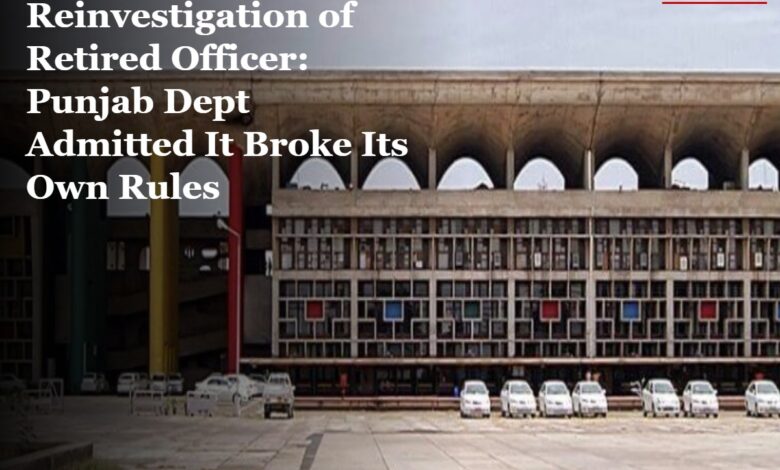
Reinvestigation of Retired Officer: HC quashes Punjab’s “de novo enquiry” against an already-exonerated officer, calls out a tactic the department itself conceded had no legal basis
North Desk Correspondent
Chandigarh, August 18
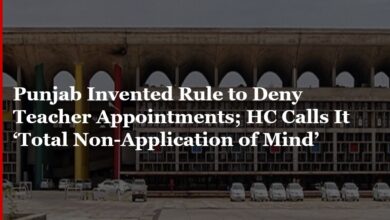
The Punjab and Haryana High Court has quashed an order by the Punjab government’s Department of Social Security and Women & Child Development that appointed a fresh Inquiry Officer to reinvestigate a retired officer who had already been cleared of all charges — a move the department itself had admitted, in its own written statement to the court, was not permitted under the applicable service rules.
Justice Sandeep Moudgil has ruled that the department’s action was “ex facie illegal” and set aside both the order appointing the new inquiry officer and the subsequent order denying the petitioner an extension in service — a denial that was based entirely on the disciplinary proceedings the court has now found to be unlawful.
Reinvestigation of Retired Officer: The case
Reinvestigation of Retired Officer: Rakesh Walia served as District Programme Officer in the department, posted at Mansa and Ludhiana. In September 2014, he was issued two charge-sheets relating to his tenure at both postings. He replied to both, departmental enquiries followed, and on January 11, 2016, the Inquiry Officer submitted separate reports exonerating him of every charge in both matters.
Then nothing happened. For nearly two years and ten months. The disciplinary authority sat on the exoneration reports without passing a final order. When it finally moved, it wasn’t to close the matter. The department issued dissent notes challenging the enquiry findings and sought Walia’s explanation.
Walia, due to superannuate on April 30, 2019, had in the meantime applied for a service extension under a 2012 government policy, submitting his option in December 2018. It was done on the strength of his already-completed exoneration. The department forwarded his application in March 2019 but never acted on the merits.
Instead, he was retired on schedule on April 30, 2019. On August 5, 2019, his extension request was formally rejected. It was done on the ground that disciplinary proceedings were still pending. A month later, on September 2, 2019, the department appointed IAS (Retd.) officer Surjit Singh Dhillon to conduct a completely fresh — de novo — enquiry into the same two 2014 charge-sheets that had already produced a clean exoneration report three and a half years earlier.
Walia challenged both the fresh-enquiry order and the extension denial in the High Court.
Why the fresh enquiry was illegal
Reinvestigation of Retired Officer: The petitioner’s counsel, Senior Advocate Vikas Chatrath with others, argued that Rule 9 of the Punjab Civil Services (Punishment and Appeal) Rules, 1970, gives a disciplinary authority dissatisfied with an enquiry only one option: remit the matter back for further enquiry, typically to the same officer. It does not permit scrapping the process and starting over with a new Inquiry Officer.
Crucially, the court records that “the respondents themselves have admitted in their written statement that the Rules do not contemplate holding of a de novo enquiry” — the department’s own pleadings conceded the point being challenged against it.
The bench leaned on Supreme Court precedents holding that a de novo enquiry is impermissible without a specific enabling provision. The court called the issue “no longer res integra” — settled law, not open for fresh argument.
Why the extension denial couldn’t survive either
Reinvestigation of Retired Officer: The state’s defence on the extension was that an employee facing pending major-penalty disciplinary proceedings is ineligible for extension, and that the disciplinary authority isn’t bound by an Inquiry Officer’s exoneration findings — it may record disagreement and proceed further.
The court rejected this on a narrower but pointed ground: an employee’s eligibility for extension has to be assessed on the facts as they stood on the date of consideration, not on the basis of events manufactured afterward. On the date Walia’s extension application should have been decided, he stood exonerated — no finding of guilt existed against him. The subsequent “dissent” and fresh-enquiry order (September 2019), the court held, couldn’t retroactively be used to justify denying him extension consideration that predated it.
The court affirmed the extension claim had to be judged on the facts at the time, and at that time, Walia had a clean record.
The order
The High Court:
Quashed the September 2, 2019 order appointing a fresh Inquiry Officer and the September 5, 2019 communication forwarding it.
Set aside the August 5, 2019 order denying extension.
Directed the department to reconsider Walia’s extension claim and consequential service benefits based on the January 2016 exoneration reports, in line with the 2012 government instructions and 2015 clarification.
Ordered that any admissible monetary benefits be released within three months of a certified copy of the order being furnished.
ALSO: Qaumi Insaaf Morcha Protest: Hawara’s Father, Simranjit Mann Booked; 17 Arrested
ALSO: Punjab’s Employees Turn on the Govt That Claimed to Have Fixed Their Pensions
Follow North Desk on WhatsApp for the latest from Punjab, Haryana and Himachal Pradesh: https://whatsapp.com/channel/0029Vb7ccdxJENy2H87DBG3E