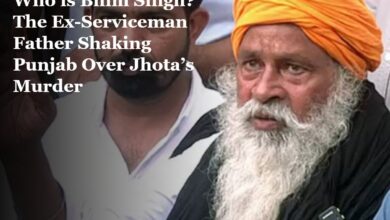
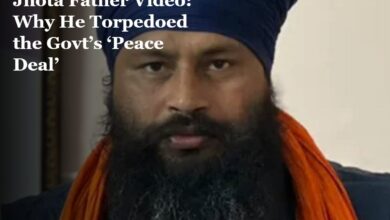
Harpal Cheema Named in Gulzar Singh's Dying Declaration. FIR Silent on Minister. What Law Says
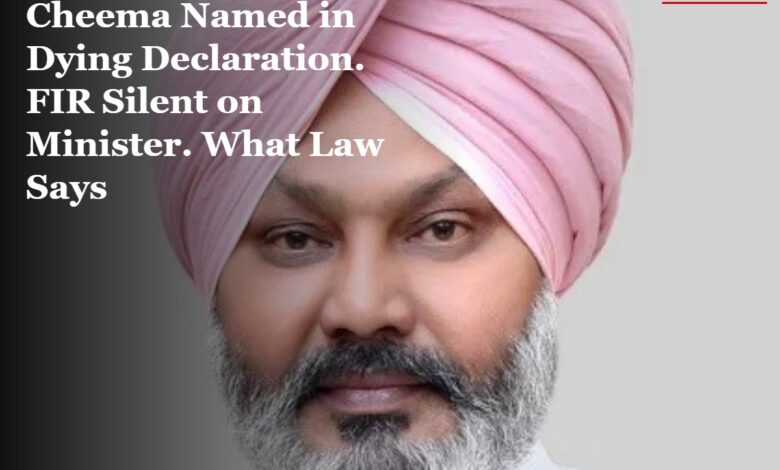
Harpal Cheema Dying Declaration: Harpal Cheema was allegedly named in Gulzar Singh’s dying declaration before his death in Sangrur. Punjab’s FIR doesn’t name him. Here’s what the law says, and what’s still unanswered.
North Desk Correspondent
Chandigarh, September 8
A 46-year-old Dalit daily-wage worker from Sangrur district is dead, and the manner of his dying has opened a legal question that Punjab’s political class has so far only used as a slogan.
Gulzar Singh, a resident of Toor Banjara village in the Dirba assembly constituency, consumed pesticide on the night of September 7 and died the following night at Dayanand Medical College and Hospital (DMCH), Ludhiana. In the hours before his death, he repeatedly named two men as responsible: Punjab Finance Minister Harpal Singh Cheema, and the village sarpanch. As of this reporting, neither has been booked. The FIR registered so far covers unnamed “village officials” for abetment of suicide and offences under the SC/ST (Prevention of Atrocities) Act — a case built around the men around Singh, not the minister he named.
Harpal Cheema Dying Declaration: What exactly happened
Harpal Cheema Dying Declaration: On September 6, Cheema was in Toor Banjara village as part of the state government’s “Yuddh Nashe Virudh” (War Against Drugs) outreach, addressing a small gathering around 5 pm. Singh stood up and challenged the minister’s claims, saying chitta — the local term for synthetic heroin — had reached households across the state, including his own. His son, he said, was an addict; the family had sold land and a house trying to cope. Cheema’s own account reported in media says he heard the grievance and directed police to act against drug suppliers.
What happened next is contested only in degree, not in substance. By multiple accounts — from BJP leader Daaman Bajwa, SAD’s Bikram Singh Majithia, Congress’s Pratap Singh Bajwa, and Singh’s own family — after the minister left, the sarpanch visited Singh’s home and pressed him to apologise for speaking up in public. Singh’s son has said the sarpanch “got furious and scolded my father.” Singh also alleged police pulled him aside and pressured him separately.
By Monday night, Singh had consumed Celphos, a pesticide. What followed was a chain of hospital transfers that opposition leaders have flagged as a second failure in its own right: Sangrur Civil Hospital, then Government Rajindra Hospital in Patiala, then back to a private facility in Sangrur, and finally DMCH Ludhiana — a sequence Bajwa says took roughly seven hours, at one point stalling for lack of a ventilator. Singh was conscious for much of it. Before he died, he told those around him — captured on video that the BJP has since played at a press conference and posted by many others on social media— that Cheema and the sarpanch bore responsibility for what he’d done to himself.
Why the wording of his statement actually matters
Harpal Cheema Dying Declaration: Under Indian evidence law, a dying declaration is not just testimony — it’s a category with real evidentiary weight, and it doesn’t need to be dramatic or formally recorded to have it.
The Supreme Court has held, going back to Khushal Rao v. State of Bombay (1958), that a dying declaration can be the sole basis for a conviction if a court finds it reliable — no corroborating witness required. In Dalip Singh, the Court went further, holding that a declaration doesn’t need to be recorded by a magistrate to count; what matters is whether it’s authentic, not who wrote it down. That matters here specifically, because what exists in Singh’s case is not a magistrate-recorded statement but a video and accounts relayed by family and villagers.
The Court has also said brevity isn’t a defect — in Atbir v. State (NCT of Delhi), it held that a short, inconsistency-free statement can be just as credible as a long one. And in Lakhan v. State of M.P., it set out the working test: was the person conscious and mentally fit, did they speak voluntarily, and is there any sign of tutoring or prompting.
Harpal Cheema Dying Declaration: That last word — tutoring — is where the caution belongs. In Phulel Singh v. State of Haryana (2023), the Supreme Court acquitted a man despite being named in a dying declaration, because it found reason to doubt whether the statement was voluntary or shaped by someone else’s influence.
Being named is not, on its own, proof. The same court that has repeatedly said a dying declaration can convict has also repeatedly said it must first survive scrutiny — was this Singh’s own account, undirected, or was it amplified and framed in the retelling by the political actors who were quick to put a camera and a press conference behind it within a day of his death.
The reactions
Harpal Cheema Dying Declaration: The political response has been unusually uniform for Punjab’s fractured opposition. BJP national spokesperson Gaurav Bhatia, addressing reporters in Delhi, demanded Chief Minister Bhagwant Mann’s resignation, Cheema’s resignation, and an FIR under the Bharatiya Nyaya Sanhita’s abetment-of-suicide provisions against everyone named in Singh’s video — with SC/ST Act charges added given Singh’s caste.
Congress’s Jairam Ramesh accused the AAP government of arrogance and demanded accountability; state Congress chief Amrinder Singh Raja Warring called it the result of sustained harassment.
SAD’s Sukhbir Badal and Bikram Singh Majithia went furthest rhetorically, with Majithia calling the death “a killing” and claiming, along with Congress, that drug supply in Punjab now moves faster than food delivery.
Cheema has denied responsibility for what happened after he left the village, calling Monday’s events “a matter of serious investigation.” Neither he nor the state government has responded specifically to the demand that he be named in the FIR.
BJP reaches the Governor
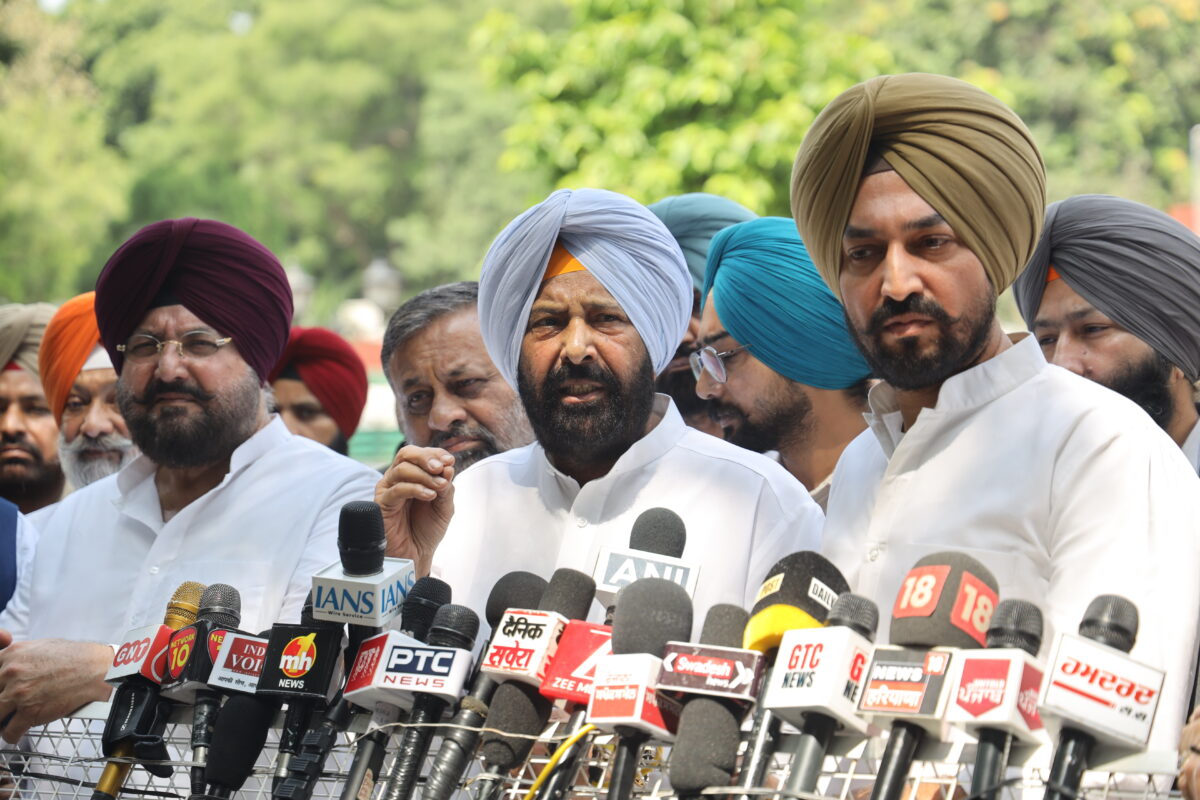
Harpal Cheema Dying Declaration: BJP on Tuesday reached the Punjab governor. Punjab state president Kewal Singh Dhillon wrote directly to Punjab Governor Gulab Chand Kataria, formalising the party’s demand in writing.
The letter asks that an FIR for abetment of suicide “and other applicable offences” be registered against Cheema and “all other persons named in Gulzar Singh’s dying declaration, subject to investigation and due process of law” — notably, the letter itself hedges on classification, describing Singh’s statement as “his video before death or dying declaration,” which reflects the same evidentiary ambiguity this report has flagged: it has not yet been established through what process, or in front of whom, Singh’s statement was actually taken.
The letter goes further than the press-conference demands, asking that any investigation into Cheema be handed to the CBI rather than Punjab Police, on the stated ground that a probe into a sitting Finance Minister conducted by a police force under his own government’s administrative control cannot be seen as free and fair. It specifically asks that the dying declaration, video recordings, communications, and family statements be preserved against tampering.
As of this writing, neither the Punjab government nor the Governor’s office has responded to the letter or the incident.
Drugs has been a serious issue now for decades in the state. And this incident has given an ammunition to the opposition parties against the ruling AAP.
Government data shows admissions at state-run deaddiction and rehabilitation centres rose from 9,577 in 2024 to 25,290 in 2025 — an increase of more than 164 percent. More than 14,000 patients had already been admitted by July this year, suggesting the surge has not slowed.
ALSO: Chief Justice Ashwani Kumar Mishra Swearing-In: Why CM Mann Boycotted It
Follow North Desk on WhatsApp for the latest from Punjab, Haryana and Himachal Pradesh: https://whatsapp.com/channel/0029Vb7ccdxJENy2H87DBG3E