Dussehra 2026: Tallest Ravan Effigy, Who Makes the Ravan, and Who Pays for It?
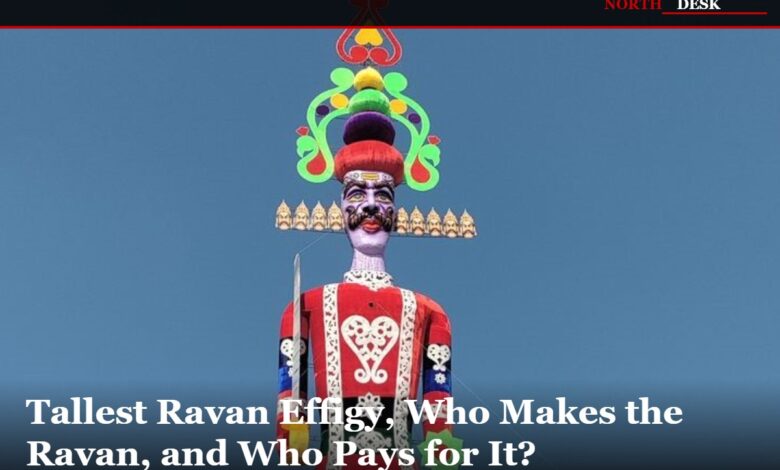
Dussehra 2026: A 50-foot Ravan sells for around Rs 25,000 in Delhi’s Tatarpur, while a 221-foot giant cost about Rs 40 lakh. Here’s who builds these effigies, what goes into them and who foots the bill.
North Desk Correspondent
Chandigarh, October 20
Dussehra 2026: We all know that the effigies of Ravan, Meghnad and Kumbhakarna are burnt on Dussehra, which falls today, October 20. But who makes these towering figures? How much does it cost to build them? And who pays for them? These are questions that often cross people’s minds as they watch the fire go up, and they rarely get answered. So let’s take a look at the numbers.
Dussehra 2026: WHAT’S GOING UP IN FLAMES TODAY
Start with the Chandigarh Tricity. In Panchkula, a 221-foot Ravan, billed as the tallest in the Tricity, will be burnt at the Dussehra ground near Shalimar Mall. Haryana chief minister Nayab Singh Saini will be the chief guest at the event. The organisers claim this is the tallest effigy in the country.
In Chandigarh’s Sector 46, a 106-foot Ravan, the tallest in the city, will go up along with effigies depicting the drug menace.
Both are the work of artisans from Uttar Pradesh. The Sector 46 team worked day and night for 20 days. Jitendra Bhatia, chairman of the Shri Sanatan Dharma Dasehra Committee, says Punjab Governor and UT Administrator Gulab Chand Kataria will be the chief guest, and the event starts at 5 pm.
The Ravan there has a revolving neck and face, a stream of Amrit Kund flowing from the navel, and embers of fire coming out of the eyes.
THE BIGGEST BILL: DWARKA’S 221-FOOT RAVAN
Delhi’s Dwarka has a 221-foot Ravan of its own this year. Business Today reports that the Dwarka Sri Ramleela Society’s effigy uses about seven tonnes of iron and will be lit by remote control. The total cost is roughly Rs 40 lakh, with about 120 artisans and workers on the job, some of them craftsmen who came from Chandigarh, after three months of work.
Two years ago, PTI reported, Dwarka’s 211-foot effigy cost Rs 30 lakh. It took 40 artisans over four months and was built by artisans from Barara village in Haryana’s Ambala district.
Doing the arithmetic on those reported figures (this is North Desk’s calculation, not official data):
- 2024 Dwarka: Rs 30 lakh for 211 feet, about Rs 14,200 per foot
- 2026 Dwarka: Rs 40 lakh for 221 feet, about Rs 18,100 per foot
- Between the two years, the reported cost went up about 33 per cent while the height went up about 5 per cent. The artisan counts and build times were reported differently in the two accounts, so they can’t be compared strictly.
THE ROADSIDE MARKET: TATARPUR
Dussehra 2026: Now go to the other end of the scale. Tatarpur in West Delhi is known to locals as the “Lanka of Delhi.” Outlook reports that after Raksha Bandhan every year, hundreds of artisans spend about three months working on pavements, dividers and under the metro bridge, making effigies for Delhi-NCR, UP, Rajasthan and Punjab.
A 50-foot effigy there costs roughly Rs 10,000-15,000 to make and sells at Rs 500 per foot, which puts the selling price at Rs 25,000. The same report says artisans now use green bamboo from Himachal Pradesh and Uttarakhand and waterproof paper from Japanese bags so the effigies last longer.
BARARA AND THE TRICITY: A BIT OF HISTORY
Dussehra 2026: Barara in Ambala has long been associated with giant effigies. In 2022 the village installed a 125-foot Ravan costing Rs 13 lakh, and residents said their celebrations had shrunk after the venue moved to Panchkula in 2018 and Chandigarh the next year because of space constraints. Organisers also said the cost of bamboo, cloth, fibreglass, welding rods and twine had gone up, making the effigy about twice as expensive as before. On those figures, the Barara Ravan worked out to about Rs 10,400 per foot.
Tricity effigies have had their share of drama too. In 2024, the 180-foot Ravan being built for Sector 46 broke into three pieces in strong winds, reducing its height to 155 feet. The artisans that year were a 25-member team from Aligarh, UP, who had worked on it for over 40 days.
WHY THE BILL KEEPS GOING UP
Dussehra 2026: The pressure on makers’ costs shows up in reports from other cities too. Gaon Connection, reporting from Bhopal, says glue has gone from Rs 50 to Rs 80 a kilogram, thread from Rs 50 to Rs 60, and the cost of making one Ravan head from Rs 500 to Rs 1,000. Rising raw-material prices, the report adds, have kept some traditional makers away from the craft.
SO, WHO PAYS?
Dussehra 2026: Large effigies are typically paid for by Ramleela and Dussehra committees through donations, sponsorships and stalls at the ground.
QUICK NUMBERS
- Roadside 50-ft effigy, Delhi’s Tatarpur (2024): making cost Rs 10,000-15,000, sold at Rs 500 per foot
- Barara 125-ft (2022): Rs 13 lakh
- Dwarka 211-ft (2024): Rs 30 lakh, 40 artisans, 4 months
- Dwarka 221-ft (2026): Rs 40 lakh, about 120 artisans and workers, 3 months, about 7 tonnes of iron
- Panchkula 221-ft and Sector 46 106-ft (2026): built by artisans from Uttar Pradesh; Sector 46 team worked 20 days
ALSO: Jagmohan Garg ED Arrest: Full Explainer on the Remigate GMADA Land Deal Case
Follow North Desk on WhatsApp for the latest from Punjab, Haryana and Himachal Pradesh: https://whatsapp.com/channel/0029Vb7ccdxJENy2H87DBG3E