Cyclone Arnab: How Are Cyclones Named? And All You Need to Know About ‘Cyclone Arnab’
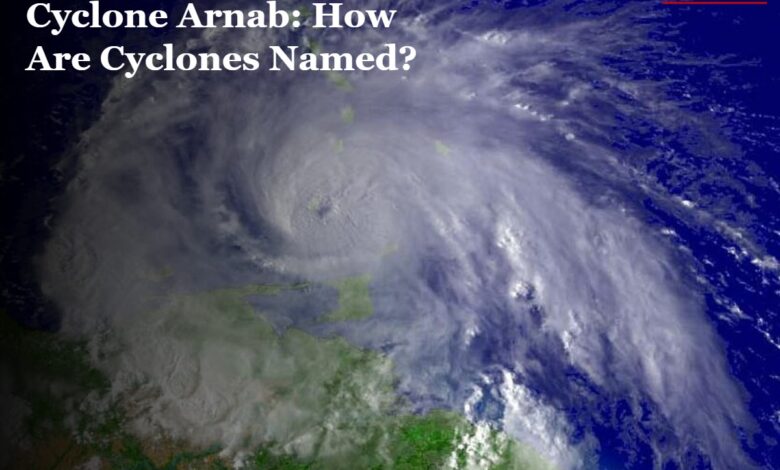
Cyclone Arnab: How do tropical storms get their names? Here’s our explainer detailing the naming system and how Cyclone Arnab got its name from Bangladesh.
By North Desk Bureau
Whenever a deep depression over the Bay of Bengal or the Arabian Sea intensifies into a major storm system, an official name suddenly appears across headlines, alerts, and tracking maps. With Cyclone Arnab churning in the Bay of Bengal, many wonder: Who names these cyclones, what do the names mean, and does the country facing landfall pick the name?
Here is a structured, comprehensive Q&A explainer detailing the international naming system, the governing guidelines, and the exact origin of Cyclone Arnab.
Q1: Why are cyclones given human names instead of technical numbers?
In the early days of weather tracking, storms were identified by their technical coordinates—latitude and longitude. Because coordinates are cumbersome to pronounce and error-prone during critical communications, meteorologists shifted to short, distinct, pre-selected names.
Assigning names helps:
- Eliminate Confusion: When multiple storms form concurrently in the same oceanic basin, names avoid communication blunders.
- Disaster Management: Public advisories, coastal evacuations, and port warnings can be transmitted swiftly through the press and emergency response networks.
- Historical Archiving: Weather agencies can catalogue and analyze storm impacts over decades without confusing alphanumeric codes.
Q2: Who names the cyclones in the Indian Ocean region?
Cyclones in the North Indian Ocean basin (which includes both the Bay of Bengal and the Arabian Sea) are named by the WMO/ESCAP Panel on Tropical Cyclones (PTC).
The group comprises 13 member nations arranged alphabetically:
- Bangladesh
- India
- Iran
- Maldives
- Myanmar
- Oman
- Pakistan
- Qatar
- Saudi Arabia
- Sri Lanka
- Thailand
- United Arab Emirates (UAE)
- Yemen
The official operational duty of christening the storm lies with the India Meteorological Department (IMD), functioning as the Regional Specialised Meteorological Centre (RSMC) in New Delhi.
Q3: Who named “Cyclone Arnab” and what does it mean?
Cyclone Arnab was named by Bangladesh.
- Meaning: In the Bengali language, the word Arnab translates directly to “sea” or “ocean”.
- Pronunciation: The IMD’s official naming registry specifies the phonetic pronunciation as “Or-nab”.
- Common Misconception: While some assume the cyclone is named after an individual or media personality, regional guidelines explicitly forbid naming storms after public figures.
Q4: Does the country hit by the cyclone get to name it?
No. Names are assigned from a pre-determined master table sequentially, irrespective of which country’s coastline the cyclone eventually strikes or where it forms.
Even though Cyclone Arnab impacts the eastern coast of India, the name was contributed by Bangladesh simply because Bangladesh was next in sequence on the panel’s active roster.
Q5: How does the sequential list work?
The current operational master list was adopted in April 2020 after the previous 2004 roster was exhausted following Cyclone Amphan.
- Each of the 13 member nations contributed 13 names, producing a total pool of 169 names.
- The table is arranged in columns alphabetically by country (from Bangladesh to Yemen).
- When a depression reaches the threshold of a Cyclonic Storm (sustained wind speed of at least 34 knots / 62 km/h), the IMD assigns the next available name from the top to the bottom of the column.
- Once Column 2 finished with Ditwah (contributed by Yemen), the list progressed to the top of Column 3, beginning with Arnab (Bangladesh).
Q6: What will the NEXT cyclone be called?
Once Cyclone Arnab dissipates, the next cyclonic storm that develops over the Bay of Bengal or Arabian Sea will be named Murasu.
The name Murasu (a traditional Tamil percussion drum/instrument) was contributed by India. Following Murasu, subsequent storms will be called Akvan (Iran), Kaani (Maldives), and Ngamann (Myanmar).
Q7: What are the golden rules countries must follow while submitting names?
The WMO and IMD enforce strict criteria for all submitted storm names:
- Neutrality: The name must be completely neutral—free from political, religious, ethnic, or cultural bias.
- Inoffensive: It must not hurt the sentiments of any community or social group.
- Short & Crisp: It should be easy to pronounce across multiple languages, with a maximum length limit of 8 letters.
- Single-Use Rule: Names used once in the North Indian Ocean are never repeated.
Recent & Upcoming Cyclone Names
| Cyclone Name | Contributed By | Meaning / Significance | Status |
| Montha | Thailand | Fragrant flower | Used |
| Senyar | UAE | Travelling together | Used |
| Ditwah | Yemen | Coastal lagoon in Socotra | Used |
| Arnab | Bangladesh | “Sea” or “Ocean” in Bengali | Active / Current |
| Murasu | India | Traditional Tamil instrument | Next in Line |
| Akvan | Iran | Mythological entity | Upcoming |
ALSO: Diwali 2026 Movie Releases Ramayana Clash: Epic ₹4000-Cr Spectacle vs Godzilla and 90s Hits
Follow North Desk on WhatsApp for the latest from Punjab, Haryana and Himachal Pradesh: https://whatsapp.com/channel/0029Vb7ccdxJENy2H87DBG3E