The Day Ambani Wept: How Mukesh Ambani Tears at Jio Blockbuster Debut Redefined Reliance

Mukesh Ambani tears: As Jio Platforms debuted at a stunning 27% surge to become India’s second most valued company, Mukesh Ambani sat in the audience fighting back tears as his children took the stage.
Arvind Chhabra
Chandigarh, October 28
There are moments when the deafening roar of financial markets fades into quiet, intimate human history.
On Wednesday, October 28, 2026, the bell at the exchange floor did not just ring in India’s largest-ever public listing—it signalled the culmination of a decade-long audacious dream. As shares of Jio Platforms Ltd surged over 21% at open and settled nearly 27% higher by closing bell, the digital behemoth catapulted into history as India’s second most valuable listed company, with a staggering market capitalization exceeding ₹13 lakh crore.
Yet, away from the blinking green tickers and manic television screens, the defining image of the morning belonged not to numbers, but to tears.
Sitting in the audience beside his wife Nita Ambani, Asia’s wealthiest patriarch—a man celebrated for building colossal oil refineries and navigating ruthless boardroom wars—wiped away tears. At 69, Mukesh Ambani did not take the microphone. He did not ring the ceremonial bell.
Instead, he watched from the front row as his three children—Akash, Isha, and Anant—stepped onto the podium to take the wheel.
Mukesh Ambani Tears at Jio’s Debut Redefines Reliance
From a Daughter’s Frustration to a ₹13-Lakh-Crore Reality
To understand why Mukesh Ambani fought back tears, one has to travel back more than a decade.
In 2011, Isha Ambani had returned home from Yale for the holidays, struggling with sluggish dial-up internet while trying to submit coursework. Beside her, Akash wondered aloud why the world’s most populous democracy was stranded in a 2G backwater while global peers were leaping ahead.
That kitchen-table conversation planted an obsession in Mukesh Ambani. Where Wall Street and Dalal Street saw a cash incinerator, Ambani saw a canvas. Reliance poured over $35 billion into building an indigenous 4G greenfield network before charging a single rupee. Critics called it an existential gamble that would bleed the legacy petrochemical empire dry.
On Wednesday, Anant Ambani reminded the hall of that daunting path:
“Once-barren land of Jamnagar turned into the site of the world’s largest refinery. He showed the world that when India builds, the world takes notice. Then came a new dream: internet in every hand and the world within reach of every village. The seed of this dream was planted by Isha Didi, and Akash Bhai made it his own. Today, Jio is shared with India.”
Watching Anant speak, Mukesh Ambani’s eyes welled up. The bet that skeptics warned would break Reliance had instead become the heartbeat of over 530 million Indians—and now, the country’s public pride.
The Blockbuster Numbers: What Happened on Listing Day
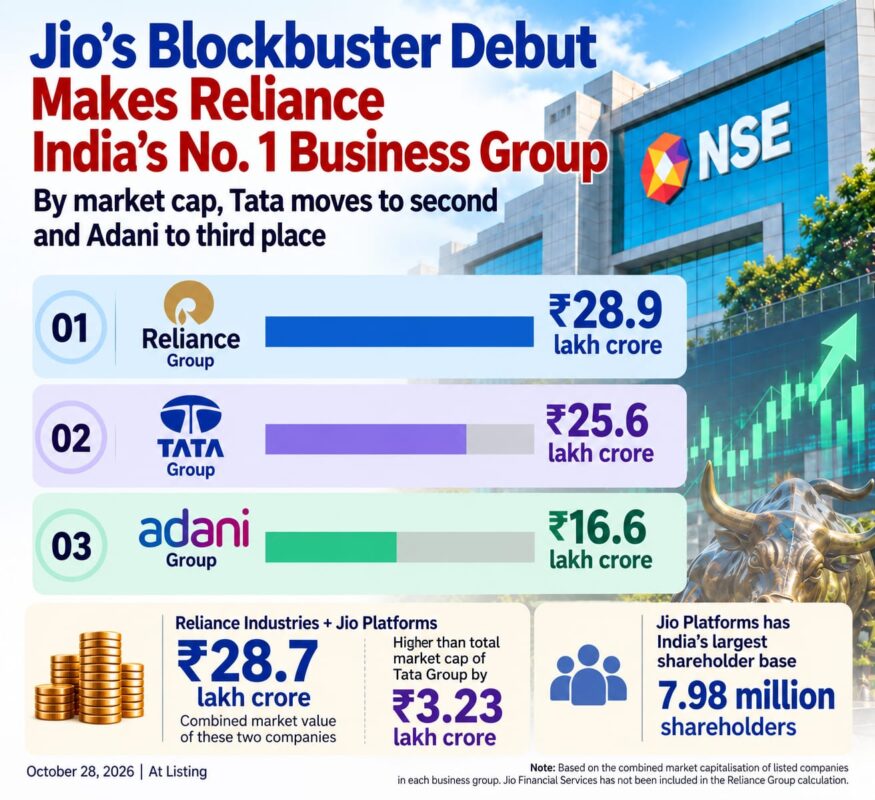
If the ceremony was soaked in emotion, the market response was pure financial adrenaline:
Issue Price vs Listing Price: Offered at ₹1,119 per share, Jio Platforms debuted at ₹1,358—a swift 21.36% listing premium.
Day-End Surge: Defying broader market corrections, the stock rallied through the session to close at ₹1,419.00, delivering a staggering 26.81% listing gain from the issue price.
Valuation Milestone: By market close, Jio’s valuation settled at ₹13.06 lakh crore ($150+ billion).
India’s No. 2: The debut vaulted Jio past legacy titans including Bharti Airtel, HDFC Bank, and TCS. The company now stands second only to its parent, Reliance Industries Ltd.
Combined Group Supremacy: Together, Reliance Industries and Jio Platforms pushed the group’s combined market cap past ₹28.4 lakh crore, overtaking the Tata Group conglomerate in aggregate value.
The issue itself—India’s largest IPO at ₹30,213 crore—had received a world-record demand of over ₹7.4 lakh crore across 1.39 crore applications, fully subscribing within 95 minutes of opening last week.
A Father’s Succession Without the Shadows of the Past

For seasoned corporate observers in Mumbai, Ambani’s visible emotion held an even deeper resonance.
Following the untimely demise of founder Dhirubhai Ambani in 2002 without a will, the family suffered a protracted, painful public feud between Mukesh and his younger brother Anil that fractured the empire.
For the past five years, Mukesh Ambani has meticulously orchestrated a generational handover unlike anything seen in family-owned conglomerates. He divided the empire into three clear pillars: Akash helming telecommunications and digital infrastructure, Isha driving retail and fashion, and Anant steering energy and green initiatives.
Wednesday’s listing was the living proof that the generational transition had succeeded. As Isha celebrated her father’s courage—remarking that he “saw a future others could not imagine, in different decades, with the same faith in India” and Akash pledged to steward shareholder wealth for the next 50 years into AI, cloud, and satellites, the patriarch sat not as an all-powerful chairman, but as an extraordinarily proud father.
“Today’s Jio listing is not a finish line,” Akash Ambani declared to investors. “It is our starting line.”
ALSO: SBI Bank Data Breach? What Happens To Your Money Now?
ALSO: Maran Family Net Worth: Inside Kalanithi & Kavya Maran’s ₹26,000 Crore Sun Group Empire
Follow North Desk on WhatsApp for the latest from Punjab, Haryana and Himachal Pradesh: https://whatsapp.com/channel/0029Vb7ccdxJENy2H87DBG3E