Tractor, Yatra, and Welfare Guarantees: The 3-Way Tug-of-War for 32% Dalit Vote Ahead of 2027
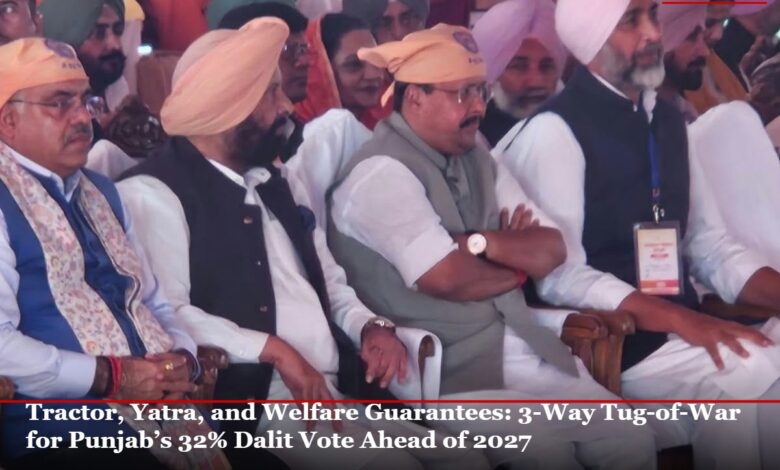
Punjab Dalit Vote Bank: With BJP flagging off its Samrasta Sankalp Yatra from Dera Sachkhand Ballan, Charanjit Singh Channi scheduling a cycle rally culmination there, and CM Mann rolling out targeted SC schemes, Punjab’s 32% Dalit vote is ground zero for 2027.
Arvind Chhabra
Chandigarh, November 19
If one political snapshot captured the battle lines for the 2027 Punjab Assembly elections on Wednesday, it was the simultaneous choreography aimed squarely at the state’s Scheduled Caste electorate.
In Jalandhar, Bharatiya Janata Party (BJP) National President Nitin Nabin sought the blessings of Sant Niranjan Dass Ji Maharaj at Dera Sachkhand Ballan before flagging off the 16-day Samrasta Sankalp Yatra—a 2,500-kilometre outreach dedicated to Sri Guru Ravidas Ji’s 650th birth anniversary celebrations. Miles away in Bathinda’s Rampura Phul, former Chief Minister Charanjit Singh Channi arrived at his Jawani Sambhal cycle rally driving a tractor—having already announced that the second leg of his yatra will culminate at Dera Ballan on December 6.
Meanwhile, Chief Minister Bhagwant Mann spent the day in Jalandhar reassuring voters that the Aam Aadmi Party (AAP) government’s welfare schemes will not stop as long as AAP stays in power, coming just 24 hours after extending ration and nutrition benefits to 10 lakh new beneficiaries—a majority of them from Dalit households.
Accounting for roughly 32 per cent of Punjab’s population—the highest proportion in any Indian state—and holding the key to 34 reserved Assembly seats (and dozens more across Doaba and Malwa), Dalit voters have become the decisive battleground ahead of early 2027.
Punjab Dalit Vote Bank:
1. BJP’s Institutional & Cultural Play in Doaba
Punjab Dalit Vote Bank: For the BJP, which won just two seats in 2022, making serious headway in 2027 is mathematically impossible without denting Doaba’s 23 Assembly constituencies, where Dalits make up nearly 40 per cent of the electorate.
Rather than relying solely on political rallies, the BJP has paired cultural recognition with central welfare messaging:
- Dera & Heritage Outreach: Launching the Samrasta Sankalp Yatra from Raipur village right beside Dera Sachkhand Ballan—and culminating it in Varanasi on December 3—places the party at the heart of Ravidassia community celebrations.
- Symbolic Milestones: Nabin’s Jalandhar speech repeatedly underscored the Modi government’s gestures—naming Adampur Airport after Sri Guru Ravidas Ji, conferring the Padma Shri on Sant Niranjan Dass Ji, building a ₹101-crore temple in Sagar, and upgrading facilities in Kashi—alongside central schemes like PM Awas, Ayushman Bharat, and PM-AJAY
- Daily Grassroots Contact: With eight structured daily events including Samrasta Samvad dialogues and community meals (Samrasta Bhoj), the BJP is attempting to build permanent booth-level bridges in SC settlements.
2. Congress’s Channi Card and the Dera Ballan Circuit
Punjab Dalit Vote Bank: For the Congress, which historically commanded Punjab’s Dalit vote before losing large swathes of it to AAP in 2022, the strategy revolves around Charanjit Singh Channi—Punjab’s first Dalit Chief Minister and the sitting Jalandhar MP.
By structuring his Jawani Sambhal cycle yatra into two phases—the first wrapping up on November 19, and the second running from Shaheed Bhagat Singh’s ancestral village Khatkar Kalan (November 29) straight to Dera Sachkhand Ballan on December 6—Channi is blending youth unemployment and anti-drug messaging with direct Ravidassia consolidation. Alongside him, Punjab Congress chief Amarinder Singh Raja Warring and senior leaders are banking on anti-incumbency against AAP to bring traditional Scheduled Caste voters back into the party fold.
3. AAP’s Welfare Shield and Targeted Transfers
Punjab Dalit Vote Bank: Having swept 27 of Punjab’s 34 reserved seats in 2022 on the promise of badlaav and household relief, the ruling AAP is defending its turf through aggressive welfare saturation aimed at low-income and Dalit families:
- Ration & Nutrition Expansion: On November 17, CM Mann extended the Food For All and Meri Rasoi schemes to 10 lakh additional beneficiaries, explicitly noting that the largest share belongs to daily-wage Dalit households.
- Targeted Financial Support: Highlighting 300 units of free power, Mukh Mantri Sehat Yojana (up to ₹10 lakh cashless treatment), and the Mawan Dheeyan Satkar Yojana—which offers ₹1,500 per month to Scheduled Caste women compared to ₹1,000 for general category women—AAP is betting that direct cash and household savings will insulate it from opposition yatras.
The Road to 2027
Unlike past elections where Punjab’s Dalit vote moved largely as a bloc, 2027 is shaping up as a fiercely contested three-way split—with AAP leaning on welfare delivery, Congress banking on Channi’s identity and anti-incumbency, and the BJP deploying national organizational muscle and spiritual outreach from Dera Ballan to Kashi. Whichever party cracks this 32 per cent puzzle will hold the clearest path to the capital, Chandigarh.
ALSO: Bhagwant Mann ji You Have Become ATM for Kejriwal, BJP Chief To Punjab CM
ALSO: Highways as Battlegrounds: How ‘Yatra Politics’ Is Shaping Punjab’s Run-Up to 2027
Follow North Desk on WhatsApp for the latest from Punjab, Haryana and Himachal Pradesh: https://whatsapp.com/channel/0029Vb7ccdxJENy2H87DBG3E