Trident Group Raid: Fear of Political Vendetta ‘Reasonably Palpable’; 30-Day Notice Must Before Action, rules HC
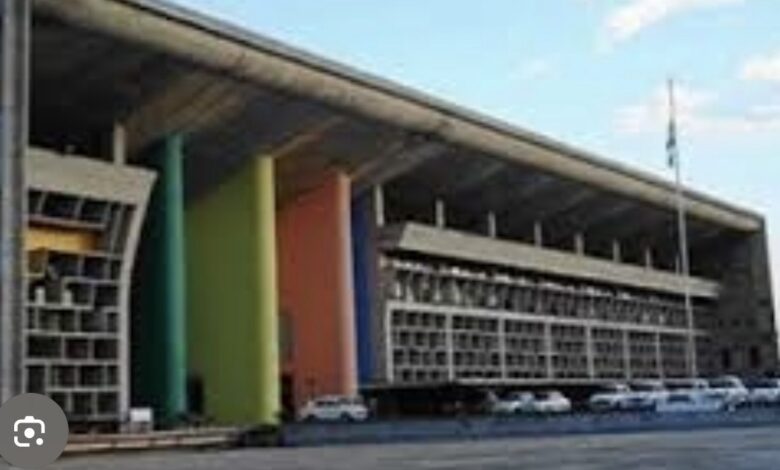
In a significant judicial observation pronounced Friday, Chief Justice Sheel Nagu says the Punjab Pollution Control Board failed to show any emergent environmental situation to justify its Trident Group raid at its Barnala unit — and that the company’s apprehension of political vendetta stemming from the timing of the raid deserves serious consideration.
Arvind Chhabra
CHANDIGARH, May 8
Eight days after the Trident group raid– when a team of more than 30 Punjab Pollution Control Board officials descended on Trident Limited’s factory at Village Dhaula, Barnala — and one week after the company rushed to the Punjab and Haryana High Court, the Chief Justice has spoken.
In a judgment pronounced Friday by a bench of Chief Justice Sheel Nagu and Justice Sanjiv Berry, the Punjab and Haryana High Court has said that Trident’s apprehension of political vendetta following the BJP switch of its Chairman Emeritus Rajinder Gupta “appears reasonably palpable.”
The court further held that the PPCB “failed to show any emergent situation” to justify coercive action, and ordered that the Board can proceed only after giving the company 30 days to rectify what the court termed “minor deficiencies.”
It is a judgment that will reverberate well beyond the Barnala factory gates.
The Wednesbury test — and what the court found
The legal standard the Chief Justice applied is the Wednesbury principle — a foundational doctrine of administrative law that allows courts to strike down state action that no reasonable authority, acting reasonably, would have taken. It is a high bar. Courts do not invoke it casually.
Chief Justice Nagu applied it to the timing of the April 30 Trident group raid — conducted six days after Rajinder Gupta, along with six other AAP Rajya Sabha MPs, crossed the floor to join the Bharatiya Janata Party on April 24.
The judgment notes that the timing of the Trident group raid is in “close proximity” to the political switch and that this “deserves consideration.” The court goes further: by applying the Wednesbury principle, the apprehension of political vendetta in the company’s mind “appears reasonably palpable.”
That is not boilerplate. A Chief Justice using the word “palpable” to describe a company’s fear of state-sponsored vendetta is a pointed judicial observation, on the record, in a speaking and reportable judgment.
Trident group raid: PPCB couldn’t justify the urgency
Equally significant is what the PPCB could not do in court. The Board had the option to argue emergent powers — Rule 32(6) of the Punjab Water Prevention and Control of Pollution Rules, 1977 allows the Board to act without prior notice where a “grave injury to the environment” is imminent. The Advocate General Punjab, Maninderjit S. Bedi, appearing for the state, and Senior Advocate D.S. Patwalia, appearing for the PPCB, both argued the case fully. The court heard them.
And then held that the PPCB had “failed to show any emergent situation where any stream, well, land or environment is being polluted by poisonous effluents.”
Thirty officials. Ten vehicles. No prior notice. And in the end, the court found no emergency.
“Minor deficiencies” — the court’s own characterisation
The operative relief is equally telling. The court has directed that PPCB may take coercive action only after affording the company a “reasonable opportunity of 30 days to rectify any minor deficiencies.”
The phrase “minor deficiencies” carries judicial weight.
North Desk had earlier reported — in an exclusive based on the PPCB’s own visit report that the April 30 inspection recorded observations including a malfunctioning Effluent Treatment Plant, RO reject mixing with plant effluent, a leaking pipeline near the canal intake, and uneven plantation distribution.
The court, having reviewed the record, has characterised these as minor — a significant comment on the proportionality of deploying 30 officers without notice to address issues the Chief Justice considers rectifiable in 30 days.
Who is Rajinder Gupta — and why this case matters
Rajinder Gupta, 73, is the founder and Chairman Emeritus of the Trident Group — a USD 1 billion enterprise and the world’s largest terry towel manufacturer, with customers across more than 100 countries. He was awarded the Padma Shri in 2007 for services to trade and industry.
His political biography is as substantial as his business one. He served as vice-chairman of the Punjab State Planning Board under the SAD-BJP coalition (2012–2017) — a Cabinet-equivalent post. He continued in an equivalent role under the Congress government (2017–2022). When AAP swept to power, he was appointed vice-chairman of the Punjab State Economic Policy and Planning Board in June 2022 — again Cabinet-equivalent — before resigning to enter the Rajya Sabha on an AAP ticket in November 2025.
On April 24, 2026, he was among seven AAP Rajya Sabha MPs who joined the BJP — triggering protests outside his Ludhiana residence and his Barnala factory, with AAP workers spray-painting “gaddaar” meaning ‘traitor’ on walls. Six days later, PPCB arrived.
North Desk has previously reported that on April 25 — the morning after the switch — Trident’s Managing Director Deepak Nanda wrote to the Union Home Secretary listing eleven specific categories of state action the company feared, including PPCB closure notices, Punjab Police FIRs, Vigilance action, canal water disruption, and truck union boycotts. The raid came five days after that letter.
Liberty granted
The court has also granted Trident liberty to approach the National Green Tribunal under Section 33(B)(c) of the Water Act if PPCB takes any coercive steps in the interim.
The petition stands disposed of.
This is the third in North Desk’s series of exclusive reports on the Trident-PPCB case.
Read: