5 Days Before the Raid, Trident Wrote to Delhi: North Desk Accesses Letter to Home Secretary

Days before the Trident Group raid by PPCB, and one day after switching to the BJP, its MD wrote to the Union Home Secretary listing eleven specific forms of state action he feared were coming — from PPCB closure notices to police FIRs, truck boycotts and canal water disruption. Five days later, 30 PPCB officials arrived at the Barnala factory.
Arvind Chhabra
CHANDIGARH, May 2
The raid on Trident Group hadn’t happened till then. On April 24, 2026, seven Aam Aadmi Party Rajya Sabha MPs crossed the floor to join the Bharatiya Janata Party. Among them was Rajinder Gupta — Padma Shri recipient, founder of the Trident Group, and one of Punjab’s most politically agile industrialists.
The next morning, April 25, before the protests had fully gathered outside his Ludhiana home and before AAP workers had spray-painted “gaddaar” on his factory walls in Barnala, Trident Group’s Managing Director Deepak Nanda quietly wrote a letter to the Home Secretary, Government of India.
North Desk has accessed the letter.
Eleven fears, itemised
The letter — just five days before the Trident group raid — is not a vague appeal for protection. It is a remarkably specific document — a pre-emptive list of eleven categories of state action that the company said it anticipated from the Punjab government following Gupta’s political switch.
Point by point, the letter names: closure notices from the Punjab Pollution Control Board; disruption of power supply; false or fake FIR complaints through Punjab Police; Punjab Vigilance Department action; Punjab State Excise and Taxation scrutiny; interference with canal water supply by district administration; labour and factory department notices; politically motivated agitation by workers, farmers and village councils; road blockades and intimidation of senior management and family; boycott of raw material supply — including wheat straw and cotton; and transport disruption through a truck union boycott.
The letter was signed by Deepak Nanda in his capacity as Managing Director of Trident Limited.
Five days later, on the evening of April 30, a team of more than 30 Punjab Pollution Control Board officials arrived at the Trident unit in Village Dhaula, Barnala — in roughly ten vehicles, without prior notice.
Was it political acumen — or inside knowledge?
The letter before the Trident group raid raises a question that goes beyond the immediate dispute: how did Trident know, with such specificity, what was coming?
There are at least three ways to read it. The first is political acumen — that a company with deep roots in Punjab’s power corridors simply understood how the state’s administrative machinery could be deployed against those who fall out of favour. The second is fear — that the protests and the speed of AAP’s reaction in the 24 hours after the switch were alarming enough to prompt the most cautious response available. The third is that the list is too precise to be guesswork, raising the possibility of forewarning from sources within the system.
The list is notable for what it reveals about how Punjab’s industrial-political ecosystem functions regardless of which party is in power. Trident did not arrive at this list by imagination alone.
Rajinder Gupta–the man who has read the Punjab weather before
Rajinder Gupta, 73, is not a political novice stumbling into his first storm. He is, by any measure, one of Punjab industry’s most accomplished survivors.
He started the Trident Group in 1990 in Ludhiana as a yarn unit. Over three decades, he scaled it into a USD 1 billion enterprise — the world’s largest terry towel manufacturer and among India’s biggest wheat straw-based paper producers, with customers in more than 100 countries and a stock market listing on both BSE and NSE. In 2007, he received the Padma Shri for services to trade and industry.
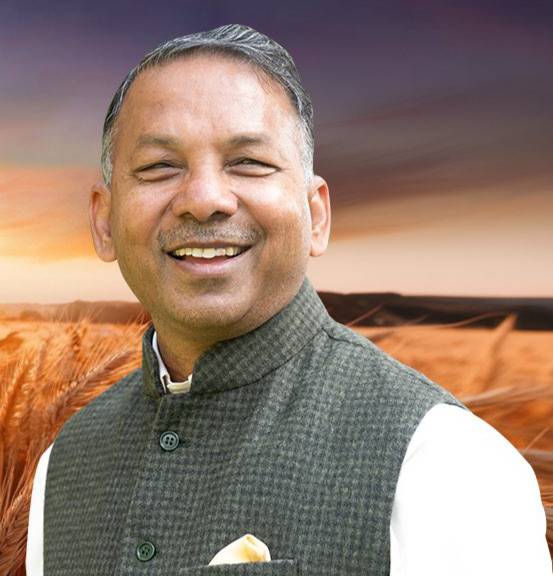
His political biography is, if anything, more striking than his business one. He served as vice-chairman of the Punjab State Planning Board under the SAD-BJP coalition (2012–2017) — a post equivalent to Cabinet rank. He then continued in the same equivalent Cabinet-rank role under the Congress government (2017–2022). When AAP swept to power, he was appointed vice-chairman of the Punjab State Economic Policy and Planning Board in June 2022 — again, Cabinet equivalent. He resigned that post before being sworn in as an AAP Rajya Sabha MP from Punjab in November 2025.
So, Gupta has had association with successive Punjab governments across party lines — SAD, Congress, AAP and of course now BJP. The implication is clear: this is a man who has mastered the art of political continuity across changes of regime. His switch to BJP, then, was not a departure from character. It was consistent with it.
Which is precisely what makes the April 25 letter (sent before the Trident group raid) so interesting. A man who has successfully navigated every Punjab government since 2012 was alarmed enough the morning after his switch to write to the Home Secretary in Delhi. That is either a measure of how dramatically the political temperature had shifted — or of how well he understood what tools an aggrieved state government could deploy.
The Trident group raid — and what followed
The company’s representative signed the report under protest.
After the Trident group raid, it filed a writ petition before the Punjab and Haryana High Court the same night. On the morning of May 1, the matter came before a bench headed by the Chief Justice. Senior counsel D.S. Patwalia, appearing virtually for the PPCB, submitted that no coercive steps would be taken against the company till Monday, May 4. He also sought time to file a para-wise reply.
BJP condemns. AAP silent.
BJP Punjab working president Ashwani Sharma called the Trident group raid “deplorable and politically motivated,” alleging it was carried out “at the behest of AAP supremo Arvind Kejriwal and Chief Minister Bhagwant Mann.” He said targeting a company of Trident’s stature “undermines the credibility of institutions like the PPCB.”
The AAP government and the PPCB have not issued a public response to the political allegations that the trident group raid evinced.
North Desk awaits response
North Desk has reached out to Trident Group Managing Director Deepak Nanda by phone and message seeking comment on the letter to the Home Secretary and on the sequence of events since April 24. This report will be updated as and when there’s a response.
ALSO READ: Bhagwant Mann Alcohol Row: A Decade of Allegations, From Lok Sabha to Vidhan Sabha





6 Comments