Rajinder Gupta Security Withdrawn After BJP Switch: 20-Year Cover Gone Overnight, Gupta Cites Moosewala
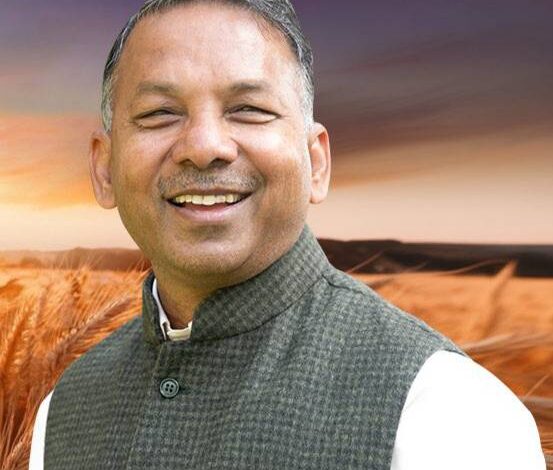
Rajinder Gupta security withdrawn: A sitting Rajya Sabha MP cum founder of Trident Group whose security had just been enhanced three months ago found himself without a single armed guard the day after switching to the BJP. His petition — reviewed by North Desk — invokes Sidhu Moosewala’s murder. The Chief Justice has directed Punjab to ensure no harm comes to him or his family.
Arvind Chhabra
Chandigarh, May 9
On the day Rajinder Gupta switched from the Aam Aadmi Party to the Bharatiya Janata Party, he had nine security personnel around him — four armed Head Constables of the India Reserve Battalion, two Assistant Sub-Inspectors from Ludhiana Police Lines, and three trained Commandos. A cover that had been in place, uninterrupted, for over two decades. A cover that had, in fact, been enhanced just four months earlier — in December 2025 — when both State and Central intelligence agencies reviewed his threat perception after his election to the Rajya Sabha and deployed additional personnel, formally reaffirming an elevated and subsisting threat.
By the time the political switch was complete on April 25, those nine personnel were gone. Not reduced. Not reviewed. Gone — to zero — without a written order communicated to Gupta, without a fresh threat assessment, and without a single word of notice or hearing.
A petition filed by Rajinder Gupta before the Punjab and Haryana High Court, reviewed by North Desk, makes for stark reading. Chief Justice Sheel Nagu has directed the State of Punjab to ensure that no harm comes to the petitioner or his family members residing in Punjab until the next date of hearing on May 15. Punjab’s counsel has been directed to seek instructions and file a para-wise reply.
Who is Rajinder Gupta — and Why This Case Carries Extra Weight
Rajinder Gupta, 67, is the founder and Chairman Emeritus of the Trident Group — a USD 1 billion enterprise and the world’s largest terry towel manufacturer, with customers across more than 100 countries and a listing on both BSE and NSE. He was awarded the Padma Shri in 2007 for services to trade and industry. Born in Bathinda, he built the group from a yarn unit in Ludhiana in 1990 into one of India’s most recognised industrial names.
His political biography is as substantial as his business one. He served as vice-chairman of the Punjab State Planning Board under the SAD-BJP coalition (2012–2017) — a Cabinet-equivalent post — and continued in an equivalent role under the Congress government (2017–2022). When AAP swept to power, he was appointed vice-chairman of the Punjab State Economic Policy and Planning Board in June 2022, again Cabinet-equivalent, before resigning to enter the Rajya Sabha on an AAP ticket in October 2025. He has, in other words, held Cabinet-rank positions under every Punjab government for over a decade across party lines.
It is this same Rajinder Gupta whose Trident Group’s Barnala factory was raided by more than 30 PPCB officials on April 30 — six days after his BJP switch. Yesterday, in a full reportable judgment, the bench headed by Chief Justice Sheel Nagu found the apprehension of political vendetta “reasonably palpable” and held that the PPCB had “failed to show any emergent situation” to justify the raid.
But buried inside the allegations is the detail that gives this case its true weight — a reference to Sidhu Moosewala.
Here it is:
The Moosewala Invocation
Represented by Senior Advocates Chetan Mittal and P.S. Ahluwalia with Advocates Vipul Joshi and Piyush Kumar, the Rajinder Gupta security petition notes that Punjab’s law and order situation is “marked by persistent threats emanating from organised criminal networks, including gang-related activities and extortion rackets, which have increasingly targeted businessmen, public figures, and persons of prominence.”
Rajinder Gupta security petition then names Sidhu Moosewala directly — that his murder “occurred shortly after the withdrawal/downgrading of his security cover, which incident starkly highlights the serious consequences that may ensue upon abrupt withdrawal of protection in a sensitive security landscape.”
This is not a rhetorical flourish. This is a sitting Rajya Sabha MP, through his lawyers, telling the Punjab and Haryana High Court: what happened to Moosewala after his security was withdrawn could happen to me. That is the weight of what has been filed.
Rajinder Gupta Security: Nine to Zero — How It Happened
The Rajinder Gupta security petition documents the sequence with precision. Gupta had been provided security by the Punjab government for over two decades on the basis of periodic threat assessments. As recently as December 2025, following his election to the Rajya Sabha in October, the security was formally reviewed and enhanced — three additional personnel deployed, bringing the total to at least nine. The threat perception was assessed as “subsisting and elevated.”
On April 24, Gupta was among seven AAP Rajya Sabha MPs who crossed over to the BJP. On April 25, the security personnel deployed with him at the time “abruptly withdrew from his protection and left his company upon receiving directions to report back to their respective units/place of posting.” The petition states that the impugned order or instructions “have not been communicated to the Petitioner and, therefore, no copy thereof is available with him.”
In short — the guards left. No paper trail was given to Gupta.
The Vandalism
On April 26, the outer walls of Gupta’s residence at House No. E-212, Kitchlu Nagar, Ludhiana, were vandalised. A security guard working at his Chandigarh kothi at Sector 9 told police that two vehicles arrived from which seven to eight persons emerged, entered the property, and spray-painted “Gaddaar” (traitor) in Punjabi and English on the gate and walls before fleeing.
This is not the picture of a man whose threat perception had diminished. It is the picture of a man whose threat perception had escalated — at the precise moment his security was pulled.
Harbhajan Singh: The Pattern Next Door
Rajinder Gupta security case does not stand alone. As North Desk reported exclusively on May 1, former international cricketer and Rajya Sabha MP Harbhajan Singh faced an almost identical sequence. His security — 24 personnel across his Jalandhar residence and Delhi — was withdrawn by the ADGP Security, Punjab, on the morning of April 25, the day after the AAP exit announcement, without any fresh threat assessment or notice.
By afternoon, a mob had arrived at his private residence at Chhoti Baradari , Jalandhar. The local ACP (East) and SHO of Sub Division No. 7 were present throughout, alleges Harbhajan. They did not intervene. The district administration had, that same morning, granted permission for an AAP protest at his private residence. The attack continued the next day. It was only after that that the Ministry of Home Affairs deployed four CRPF personnel — a fraction of what had been withdrawn.
Harbhajan approached the High Court. On April 30, Justice Jagmohan Bansal directed that no physical injury be caused to him or his family members while in Punjab.
Two MPs. Two sets of security withdrawn the same morning. Two mobs. Two High Court orders directing the state to ensure no physical harm. That is a pattern, not a coincidence.
The Constitutional Argument
The Rajinder Gupta security petition frames the security withdrawal not merely as administrative overreach but as a violation of Articles 14 and 21 of the Constitution — the rights to equality and to life and personal liberty. It argues that withdrawing security “is an attempt to penalise the Petitioner for exercising a lawful political choice, which is impermissible in a constitutional democracy governed by the rule of law.” It further contends that the action has “a direct chilling effect on the exercise of democratic freedoms, including the right to political association.”
The questions framed for the court’s consideration include whether the state can withdraw decades-long security without demonstrating any material change in threat perception — and whether action temporally proximate to a lawful political realignment is vitiated by mala fides.
MHA Has Stepped In — Partially
The hearing on Rajinder Gupta security produced one significant factual disclosure: during arguments, it emerged that the Ministry of Home Affairs, New Delhi, has provided security cover to Gupta in Punjab and Delhi only. The Centre has thus partially filled the vacuum left by the state — but the cover is geographically limited, the arrangement is uncertain, and Gupta travels frequently across the country in his capacity as a Rajya Sabha MP and as Chairman Emeritus of a USD 1 billion industrial group.
North Desk has been covering the Trident-PPCB case and the security withdrawals of BJP-switching MPs exclusively. Read:
[What PPCB’s own inspection report found at Trident’s Barnala unit]
[Before the raid, Trident wrote to Delhi]
[HC finds political vendetta apprehension ‘reasonably palpable’ in Trident raid case]
[Harbhajan Singh: Mob attacked home in presence of ACP, SHO]

5 Comments