Nihang Sikhs Impose ‘Khalsa Tax’ on Himachal Vehicles in Punjab — Here’s Why
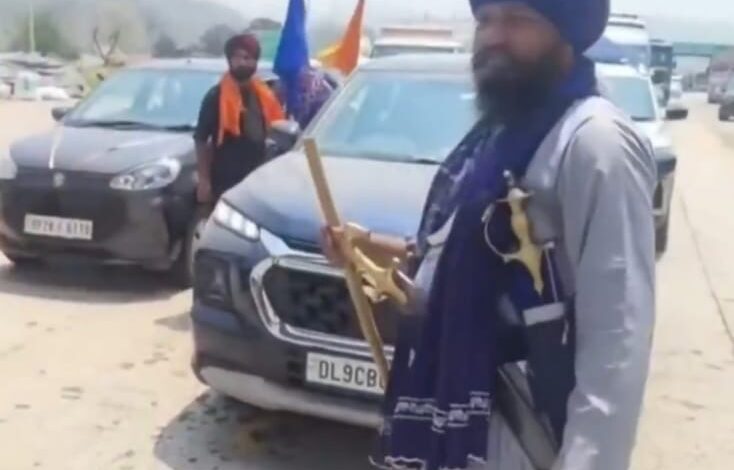
Nihang Sikhs set up a symbolic ‘Khalsa Tax’ checkpoint on the Kiratpur Sahib-Manali highway on Wednesday, protesting Himachal Pradesh’s steep hike in entry tax on out-of-state vehicles. Here’s the full story.
North Desk Correspondent
Chandigarh, June 3
On a busy Wednesday morning on the Kiratpur Sahib-Manali highway, a group of Nihang Sikhs — warriors in their distinctive blue robes and steel-adorned turbans — set up an unusual checkpoint near the Gara Mora NHAI toll plaza. They weren’t collecting fees for the government. They were collecting what they called the Khalsa Tax.
For one hour, between 11:30 am and 12:30 pm, Nihang Singh warriors stopped vehicles bearing Himachal Pradesh registration plates entering Punjab and appealed to drivers to voluntarily contribute a symbolic amount. The money, they announced, would go towards Sarbat da Bhala — the welfare of all.
It was theatre. It was protest. And it carried a pointed message for two state governments.
What Is This All About?
Khalsa tax: At the heart of the agitation is a tax that Himachal Pradesh has been levying for decades but recently hiked sharply: an entry tax on vehicles registered outside the state.
Every time a Punjab-registered car, truck, or bus crosses into Himachal Pradesh, the driver must pay at one of over 50 toll barriers the hill state operates under the Himachal Pradesh Toll Act, 1975. This has long been a source of friction, but the latest revision — effective April 1, 2026 — has pushed residents of border areas to breaking point.
For a local driver in Nangal, Anandpur Sahib, or Ropar — towns that sit on the Punjab-Himachal border and whose residents may cross into Himachal Pradesh multiple times a week for work, trade, hospitals, or family — this adds up to a significant financial burden. Local residents living just 100 metres from the Himachal border are also subjected to the tax every time they enter the neighbouring state.
Himachal Pradesh has defended the hike, saying it is necessary to compensate for financial stress caused by the withdrawal of the Revenue Deficit Grant from the Centre. It also points out that the Toll Act has been in place for over fifty years.
Critics, however, call it discriminatory — and note that Himachal is the only state in the country that levies an entry tax specifically on vehicles registered in other states.
Who Are the Nihang Sikhs?
Khalsa tax: To understand why men in blue turbans carrying swords were manning a highway checkpoint, it helps to know who the Nihangs are.
The Nihang Sikhs are one of the oldest and most distinctive warrior orders within Sikhism. The word nihang means without fear, unblemished, and indifferent to worldly comfort.
Their origins trace back to Guru Gobind Singh, the tenth Sikh Guru, who founded the Khalsa in 1699 at Anandpur Sahib — the same city at the heart of this protest. Historically, Nihangs formed the frontline fighting force of the Sikh Khalsa army, defending Sikh communities against Mughal and Afghan oppression during some of the darkest periods of Punjabi history.
Recognisable by their dark blue robes, towering turbans adorned with steel chakras (circular weapons) and other traditional Sikh insignia, and their carrying of spears, swords, daggers, and shields, the Nihangs are a living connection to an older tradition. Anandpur Sahib — which falls in the Ropar district of Punjab, precisely in the area most affected by this entry tax dispute — remains the main centre of Nihang gatherings. Every year, thousands of Nihangs congregate there to celebrate Hola Mahalla, the festival of martial arts and mock battles instituted by Guru Gobind Singh.
In modern times, Nihangs have occasionally made news for their assertion of what they regard as Khalsa sovereignty and customary rights. Their appearance at the Gara Mora toll plaza on Wednesday was consistent with their historical self-image as guardians of the common Sikh and the wider community.
The Protest Escalates
Wednesday’s Khalsa tax or toll was the latest escalation in a movement that has been building for weeks.
On June 1, members of the Sangharsh Committee — a cross-party citizens’ body formed specifically to oppose the entry tax — blocked traffic on major highways leading to Himachal Pradesh. The agitation has drawn in farmers’ unions including the Kirti Kisan Union, traders, transporters, and ordinary residents.
The Nihang Singhs announced that their toll collection would resume every Wednesday and continue indefinitely until either the Himachal Pradesh government withdraws the entry tax or their concerns are heard. “Tagde ho ke aayo,” a Nihang spokesperson said at the protest site, invoking the Khalsa salutation.
Addressing protesters, Sangharsh Committee leader Gaurav Rana said the entry tax was adversely affecting traders, transporters, farmers, and ordinary citizens. “Thousands of families in both states share close social and economic ties. Imposing an entry tax will create unnecessary hurdles and negatively affect trade, tourism, and daily travel,” he said.
The agitation received a significant religious endorsement when the acting Jathedar of the Akal Takht, Kuldeep Singh Gargaj, reportedly described Himachal’s entry tax as jazia — the tax levied on non-Muslims during the Mughal era. The comparison, loaded with historical resonance for Sikhs whose Gurus resisted Mughal persecution, has given the protest a moral and spiritual weight that goes well beyond a highway toll dispute.
ALSO READ: Bikram Majithia Row: Who Is Jobanpreet, and Why Bikram Majithia Was Named in FIR
Follow North Desk on WhatsApp for the latest from Punjab, Haryana and Himachal Pradesh: https://whatsapp.com/channel/0029Vb7ccdxJENy2H87DBG3E

3 Comments