Mata Sita temple in Amritsar: But Why Amritsar? The Legend Linking Holy City to Mata Sita and Birth of Luv-Kush
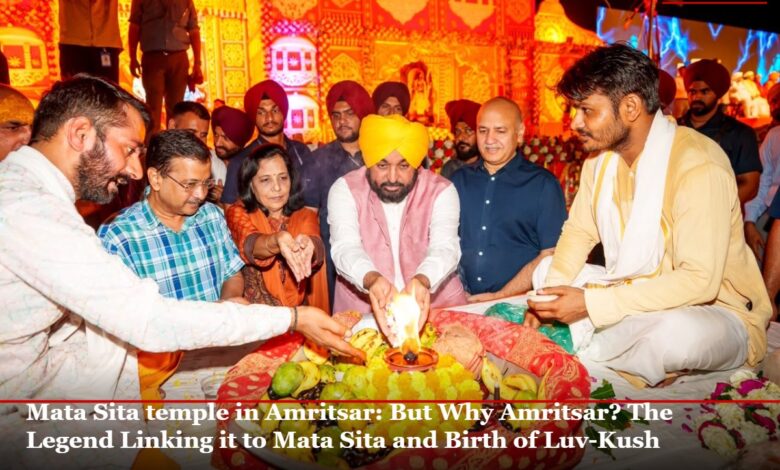
Mata Sita temple in Amritsar: Arvind Kejriwal announced a grand temple for Mata Sita and Luv-Kush in Amritsar. Here is the full story of the ancient legend — and why Amritsar’s sacred geography runs far deeper than most Indians know.
North Desk Correspondent
Chandigarh, June 28
When AAP chief Arvind Kejriwal announced a grand new temple dedicated to Mata Sita and her sons Luv and Kush in Amritsar on Saturday evening, most people in the audience at the ‘Ek Shaam Bhagwan Shivji Ke Naam’ bhajan event probably focused on the politics of the moment. What deserved equal attention was the history behind his words.
AAP chief Arvind Kejriwal did not choose Amritsar for this temple arbitrarily. He took pains to explain why, and what he said points to one of the most remarkable and least-known chapters of sacred geography in North India — a chapter that places the spiritual capital of the Sikh faith at the very heart of the Ramayana story.
The Ramayana Comes to Punjab
Kejriwal laid out the connection explicitly at the bhajan evening. “Bhagwan Valmiki wrote the Ramayana while residing in Amritsar,” he said. “This is where the sacred mandir of Bhagwan Valmiki is located. Mata Janaki, Mata Sita, lived here. Luv and Kush were born here, and they received their education here. When Bhagwan Ram released the horse for the Ashwamedha Yagna, it was here that Luv and Kush stopped the horse and tied it to a tree.”
He then added: “Amritsar is truly an extraordinary and sacred place.”
This is not political invention. It is a living tradition rooted in the Uttara Kanda — the final book of Maharishi Valmiki’s Ramayana — which narrates what happened to Mata Sita after her exile from Ayodhya.
Sita’s Exile and the Ashram at the Edge of Punjab
The story, as the Ramayana records it, begins with one of the most painful episodes in Indian epic literature. After returning victorious from Lanka, Rama faces questions about Sita’s purity during her captivity under Ravana. Despite Sita having proven herself through the Agni Pariksha (trial by fire), public whispers persist, and Rama — torn between his duties as king and husband — makes the agonising decision to send her away. She is pregnant at the time.
After Sita was banished from the kingdom of Ayodhya, she took shelter in the ashram of Valmiki, which was situated in a forest. Luv and Kush were born in this ashram of Rishi Valmiki, who educated and trained them himself.
The question of precisely where this ashram stood has been debated by scholars and pilgrims for centuries. The location of Valmiki’s ashram is disputed — some say it is on the Indo-Nepal border, while others trace it to Avani Bettar in Karnataka. But for generations of devotees in Punjab, the answer has never been in doubt.
The Sacred Site: 11 Kilometres West of Amritsar
Bhagwan Valmiki Tirath Asthan, dedicated to Valmiki, is situated 11 km west of Amritsar on the Amritsar-Lopoke road. As per regional tradition, the temple dates back to the period of events of the epic Ramayana, identified as the location of the ashram of the sage. According to legend, this is the site where the sage gave shelter to Sita after Rama decided she would not return to Ayodhya. The place is also considered to be the birthplace of Lava and Kusha, the twin sons of Rama.
The temple complex includes a hut where Sita is said to have lived, a well attributed to her, and an ancient tank believed to have been dug by Hanuman.
Tradition holds that Mata Sita spent twelve years of her life in exile here at the ashram of Maharishi Valmiki, and a hut marks the site where she gave birth to Luv and Kush.
The Birth of Luv and Kush — and a Legend Within a Legend
Valmiki trained Luv and Kush in archery to a level where no one on earth could conquer them. He also trained them in divine and celestial warfare, establishing such a deep connection between his mind and theirs that he could directly transmit all his knowledge to them.
There is also a charming legend about how Kush came to be born at all. Sita gave birth to only one child, Luv, in some retellings. She raised the child in the ashram of Valmiki. One day, when she went to gather fruits and berries from the forest, she left the child in the care of Valmiki. When she returned, however, there were two children. Valmiki explained that Luv had wandered off while he was deep in his writing. In panic, he fashioned a doll from Kusha grass and breathed life into it, creating a second child who was the very likeness of the first. This is how the second twin came to be, named Kush after the sacred grass from which he was made.
The Ashwamedha Horse: When Sons Unknowingly Faced Their Father
Kejriwal specifically mentioned the Ashwamedha episode, and it is one of the most dramatic moments of the entire Ramayana cycle.
After being raised by Valmiki and trained in warfare, scriptures and dharma, Luv and Kush unknowingly captured Lord Rama’s horse during the Ashwamedha Yagna — the great horse sacrifice — leading to a battle between them and the armies of Ayodhya, including their own father. Neither side knew they were facing kin. The boys, matchless archers trained by the greatest poet-sage of the age, defeated every warrior Rama sent against them — including Hanuman and Lakshmana. It was only when Rama himself came forward and heard the two young boys begin to recite the Ramayana — a poem about his own life — that recognition slowly, painfully dawned. Eventually the family was reunited, but Sita chose to return to Mother Earth, making the place deeply sacred for Hindus.
Mata Sita temple in Amritsar:The Temple That Stands There Today
The existing Bhagwan Valmiki Tirath Asthan is itself a remarkable monument. The site was renovated with ₹200 crore and was inaugurated on December 1, 2016 by the Chief Minister of Punjab. It has entrance portals at both ends, a sacred pond, a circumambulation bridge, a devotee hall with capacity for 5,000, a Sanskrit library, a museum, and modern car parking. Since its inauguration, it has housed an 8-foot-tall, 800-kg gold-plated idol of Sage Valmiki.
The site was formerly known as Ram Tirath and was renamed Valmiki Tirath in 2016 through an Act of the Punjab legislature, reflecting a long-pending demand of the Valmiki community and marking a significant moment in Punjab’s caste and religious identity politics. Scheduled castes comprise 32% of Punjab’s population, giving the Valmiki community considerable social and political weight.
Every year, a fair running for 20 days is held here during Kartik Purnima, drawing thousands of pilgrims who come to bathe in the sacred sarovar and seek blessings.
What Kejriwal Announced — and Why It Matters
The new temple that Kejriwal announced will come up adjacent to the existing Bhagwan Valmiki Tirath Asthan — dedicated specifically to Mata Sita (Mata Janaki) and her twin sons Luv and Kush. CM Bhagwant Mann added that it would be “aesthetically designed to preserve the glorious legacy of Mata Janaki, Luv and Kush” and would serve as “a major centre of faith attracting devotees and tourists from across the world.”
The political subtext is clear enough — this is AAP deepening its hold among the Hindu devotional vote and the Valmiki community, both significant in Punjab — but it would be a mistake to reduce Kejriwal’s Amritsar announcement to electoral arithmetic alone.
What he was pointing to — whether or not most in the audience fully grasped it — is that Amritsar’s sacred geography goes far deeper than most Indians know. The city where Guru Nanak’s successors built the holiest shrine in Sikhism is, in Hindu tradition, also the very land where Maharishi Valmiki gave refuge to an exiled queen, where the world’s first epic poem was composed, and where two boys named Luv and Kush grew up not knowing who their father was — until the day they stopped his horse.
The new temple, if built as announced, will make that story visible in stone.
Follow North Desk on WhatsApp for the latest from Punjab, Haryana and Himachal Pradesh: https://whatsapp.com/channel/0029Vb7ccdxJENy2H87DBG3E
READ ALSO: Bhagwant Mann Video Row: CM Says Prosthetic Mask, Sunglasses Used to Impersonate Him
READ ALSO: Who Is Jagman Samra? The Canada-Based NRI at the Centre of the Bhagwant Mann Video Row