Hawara Parole U-Turn: Punjab Police Opposed It Months Ago, Now Mann Meets Governor
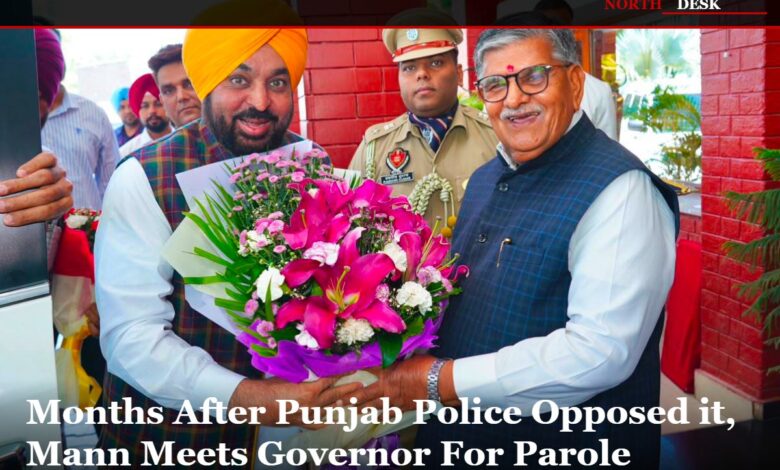
Hawara Parole: CM Bhagwant Mann personally met Governor Kataria seeking Jagtar Singh Hawara’s parole, barely months after Punjab police recommended against it in a communication on record before the High Court.
Arvind Chhabra
Chandigarh, August 12
Punjab Chief Minister Bhagwant Singh Mann met Governor Gulab Chand Kataria on Wednesday to personally press for 10 days’ parole for Jagtar Singh Hawara, convicted in the 1995 assassination of former Chief Minister Beant Singh, citing the deteriorating health of Hawara’s 83-year-old mother.
The in-person appeal comes four days after Mann’s August 8 letter to the Governor on the same request, and lands just months after Punjab’s own police machinery, on record before the Punjab and Haryana High Court, recommended against granting Hawara parole at all.
ALSO: Hawara Parole: Who Really Decides — Not CM, Punjab Govt or Governor. EXCLUSIVE
Hawara Parole: What Mann said on Wednesday
Briefing the media after the meeting, Mann said Hawara’s mother “has a renewed hope” of meeting her son after 31 years, and that the request required the Governor’s intervention because, in Mann’s telling, “the case is being heard in Delhi” and the Centre would decide on the Governor’s recommendation. He assured Kataria that the Punjab government would “take full responsibility” for law and order should Hawara be granted parole, citing assurances of support from Hawara’s “supporters and family members.”
One line from the Chief Minister’s Office’s official statement asserted that the “Punjab Govt had earlier recommended to Governor that Jagtar Singh Hawara be granted parole” — a claim that does not match the documented record available with North Desk.
What the court record actually shows
A July 2026 order of the Punjab and Haryana High Court in Hawara’s writ petition — reviewed by North Desk — records that the Government of Punjab, in a communication to Mandoli Jail dated March 5, 2026, conveyed that, based on information from the Senior Superintendent of Police, Fatehgarh Sahib, and the Director, Bureau of Investigation, multiple cases remained on record against Hawara.
It was added that the Bureau of Investigation had recommended against granting him parole. That communication forms part of the case’s official record, cited in open court by counsel for the Union Territory, Chandigarh, and stands unrebutted in the order’s own recitation of proceedings.
The same order also sets out, in precise terms, who actually has authority over Hawara’s parole. Under the Punjab Good Conduct Prisoners (Temporary Release) Act, 1962, as applicable to the Union Territory of Chandigarh, the decision rests with the Superintendent of the jail where the convict is held — in Hawara’s case, Central Jail No. 15, Mandoli, New Delhi.
The Court’s directions require Mandoli to seek a recommendation from the Home Secretary, UT Chandigarh, before deciding. Neither the Punjab state government nor “the Centre” — the authority Mann’s Wednesday statement pointed to — appears in the Court’s own three-step chain of decision-making.
The sequence, laid out
March 5, 2026: Punjab’s Home (Prisons) department communicates to Mandoli Jail, citing SSP Fatehgarh Sahib and the Director, Bureau of Investigation, that parole should not be granted to Hawara.
July 2026: The High Court, disposing of Hawara’s writ petition, lays down that the Mandoli Jail Superintendent — not Punjab, not the Governor, not the Centre — is the competent authority to decide, after receiving UT Chandigarh’s recommendation.
August 8, 2026: Chief Minister Mann writes to Governor Kataria seeking 10 days’ parole for Hawara on humanitarian grounds.
August 12, 2026: Mann meets Kataria in person to press the same request, and the Chief Minister’s Office states that Punjab had “earlier recommended” parole be granted — a claim not reflected in the March 5 communication on record before the High Court.
The wider context
Mann’s intervention comes as Punjab heads toward Assembly elections in 2027, with the Shiromani Akali Dal seeking to reclaim ground among Panthic voters and Amritpal Singh emerging as a competing pole. Hawara, declared Jathedar of the Akal Takht by a Sarbat Khalsa in 2015, remains a figure of considerable standing among sections of the Sikh community, and Wednesday’s meeting has already drawn political reaction: an AAP MLA’s demand to confer the “Fakhr-e-Qaum” title on Mann over his advocacy for Hawara has prompted a sharp response from the SAD, which cites its own record of an earlier parole denial by Punjab’s Home Department.
READ ALSO: Chandigarh Airport International Flights: Why It Connects to Just One Country
ALSO: Hawara Parole: Who Really Decides — Not CM, Punjab Govt or Governor. EXCLUSIVE
ALSO: Punjab’s Employees Turn on the Govt That Claimed to Have Fixed Their Pensions
Follow North Desk on WhatsApp for the latest from Punjab, Haryana and Himachal Pradesh: https://whatsapp.com/channel/0029Vb7ccdxJENy2H87DBG3E

7 Comments