Chandigarh Airport International Flights: Why It Connects to Just One Country
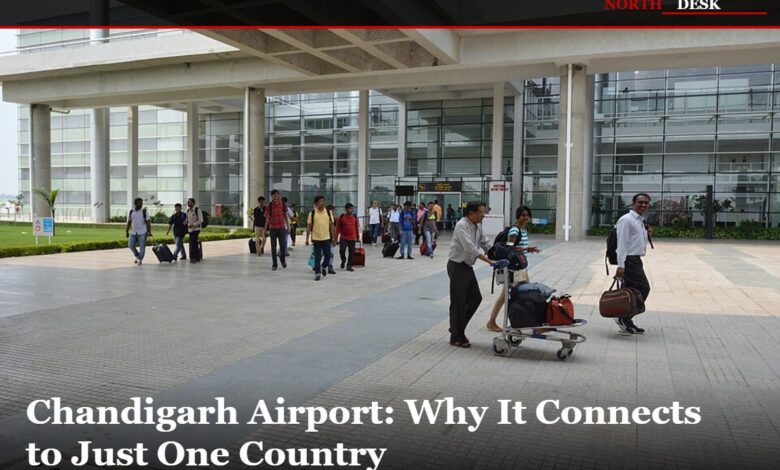
Chandigarh airport international flights remain capped at Dubai and Abu Dhabi routes even as Amritsar flies to seven destinations. Here’s the Point of Call rule Parliament’s answer left out.
North Desk Correspondent
Chandigarh, August 12
A written reply in Parliament this week has put fresh numbers to a grievance North Indian travellers have lived with for over a decade: Chandigarh’s international airport (Mohali), built to serve three states, connects to exactly one country.
Chandigarh Airport International Flights: Responding to a question from Rajya Sabha MP Sant Balbir Singh Seechewal (AAP, Punjab) on international air connectivity from Punjab, Minister of State for Civil Aviation Murlidhar Mohol told the House that Chandigarh or Mohali currently has direct flights only to Abu Dhabi and Dubai — both in the UAE. Amritsar, by contrast, connects to seven destinations across five countries: Sharjah, Dubai, Doha, Birmingham, London, Kuala Lumpur and Singapore.
The Minister’s answer leaned entirely on a familiar defence: international operations are governed by bilateral Air Services Agreements (ASAs), Indian carriers are free to fly from any designated international airport “as per mutually agreed capacity limits,” and beyond that, the government does not interfere because starting a route is “purely a commercial decision of scheduled airlines” based on demand, slots and economic viability.
That framing is accurate as far as it goes — but it leaves out the specific regulatory mechanism that has kept Chandigarh capped at two routes for more than ten years, and that mechanism has nothing to do with airline commercial appetite.
The real bottleneck: Point of Call status
Under India’s bilateral ASAs, a foreign carrier is legally barred from operating to or from an Indian airport unless that airport has been notified as a “Point of Call” (PoC) in the agreement with that country. Chandigarh does not have PoC status. That is why Emirates, Lufthansa, Air Canada and other foreign airlines cannot fly to Chandigarh even where demand clearly exists — it isn’t a matter of them choosing not to; they are not permitted to.
Indian carriers face no such restriction and can fly internationally from any airport carrying international status. That is precisely why Chandigarh’s only two overseas routes — to Abu Dhabi and Dubai — are both operated by IndiGo, an Indian carrier, rather than a foreign one.
This distinction is the difference between the Ministry’s “commercial decision” framing and what has actually been happening on the ground: it is not that no foreign airline wants to fly to Chandigarh, it is that none legally can, regardless of demand.
A decade-old fight, revisited by courts and Parliament alike
The PoC gap has been challenged repeatedly:
Chandigarh Airport International Flights: A PIL was filed in the Punjab and Haryana High Court in 2015 by the Mohali Industries Association. Earlier this year, a Bench of Chief Justice Sheel Nagu and Justice Anil Kshetarpal directed the Ministry of Civil Aviation to file an affidavit explaining why Chandigarh’s international flight count has stayed flat despite the airport’s 2023 upgrade to Category-II Instrument Landing System capability. The Bench called it “unfortunate” that Amritsar — “a district headquarter” — operates more than 14 international flights while Chandigarh, “capital of two prosperous States,” has just two.
In February 2026, BJP Rajya Sabha MP Satnam Singh Sandhu raised the same demand during Zero Hour, citing figures that Chandigarh handles 40–42.5 lakh passengers a year against a designed capacity of 60 lakh — meaning the airport is running at roughly 60 percent of capacity partly because PoC restrictions keep foreign carriers out. The Union Minister’s response then was to commit only to “examining” the traffic data.
In July 2025, Punjab Governor Gulab Chand Kataria met the Union Civil Aviation Minister specifically to press for expanded connectivity from Chandigarh on behalf of Punjab, Haryana and Himachal Pradesh.
That the same ask — from an AAP Rajya Sabha MP this time, a BJP Rajya Sabha MP in February, a Governor last July, and industry litigants since 2015 — keeps returning the same non-committal answer suggests this isn’t a partisan complaint. It is a structural one that the Centre has so far chosen not to resolve.
Chandigarh Airport International Flights: What the answer left out
Chandigarh Airport International Flights: The written reply is also notable for what it does not mention. The MP’s question specifically named Ludhiana among the Punjab airports seeking international operations.
But Ludhiana’s Halwara airport — inaugurated by Prime Minister Modi in February 2026 and built at a cost of Rs 54.67 crore under a joint venture between the Punjab government and the Airports Authority of India — carries “International Airport” branding yet does not appear anywhere in the Minister’s answer.
As of its opening, Halwara has run only a single domestic Air India route to Delhi. Its complete absence from a parliamentary answer specifically about international connectivity raises the question of whether it is being counted as an international airport at all in practice, despite the naming.
Also unaddressed: the Minister’s answer to part (c) — whether any government assessment of passenger demand for international flights from Punjab has been conducted — was folded into the same generic response as parts (a) and (b). No demand study was cited. The Rajya Sabha MP who pushed the same question in February was told the traffic data would be “examined.” Six months on, the answer to a near-identical query offers no update.
The state has spent; the Centre has demurred
Chandigarh Airport International Flights: The Punjab government’s own spending tells a different story about how seriously the state, at least, takes the connectivity gap. Under the AAP government, an estimated Rs 150–200 crore has gone into aviation infrastructure — including an Rs 200 crore road connecting Chandigarh to its airport, Rs 60 crore released from the state treasury to revive the stalled Halwara project after work had stalled since 2022, and upgrades across Ludhiana, Bathinda, Pathankot and Adampur airports under the UDAN regional connectivity scheme.
None of that state-level spending changes the PoC calculus, because Point of Call designation is entirely a Union government decision under India’s bilateral agreements. Punjab can build roads, terminals and runways; it cannot grant itself the right for foreign carriers to land.
Parliament’s answer this week is not wrong on the law — ASAs and commercial viability genuinely do govern route decisions. But by omitting the Point of Call restriction that has kept Chandigarh at two routes for over a decade, and by leaving Ludhiana’s status unaddressed and the demand-assessment question effectively unanswered, the reply gives an incomplete picture of why nearly seven crore people across Punjab, Haryana and Himachal Pradesh still have to route through Delhi — or Amritsar, 240 km away — for most of the world.
ALSO: Hawara Parole: Who Really Decides — Not CM, Punjab Govt or Governor. EXCLUSIVE
ALSO: Punjab’s Employees Turn on the Govt That Claimed to Have Fixed Their Pensions
Follow North Desk on WhatsApp for the latest from Punjab, Haryana and Himachal Pradesh: https://whatsapp.com/channel/0029Vb7ccdxJENy2H87DBG3E




13 Comments