Who Was Kehar Singh? The Man Hanged for Conspiracy in Indira Gandhi's Assassination, Whose Son Is Now a Punjab Election Candidate
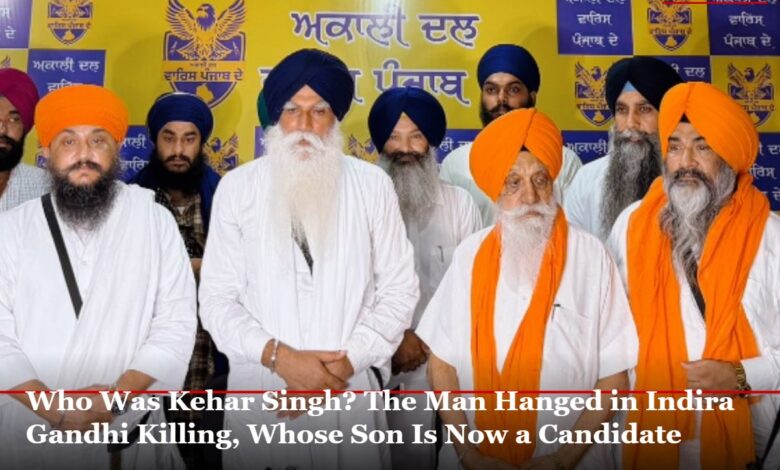
Kehar Singh & Indira Gandhi Assassination: Kehar Singh was hanged for conspiracy in the Indira Gandhi assassination. As his son Satwant Singh enters Punjab politics, here’s the full case history and SC citation.
North Desk Correspondent
Chandigarh, August 11
The Akali Dal Waris Punjab De’s decision to field Satwant Singh (son of Kehar Singh, hanged in 1989 for conspiracy in the assassination of Prime Minister Indira Gandhi) from Bassi Pathana in the 2027 Punjab Assembly election has put a four-decade-old case back in the news. Here is what the record shows about Kehar Singh’s role, and how he came to be executed alongside one of Gandhi’s actual killers.
Kehar Singh & Indira Gandhi Assassination: A clerk, not a bodyguard
Kehar Singh & Indira Gandhi Assassination: Kehar Singh was not present at the assassination on October 31, 1984. He was a government employee — an Assistant (later termed Assistant Section Officer) in the Directorate General of Supply and Disposal in New Delhi. The two men who fired the fatal shots were Sub-Inspector Beant Singh and Constable Satwant Singh, both members of Indira Gandhi’s security detail. Beant Singh was shot dead by other guards moments after the killing; Satwant Singh was arrested at the scene, seriously wounded.
Kehar Singh was arrested afterward, not for pulling a trigger, but on a charge of criminal conspiracy — the allegation that he had ideologically primed and encouraged the two guards to carry out the killing.
The relationship and the alleged role
Kehar Singh & Indira Gandhi Assassination: Contemporary case records and reporting describe Kehar Singh as related to Beant Singh by marriage — accounts vary on the exact link, with some describing him as Beant Singh’s uncle and others specifying he was uncle to Beant Singh’s wife, addressed by the family as “Poopha.” What the prosecution argued, and what courts eventually accepted, was that Kehar Singh held real influence over the younger man.
The case against him rested on claims that he was a religious hardliner deeply angered by Operation Blue Star — the June 1984 Army action against militants inside the Golden Temple complex in Amritsar, which damaged the Akal Takht and killed hundreds.
Prosecutors said Kehar Singh worked on Beant Singh, and through him on Satwant Singh, turning both toward the idea that avenging the assault on the Golden Temple was a religious duty — allegedly arranging for both men to undergo an Amrit Chakhan (baptism) ceremony at a Delhi gurdwara in October 1984, shortly before the killing. Witness testimony cited meetings between Kehar Singh and the two assassins in the run-up to the assassination, in which he was said to have expressed approval of the plan.
Kehar Singh denied all of it and maintained he had been framed.
Convicted on circumstantial evidence
Kehar Singh & Indira Gandhi Assassination: There was no direct evidence — no witness to an explicit instruction, no confession — placing Kehar Singh inside the plot. The prosecution’s case was built entirely on circumstantial evidence: his relationship to Beant Singh, his alleged meetings with the two men, his ideological positions, and their conduct in the weeks before the killing.
A trial court convicted Kehar Singh, Satwant Singh and a third accused, Sub-Inspector Balbir Singh, on January 22, 1986, after a nine-month trial, on charges under Section 302 (murder) read with Section 120-B (criminal conspiracy) of the Indian Penal Code. All three were sentenced to death. The Delhi High Court upheld the convictions.
The case then went to the Supreme Court, which decided it in August 1988.
The Court upheld the death sentences for Kehar Singh and Satwant Singh but acquitted Balbir Singh, finding the evidence against him insufficient. On the core legal question, the Court held that conspiracy is by its nature hatched in secrecy and can be established through a chain of circumstantial evidence and reasonable inference, without requiring direct proof.
A separate writ petition seeking commutation on constitutional grounds tested the scope of the President’s clemency power under Article 72 after his mercy plea was rejected by President R. Venkataraman. That too failed.
ALSO: Hawara Parole: Who Really Decides — Not CM, Punjab Govt or Governor. EXCLUSIVE
Execution and the “Shaheed” designation
Kehar Singh & Indira Gandhi Assassination: Kehar Singh and Satwant Singh were hanged together at Tihar Jail on January 6, 1989. In Sikh religious and political circles, Kehar Singh has since been conferred the title “Quomi Shaheed” (national martyr) by the Akal Takht, the highest temporal seat of Sikh authority — a designation that sits at the heart of how Panthic organisations like ADWPD frame his family today.
That framing is precisely what ADWPD invoked on Monday. Announcing Satwant Singh’s candidacy from Bassi Pathana, working president Tarsem Singh (father of Khadoor Sahib MP Amritpal Singh) said the party’s politics rests on honouring “families that had made sacrifices for the Panth,” and criticised unnamed rivals for having ignored such families. The party also named Sukhwinder Singh Agwan, described as a nephew of Satwant Singh the assassin, to its Parliamentary Board.
It is not ADWPD’s first such move: sitting MP Sarabjit Singh Khalsa, elected from Faridkot, is the son of Beant Singh, the guard who fired the first shots. Kehar Singh’s son now joins that pattern as an Assembly candidate — making lineage from the 1984 case an explicit and repeated organising theme for the party heading into 2027, rather than an isolated gesture.
ALSO: Punjab’s Employees Turn on the Govt That Claimed to Have Fixed Their Pensions
Follow North Desk on WhatsApp for the latest from Punjab, Haryana and Himachal Pradesh: https://whatsapp.com/channel/0029Vb7ccdxJENy2H87DBG3E



One Comment