Amritsar Link Emerges in Air India Immigration Breach as MHA Calls Urgent Meeting
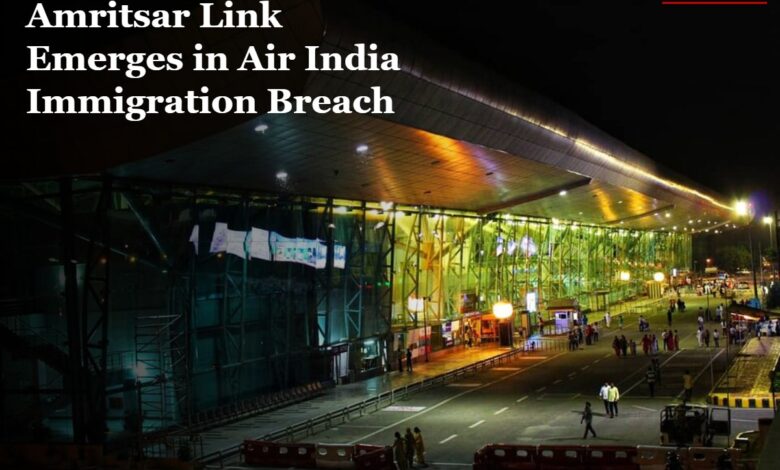
Amritsar Italian Nationals Immigration Breach: An Amritsar-Delhi-Munich immigration breach involving three Italian nationals has triggered an MHA urgent meeting and a 9-question MoCA notice to Air India, with the boarding pass anomaly traced back to Amritsar airport.
North Desk Correspondent
SAS Nagar, September 15
Three Italian passport holders — identified as Surjit Singh, Balwinder Kaur and Gurdev Singh — flew out of India on an international flight without completing mandatory departure immigration, in an incident that began not in Delhi but at Amritsar’s Sri Guru Ram Dass Jee International Airport, and has now escalated to the Ministry of Home Affairs.
The Union Ministry of Civil Aviation (MoCA) has issued a show-cause notice to Air India, dated September 12, seeking answers to nine specific questions on how the three passengers were able to bypass every safeguard built into the airline’s hub-and-spoke operating model.
The Ministry of Home Affairs has separately called an urgent meeting for Tuesday evening, chaired by Home Secretary Govind Mohan, with senior officials from the home and civil aviation ministries, Air India’s leadership, and the Delhi airport CEO expected to attend. Air India CEO Campbell Wilson has also been asked to explain the lapse.
ALSO: Chandigarh Airport International Flights: Why It Connects to Just One Country
Amritsar Italian Nationals Immigration Breach: How it unfolded
Amritsar Italian Nationals Immigration Breach: The three passengers boarded Air India flight AI1115 from Amritsar and landed at Delhi’s Indira Gandhi International Airport at 12.50 am on September 4. Under the hub-and-spoke SOP that governs Amritsar’s international connections, passengers travelling onward from a “spoke” airport like Amritsar to an international destination via the Delhi “hub” are required to hold a “D” (Domestic) boarding pass for the spoke-to-hub leg, then complete mandatory departure immigration at Delhi before proceeding to their connecting international flight.
That is not what happened. According to the MoCA notice, the three passengers were issued not just their Amritsar-Delhi boarding pass but also an onward boarding pass for their Lufthansa connection to Munich — at Amritsar itself, before they had even left Punjab.
The notice states this by itself violated the approved SOP, since spoke airports are not meant to issue onward international boarding passes at all. Further complicating matters, the boarding pass issued for the Munich leg reportedly did not fall into either of the two prescribed categories — “D” or “I” (International) — but a third, unspecified category, which the ministry has flagged as a separate procedural breach.
On arrival in Delhi, rather than being directed through the designated immigration area at Gate 39 to complete formalities, the three were allegedly escorted into the airport’s international-to-international (I-to-I) transfer area — a zone meant only for passengers who have already cleared immigration and are simply connecting between two international flights. From there, they proceeded directly to the departure zone and boarded Lufthansa flight LH763 to Munich at 1.45 am on September 4, without ever passing through Indian departure immigration.
ALSO: Neem Karoli Baba Larry Brilliant story: The Guru Behind Google.org’s Founder
The nine questions
Amritsar Italian Nationals Immigration Breach: MoCA’s show-cause notice to Air India traces the alleged failure through every stage of the journey, asking the airline to explain:
- Under what circumstances passengers holding “D” boarding passes were permitted to enter the I-to-I transfer area
- Why passenger segregation based on the boarding-pass indicator was not followed
- Why an onward Munich boarding pass was issued at Amritsar when the SOP does not provide for this at a spoke airport
- What role Air India and SATS ground-handling personnel played in handling and escorting the three passengers
- What role Air India’s designated Airline Nodal Officer — required to be on duty round-the-clock at hub-and-spoke airports — played, and what supervision was in place
- Why mandatory reconciliation of domestic and international passengers was not carried out in time at Delhi
- Whether the General Declaration, passenger manifest, and API/PNR data submitted to immigration authorities correctly reflected the passengers’ status and movement
- Why the breach was detected only after the passengers had already departed, through manual reconciliation rather than the prescribed real-time controls
Air India has seven days from receipt of the notice — a deadline falling around September 19 — to respond with a written explanation and supporting documents. MoCA has warned that if the airline fails to respond in time, it will presume Air India has no explanation to offer and proceed on the basis of available records, including consideration of administrative and regulatory action.
The hub-and-spoke model, and Amritsar’s place in it
Amritsar Italian Nationals Immigration Breach: The hub-and-spoke system was introduced to let smaller airports like Amritsar offer effective international connectivity by routing passengers through a larger hub — in this case, Delhi — rather than requiring every international sector to be flown directly.
Under the policy, passengers are meant to complete immigration formalities either at the spoke airport itself or at the hub before being treated as international transit passengers; once inside the I-to-I transfer zone, only a security check is required before boarding an onward international flight. The distinction is central to the system’s integrity: a passenger who has not completed departure formalities cannot be treated as though they have.
This is not the first time Amritsar’s international airport has faced scrutiny over its passenger-handling processes. Sri Guru Ram Dass Jee International Airport has previously seen cases flagged for irregularities at its immigration counters, including instances of passengers travelling on tampered or forged documents being caught only after landing abroad. Passenger advocacy groups such as the FlyAmritsar Initiative have also separately raised concerns with the Ministry of Civil Aviation and the Airports Authority of India about slow security and immigration processing at the airport amid rising passenger footfall, though those complaints were about processing speed rather than security bypasses of the kind now under investigation.
MoCA and MHA have not yet indicated whether any explanation has been received from Air India, or what conclusions the ongoing inquiry may reach. Both the airline’s response and the outcome of Tuesday’s MHA meeting remain awaited.
ALSO: Canada Tightens the Noose: 111 Deported in Extortion Crackdown
ALSO: ‘US-Based NRI Hid He Couldn’t Father a Child and Filmed Me While Undressing’
Follow North Desk on WhatsApp for the latest from Punjab, Haryana and Himachal Pradesh: https://whatsapp.com/channel/0029Vb7ccdxJENy2H87DBG3E