Ramayana Rise of a Legend International Reviews: How Western Media Rated India’s Costliest Epic
By North Desk Bureau
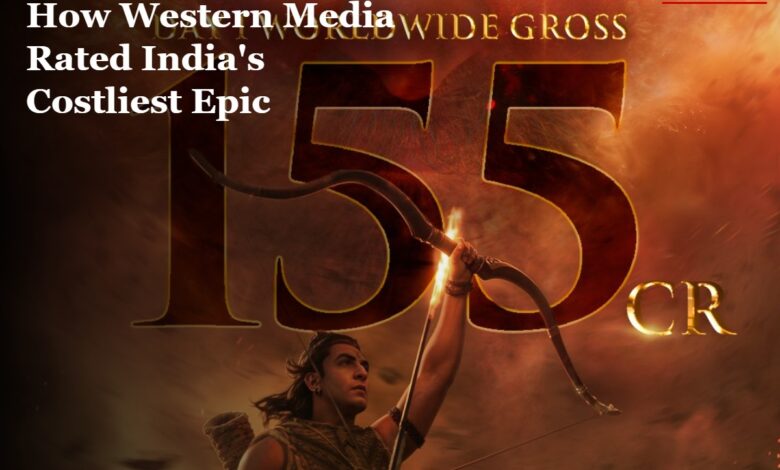
Ramayana Rise of a Legend international reviews: When producer Namit Malhotra and director Nitesh Tiwari rolled out Ramayana: Part 1 (titled globally as Ramayana: Rise of a Legend) across North America, the UK, and Australia, the production carried the immense pressure of its reported multi-crore budget and global distribution footprint. Backed by an unprecedented sonic partnership between Hans Zimmer and A.R. Rahman, the three-hour cinematic adaptation arrived before international film critics not merely as a domestic festival release, but as a direct challenge to Hollywood fantasy tentpoles.
The initial verdict from foreign critics has settled into a sharply divided split: while prominent British and American reviewers celebrated the film’s uninhibited visual scale and 1950s sword-and-sandal bravura, pop-culture and genre trade outlets questioned whether its digital spectacle overshadowed emotional depth and narrative completeness.
Across major global publications, the Ramayana Rise of a Legend international reviews provide an intriguing look into how Western film journalists received India’s most expensive epic on the global stage.
Ramayana Rise of a Legend international reviews
1. The Guardian: Peter Bradshaw Awards 4 Stars to an “Amazing Adventure”
- The Homeric and Shakespearean parallel: Chief film critic Peter Bradshaw offered enthusiastic praise, describing the 195-minute blockbuster as a “thoroughly engaging, rousing and spectacular Indian epic melodrama.” He highlighted how the royal family’s stoic acceptance of forest exile evokes Shakespearean courtly drama, noting that viewers feeling withdrawal after Christopher Nolan’s The Odyssey would find Rama’s journey to rescue his abducted wife deeply compelling.
- Visual world-building and retro energy: Bradshaw praised the grand natural skyscapes and animal kingdom tableaux, drawing comparisons to Peter Jackson’s The Lord of the Rings and Disney’s The Lion King. He particularly singled out the unselfconscious narrative energy reminiscent of classic 1950s and 60s Hollywood epics, calling Ravana’s Pushpaka Vimana flying machine an engagingly “Gilliamesque” creation.
- Standout acting presence: The review highlighted Yash’s commanding screen presence as Ravana, praising the narrative choice to explore his origins from his ascetic penance to Lord Brahma up to his lethal clash against Rama.
ALSO: Ramayana Part 1 Movie Plot Explained: What Ranbir and Yash’s Epic Actually Covers
2. IGN: Critical 5/10 Stance Over CGI Weight and Pacing
- The critique of digital overload: In one of the more skeptical foreign reviews, IGN took issue with the film’s reliance on green-screen soundstages and heavy CGI, arguing that the divine emotional resonance of ancient scripture gets diluted beneath modern digital clutter.
- The “incomplete prologue” problem: The publication noted that the 195-minute runtime struggles under the weight of being only the first installment of a two-part undertaking. By ending abruptly on the Sita abduction cliffhanger and leaving the Vanara army alliance for the next chapter, the first half can feel like an extended setup rather than a self-contained dramatic journey.
- Action mechanics: While acknowledging the physical choreography spearheaded by Hollywood action veterans Terry Notary and Guy Norris, the review argued that certain sequences lacked grounded physical weight compared to recent international cross-over hits.
3. The Hollywood Reporter & Western Trade Coverage
- Devotion versus drama: Trade reviews in major American industry trades analyzed the narrative challenge of adapting sacred scripture for international audiences. Critics observed that because Rama is treated as an inherently flawless avatar of virtue, Ranbir Kapoor’s character has less room for traditional character-driven failure or vulnerability.
- The villain outshining the hero: In contrast, foreign trades universally lauded Yash’s interpretation of Ravana. Western reviewers found his tragic internal corruption, demonic anger, and intellectual brilliance to be the most dynamic acting arc in the movie, making his kingdom of Lanka the most visually distinct world on screen.
- DNEG’s VFX milestone: Multiple American critics noted that Namit Malhotra’s DNEG delivered creature animation—especially the climactic mid-air combat between Ravana’s chariot and the mythical demigod bird Jatayu—that legitimately competes with contemporary Hollywood studio output.
4. Fresh Fiction & US Genre Outlets: A Soaring 4.5/5 Endorsement
- Praise for cultural gateway: American genre portal Fresh Fiction praised the film with an enthusiastic 4.5 out of 5 rating, describing it as a “mesmerizing, explosive epic” that serves as a soaring achievement not solely for Indian cinema, but for worldwide fantasy filmmaking.
- Balanced ensemble praise: Beyond Ranbir Kapoor’s restrained dignity, US indie critics singled out Sai Pallavi for imbuing Sita with genuine grace, vulnerability, and internal strength, while commending Ravie Dubey for grounding Lakshmana’s fierce loyalty with emotional authenticity.
- Zimmer and Rahman’s sonic tapestry: Western reviewers frequently highlighted the cross-cultural score, noting that Hans Zimmer’s thunderous orchestral brass blends seamlessly with A.R. Rahman’s Indian classical instrumentation, particularly during the celestial prologue and the tragic Jatayu funeral pyre sequence.
5. Foreign Media Review Matrix at a Glance
| International Publication | Reviewer / Critic | Verdict / Rating | Key Highlight | Primary Criticism |
| The Guardian (UK) | Peter Bradshaw | ★★★★☆ (4/5) | Rousing retro epic scale, Shakespearean exile themes | Occasional melodramatic pacing |
| IGN (US) | Siddharth Adlakha | 5 / 10 | Impressive physical creature design in practical sets | Pacing stumbles, digital CGI clutter |
| Fresh Fiction (US) | Film Desk | 4.5 / 5 | Mesmerizing visuals, Yash’s magnetic screen command | Abrupt ending leaving main war for sequel |
| US Industry Trades | Trade Critics | Positive-Leaning | Groundbreaking VFX, Jatayu aerial dogfight | Hero treated with reverential caution |
6. The Verdict: How the West Views India’s Biggest Bet
- Surpassing the Adipurush benchmark: Foreign critics made note of the massive qualitative upgrade from previous mythological adaptations, noting that Rise of a Legend successfully established a credible visual standard for Indian epics.
- A cultural test in Western markets: While the three-hour runtime and absence of standard song-and-dance numbers surprised some casual western viewers, critics largely agreed that as an introductory portal into Indian mythology, the film succeeds on sheer scale and ambition.
- The stage is set for Part 2: With the foundation laid and the core characters established, international reviews concluded that the ultimate critical legacy of the franchise will depend on how the planned sequel delivers its wartime conflict and emotional payoff.
ALSO: Gajab Raat Story Explained: Full Plot of the Manoj Bajpayee Thriller
Follow North Desk on WhatsApp for the latest from Punjab, Haryana and Himachal Pradesh: https://whatsapp.com/channel/0029Vb7ccdxJENy2H87DBG3E