Canada Tightens the Noose: 111 Deported in Extortion Crackdown as Intelligence Points to Study-Visa Route as a Gang Pipeline
Canada extortion crackdown removals nearly triple in six months to 111. Separate reporting on a classified Project SEVA assessment says Bishnoi network recruits use Canada’s study-visa route.
North Desk Correspondent
Chandigarh, September 15
The Canada Border Services Agency says it has now removed 111 foreign nationals from the country under a dedicated crackdown on people linked to extortion and organized crime — and the pace at which that number is climbing tells its own story.
As of September 3, 2026, CBSA had issued 188 removal orders and enforced 111 removals under the initiative, the agency said in its latest release. That marks a sharp acceleration: CBSA’s own March 18 release put the tally at 70 orders and 35 removals as of March 12. By June 18, CBSA told Global News the numbers had climbed to 139 orders and 81 removals, with 484 investigations opened under the initiative overall — a figure the agency has not updated publicly since. In under six months, removals have more than tripled.
Geographically, the September release shows the crackdown concentrated where Canada’s Punjabi and wider South Asian communities are largest. Of the 188 orders, 91 came from the Pacific region (58 removed), 47 from the Prairies (30 removed), and 50 from the Greater Toronto Area (23 removed) — the GTA arm only added in November 2025, three months after Pacific and Prairie operations began in August 2025.
Canada Extortion Crackdown: Four names, one pattern
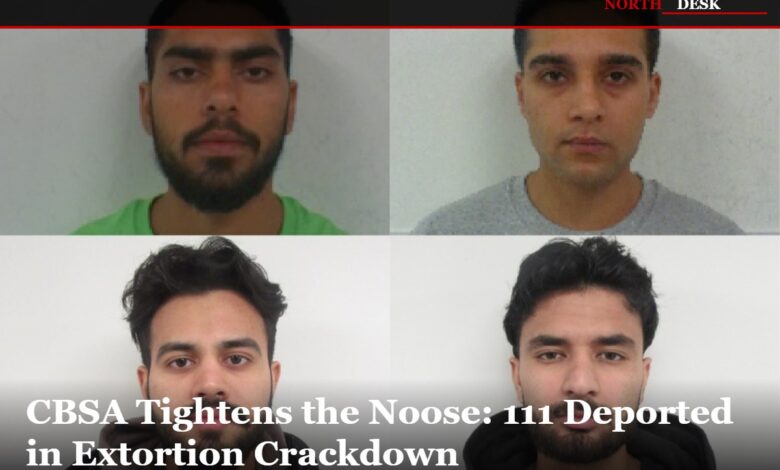
Canada Extortion Crackdown: CBSA’s September release highlighted four recent cases.
Palwinder Singh was found inadmissible after being linked to a fall-2025 shooting tied to extortion-related violence, with the Immigration and Refugee Board ruling him a member of a criminal organization.
Amitoz Bajwa was removed over firearms offences and a separate extortion-linked shooting.
Jasmer Singh was deported following a Canadian conviction for forcible confinement.
Sahibjot Singh, 21 and based in Alberta, did not contest his deportation order at a July hearing — he admitted to discharging prohibited weapons on behalf of a criminal organization, while stopping short of admitting formal membership.
The sharper pattern connecting these cases comes not from CBSA’s September release but from its own statements to reporters at the time of the Sahibjot Singh hearing: Global News reported on July 18 that CBSA said most people caught up in the extortion task force’s net had arrived in Canada on work or study permits, not through illegal entry. Separately, CBSA’s March release — reporting on two earlier flagged cases — disclosed that one of them, Arshdeep Singh, had entered Canada on a study permit in 2022.
The network behind the numbers
Canada Extortion Crackdown maps closely onto the rise of the Lawrence Bishnoi network in Canada — a Punjab-rooted crime syndicate that investigators say now runs extortion, contract killings and drug trafficking out of an Indian prison cell, through lieutenants operating in Canada, the US and Mexico.
The gang has claimed responsibility for the 2023 killing of Hardeep Singh Nijjar outside a Surrey gurdwara and the 2022 killing of Punjabi singer Sidhu Moosewala, and has been linked by Canadian and Indian police reporting to a string of shootings targeting Punjabi-Canadian businessmen and entertainers, including at the Vancouver home of a Bollywood actor-singer and, this year, at the Abbotsford home of a South Asian businessman.
In July, the US Department of Justice unsealed a racketeering indictment against Bishnoi and his Canada-based lieutenant Satinderjeet Singh, alias Goldy Brar, tying the pair directly to the Nijjar assassination and to extortion attempts against Indian-diaspora targets on US soil. Brar remains a fugitive, with a US$50,000 FBI reward on his head; Bishnoi is already jailed in India.
Where the study-visa link was first reported
Canada Extortion Crackdown: The direct claim that gangs are using Canada’s student-visa stream as a recruitment channel does not come from any CBSA release — it comes from a separate Global News investigation published August 7, based on a classified intelligence assessment the outlet said it had obtained. That report, tied to Project SEVA — an RCMP-led task force investigating foreign interference linked to India, in which CBSA participates — said the Bishnoi network has drawn members who arrived on legitimate study or work permits and were pulled into extortion work after arrival.
The same report identified a second, newer group, calling itself the Ruffians, as having emerged directly out of the Indian student community in Canada. Both groups, per that reporting, rely on WhatsApp threats against South Asian business owners in cities including Surrey, Edmonton and Brampton. CBSA has not, in its own public releases, made this student-visa claim directly — it is Global News’ sourcing, not CBSA’s, and should be read as one investigative outlet’s account of a classified assessment rather than a CBSA-confirmed figure.
A wider squeeze
The extortion-specific numbers sit inside a much larger enforcement push, per CBSA’s September release. The agency says it removed 23,160 inadmissible people from Canada in 2025 overall, of whom 1,010 were flagged for serious criminality — organized crime, national security concerns, or war-crimes and human-rights grounds.
CBSA says it is now removing roughly 400 inadmissible people a week nationwide — a general removal-capacity figure, not one specific to the extortion task force. Ottawa’s Border Plan has allocated $30.4 million to lift CBSA’s removal capacity to 20,000 a year, and Budget 2025 funds the hiring of 1,000 new CBSA officers, on top of the roughly 530 officers currently dedicated to immigration enforcement, investigation, detention and removal hearings.
Public Safety Minister Gary Anandasangaree framed the extortion numbers as evidence of sustained pressure on organized crime, while CBSA President Erin O’Gorman said the removal of more than 100 people linked to extortion reflects the agency’s coordination with police forces nationally.
CBSA continues to run a public tip line — the Border Watch Line, 1-888-502-9060 — for reports on individuals believed to be inadmissible.
What it means from this side
Canada Extortion Crackdown: For Punjab, where the study-and-work-permit route to Canada has become a mainstay of the migration economy, the pattern flagged in CBSA’s own statements to reporters — that most of those swept up were legal entrants, not illegal ones — sits uneasily next to the scale of outbound migration from the state.
Read alongside Global News’ separately sourced reporting on the classified Project SEVA assessment, it suggests the exposure isn’t at the border, where agents and families have long focused their scrutiny, but after arrival — in how legitimately-arrived students and workers are being identified and drawn into extortion networks once in Canada.
Canada Extortion Crackdown: With removal orders nearly tripling in six months and 484 investigations reported open as of June, CBSA’s numbers are very likely to keep climbing through the rest of 2026.
ALSO: ‘US-Based NRI Hid He Couldn’t Father a Child and Filmed Me While Undressing’
ALSO: Neem Karoli Baba Larry Brilliant story: The Guru Behind Google.org’s Founder
Follow North Desk on WhatsApp for the latest from Punjab, Haryana and Himachal Pradesh: https://whatsapp.com/channel/0029Vb7ccdxJENy2H87DBG3E