Sajjan Kumar Asked: ‘Have They Done The Work?’…What He Said And Did The Night Mob Killed 5 In Delhi
North Desk Correspondent
Chandigarh, August 20
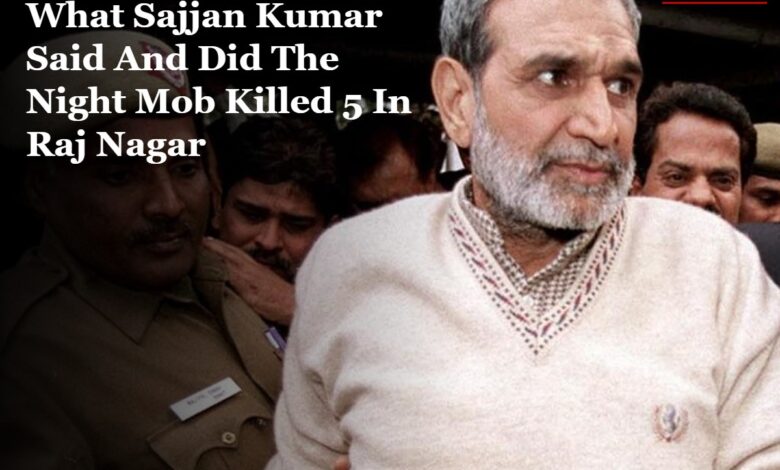
Sajjan Kumar, the former Congress MP who died Thursday after being rushed from Tihar Jail to Safdarjung Hospital, spent the last seven-plus years of his life in prison for a case whose verdict rested less on what he did with his own hands than on what witnesses said he did with his voice.
When the Delhi High Court convicted Sajjan Kumar in 2018, it relied largely on the testimony of three eyewitnesses: Jagdish Kaur, who lost her husband, son and three cousins over two days of violence in Delhi’s Raj Nagar Part-I, Palam Colony; her cousin Jagsher Singh, who survived by hiding in a neighbour’s house and watched two of his brothers die; and Nirpreet Kaur, who saw the local gurdwara burned to the ground. It is their testimony that answers the question of what exactly Sajjan Kumar did on November 1 and 2, 1984.
The question in the dark
Jagsher Singh recalls that it was the evening of November 1. After a mob had already looted and set fire to his family’s house — hunting for him and his two brothers, whom the crowd had heard described as “thekedars” (contractors) sheltering with Hindu neighbours — an Ambassador car pulled up at the turning onto Shiv Mandir Marg. Thirty to forty people gathered around it. Sajjan Kumar got out.
He asked the crowd whether “they have done the work.” Told that the mob had only managed to break the gate of the contractors’ house because the men had escaped, and that “the thekedars are being saved by the Hindus only,” Sajjan Kumar is recorded as walking over to inspect the house himself, then returning and instructing the mob to burn the houses of any Hindus found sheltering Sikhs. He got back in the car and left. Only after his departure did the mob loot and set fire to Jagsher Singh’s house, and go on to threaten the homes of the two families who had taken the brothers in.
The morning before
Earlier that same day, two things had already happened, according to the women who watched them unfold.
At the Raj Nagar Gurudwara, Nirpreet Kaur had gone for morning prayers around 5:30 am, when police personnel were still posted outside. She testified that the police “disappeared without any intimation,” and that by 7:30-8 am a mob armed with iron rods, ‘sariyas’ and jellies attacked the gurdwara, chanting slogans praising Indira Gandhi and calling for Sikhs to be killed for her assassination. Nirpreet Kaur and her brother ran in to try to save the Guru Granth Sahib and narrowly escaped the mob themselves.
Separately that morning, Jagdish Kaur went to lodge a police report and instead walked into a public meeting. She testified that she saw Sajjan Kumar — then the sitting MP for the area — address the gathering, declaring: “Sikh sala ek nahin bachna chahiye, jo Hindu bhai unko sharan deta hai, uska ghar bhi jala do aur unko bhi maro” — not a single Sikh should be left alive, and any Hindu who shelters them should have his house burned and be killed too. She testified that she also heard the local police officer-in-charge ask the mob how many “murge” — chickens — they had “bhun diye”: roasted. It was at that moment, she said, that she lost her faith in humanity.
The killings
The five deaths that form the actual charge in this case unfolded over the following hours, largely at Shiv Mandir Marg and a lane called Dada Chatriwala Marg.
Jagsher Singh testified that he was hiding in a neighbour’s house when he heard shrieking outside. From a window, he watched a mob armed with lathis and sariyas enter Jagdish Kaur’s house and drag out her husband, Kehar Singh, and their son, Gurpreet Singh. Kehar Singh fell inside the house and was beaten with iron rods where he lay. Gurpreet Singh ran for a side street trying to escape; the mob caught him and beat him to death with rods. Jagsher Singh later helped move Gurpreet Singh’s body back into the house on a cot.
That evening, after Sajjan Kumar’s visit and the subsequent burning of his own house, Jagsher Singh fled through back streets to reach an Air Force officer he knew, Major Dhanraj Yadav, who agreed to help him search for his other three brothers with a vehicle and armed jawans from the Sikh Regiment. Early the next morning, near his own house, he witnessed a Sikh man wrapped in a woollen shawl being chased down, beaten with rods and set alight. When the crowd dispersed, he identified the body as his brother Narender Pal Singh — by his wristwatch. Continuing the search, he was told his other two brothers had been killed at Dada Chatriwala Marg. He found their bodies there and identified Raghuvinder Singh and Kuldeep Singh by their clothing.
Jagdish Kaur, watching from her own doorway that same morning, testified that she saw Narender Pal Singh beaten with lathis and then burned near her house, and saw Raghuvinder Singh and Kuldeep Singh being attacked and dragged away by the mob — before she shut her door, fearing for her own children.
Sajjan Kumar: Acquitted once, convicted 34 years later
What makes the case unusual is that Sajjan Kumar was not always a convicted man in this matter. In 2013, the trial court — while convicting five other men on charges of murder and armed rioting — acquitted Sajjan Kumar of everything. The trial judge had found Jagdish Kaur, Jagsher Singh, Joginder Singh (a fourth witness) and Nirpreet Kaur credible enough to convict the other accused, but not credible enough, specifically, on the question of Sajjan Kumar’s own role.
The CBI appealed. The Delhi High Court’s 2018 judgment reversed that acquittal, and was blunt about why: “the trial Court was clearly in error in selectively finding witnesses such as PWs 1, 6, 7, and 10 reliable qua the other accused but unreliable only on the aspect of the involvement of A-1 in the violence that afflicted the area. Disbelieving key witnesses who have remained consistent and spoken clearly about his role is not acceptable.” The bench held that the trial court’s finding of Sajjan Kumar’s innocence “suffers from manifest illegality.”
On that basis, Sajjan Kumar was convicted of criminal conspiracy under Section 120B read with the murder, arson, communal-enmity and gurdwara-desecration provisions of the IPC, of abetting those same offences under Section 109, and separately of delivering provocative speeches instigating violence under Section 153A. He was sentenced to imprisonment for the remainder of his natural life and ordered to surrender by December 31, 2018 — which he did, ending up not in Tihar initially (the court sent him to Mandoli) but later held at Tihar through his subsequent cases.
The court’s closing word
Notably, the bench did not pretend Sajjan Kumar had done nothing since 1984. The judgment records that he had, in the years between, “organized peace rallies and blood donation camps and helped in rehabilitation of the victims of the violence.” The court’s response was unambiguous: “this cannot take away from his involvement in the riots in the first place.”
That conviction — and the life sentence attached to it — is the one Sajjan Kumar was serving when he died. It was, at the time of his death, still not final: his appeal against it was pending before the Supreme Court. Whether that appeal, and the others still open against his subsequent conviction and two acquittals, will now be formally closed by his death is a separate question the courts will have to answer.
ALSO: Punjab Bandh Friday: Avoid Travel As Farmers, Akali Factions Rally Behind Shutdown Call
ALSO: Qaumi Insaaf Morcha Protest: Hawara’s Father, Simranjit Mann Booked; 17 Arrested
ALSO: Hawara Parole U-Turn: Punjab Police Opposed It Months Ago, Now Mann Meets Governor
Follow North Desk on WhatsApp for the latest from Punjab, Haryana and Himachal Pradesh: https://whatsapp.com/channel/0029Vb7ccdxJENy2H87DBG3E





5 Comments