Sajjan Kumar Role Model Or Sin? Why Congress Can’t Agree On Him
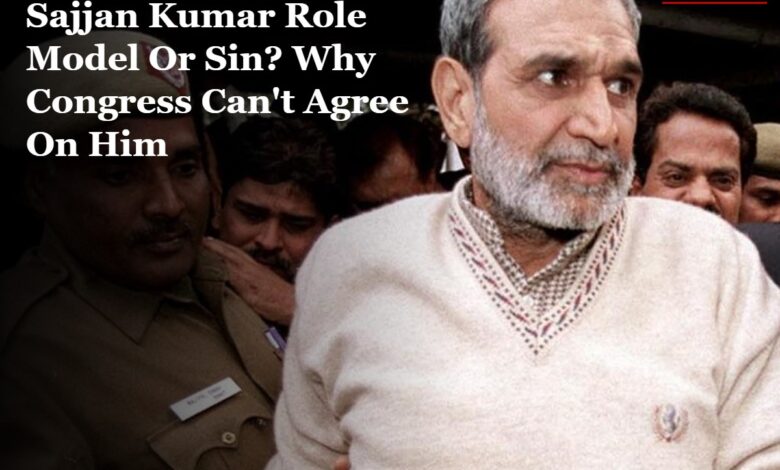
Sajjan Kumar Role Model Or Sin? Deepender Hooda called Sajjan Kumar a “role model”; Channi calls it a “sin” to say his name. Why one party has two positions, and what it means for Punjab Congress.
North Desk Correspondent
Chandigarh, August 23
Two Congress leaders, speaking about the same dead man within 48 hours of each other, could not have arrived at more opposite conclusions. One called him “a role model.” The other said even saying his name is “a sin.” Both are senior Congress figures. Neither has been disowned by the party leadership.
ALSO: Sajjan Kumar: What He Said And Did The Night Mob Killed 5 In Delhi
What happened
Sajjan Kumar Role Model Or Sin? Sajjan Kumar, former three-time Congress MP from Outer Delhi, died on August 20 at Delhi’s Safdarjung Hospital at age 80, while serving concurrent life sentences for his role in the 1984 anti-Sikh riots. He had been convicted by the Delhi High Court in December 2018 for conspiring in the killing of five Sikhs and the burning of a gurdwara in Raj Nagar, Palam Colony, and received a second life sentence in February 2025 for the killing of a father and son in Saraswati Vihar. He was acquitted in a separate case in January 2026. At the time of his death, his appeal against the 2018 conviction was still pending before the Supreme Court.
Speaking to reporters after Kumar’s death, Congress MP Deepender Hooda called it “an irreplaceable loss for the country’s political horizon,” saying Kumar “was not only a prominent figure in Delhi and rural Delhi but across North India,” that “his connection with the people was exemplary,” and that “he is cited as an example across our country” — the remark widely reported as calling Kumar a “role model.”
Two days later, former Punjab Chief Minister Charanjit Singh Channi posted on X that Sajjan Kumar “should have been shot publicly” for his role in 1984, and that it is “a sin” to even speak his name. Punjab Congress president Raja Warring echoed the distancing, calling Hooda’s remarks his “personal” views, not the party’s position.
The backlash that forced Congress’s hand
Sajjan Kumar Role Model Or Sin? Before Channi and Warring spoke, the reaction had already arrived from outside the party. Punjab BJP president Kewal Singh Dhillon called Hooda’s characterization proof of “the Congress’ anti-Sikh mindset” and demanded the party “immediately tender an unconditional apology” to 1984 victims’ families. SAD leader Bikram Singh Majithia went further, directly challenging Warring: “Punjab Congress president Raja Warring may be compromised, but now it will be seen whether he has a backbone or not.” Fellow SAD leader Daljeet Singh Cheema said glorifying “such people” in public “causes a great deal of hurt to the Sikh community,” while Surjit Singh, president of the 1984 Anti-Sikh Riots Victim Welfare Society, said Hooda “should be ashamed.”
By the time Channi and Warring spoke, they weren’t offering a spontaneous Congress position; they were responding to a 48-hour pile-on that had put Punjab Congress on the back foot in front of every rival party in the state.
Why “role model” for one, “sin” for the other
Sajjan Kumar Role Model Or Sin? The contradiction isn’t really about ideology; it’s about caste geography. Sajjan Kumar was, before he was a 1984 accused, one of the most prominent Jat political leaders in the Delhi-Haryana belt: a three-time MP from Outer Delhi, a constituency whose rural, Jat-dominated sociology is functionally continuous with Haryana’s own Jat heartland. Within Jat community networks specifically, he was never treated as the pariah that national discourse made him; he continued attending Congress rallies and community events, and his brother and son both received Congress tickets from Delhi’s Jat-belt constituencies over the years.
Deepender Hooda is among Haryana’s most prominent Jat leaders after his father, Bhupinder Singh Hooda, and his own political base in Rohtak sits directly against the Delhi border where Kumar built his career. Read in that light, “role model” wasn’t a calculated Congress position on 1984 — it was a Jat leader’s tribute to another Jat leader, delivered in the register Indian politicians reflexively use for a community elder, regardless of that elder’s record. It’s a far more plausible explanation than any deliberate attempt to rehabilitate Kumar nationally: if anything, the remark has cost Congress badly everywhere outside that specific community register.
That same caste calculus is precisely why it doesn’t travel to Punjab. Channi and Warring have no Jat-Haryana constituency to protect, and every reason to distance themselves fast: Punjab’s electorate is Sikh-majority, memories of 1984 remain acute, and 2027 Assembly elections are approaching with SAD, AAP and the BJP all competing to be seen as the toughest on the issue. For Punjab Congress, defending Kumar in any form is simply not an option regardless of what motivated Hooda’s remark.
Sajjan Kumar Role Model Or Sin? The structural bind
Sajjan Kumar Role Model Or Sin? This is why the episode is a genuine structural problem for Congress rather than a one-off gaffe from one leader. The party is trying to hold together a Haryana unit where the Hooda family is the dominant face and draws real strength from Jat community solidarity, and a Punjab unit that cannot survive even the appearance of sympathy for a 1984 convict.
Those two imperatives are not just in tension — they are, on this issue, direct opposites. Every time a Haryana Congress leader speaks about Kumar in the community register that plays well at home, it hands Punjab’s opposition parties a ready-made attack line, and Punjab Congress is left performing damage control for words spoken hundreds of kilometres away by a leader from a different unit of the same party.
Whether Hooda clarifies or walks back his remark, and whether the Congress high command steps in to settle the party’s official position, will determine how long this particular fire keeps burning heading into 2027.
ALSO: Sajjan Kumar: What He Said And Did The Night Mob Killed 5 In Delhi
ALSO: Hawara Parole U-Turn: Punjab Police Opposed It Months Ago, Now Mann Meets Governor
Follow North Desk on WhatsApp for the latest from Punjab, Haryana and Himachal Pradesh: https://whatsapp.com/channel/0029Vb7ccdxJENy2H87DBG3E

2 Comments