Akal Takht 7 Objections to Punjab’s Anti-Sacrilege Law — Explained
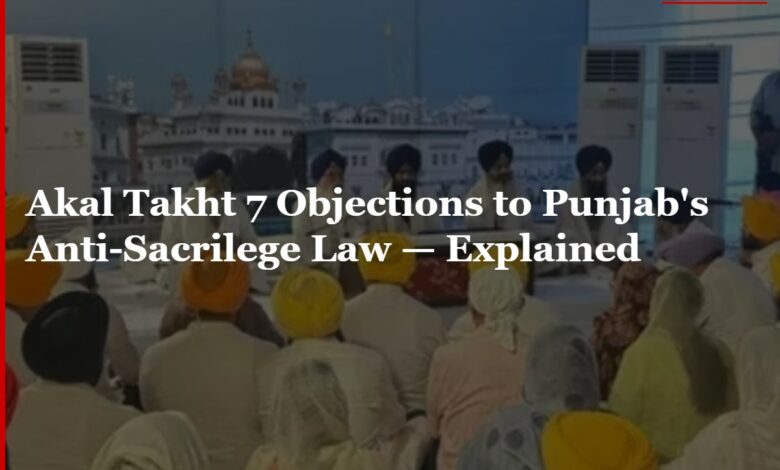
Akal Takht 7 Objections: Akal Takht handed Punjab’s Speaker a 30-day ultimatum on June 29 over the Anti-Sacrilege Act. Here are all 7 objections raised by the Sikh clergy, explained.
North Desk Correspondent
Chandigarh, June 30
All Sikh MLAs in the Punjab Vidhan Sabha appeared before the Akal Takht in Amritsar on June 29, where the Sikh clergy formally handed Speaker Kultar Singh Sandhwan a detailed written list of objections to the Jaagat Jot Sri Guru Granth Sahib Ji Satkar (Amendment) Act, 2026 — along with a strict 30-day ultimatum to put the law on hold and amend it.
The confrontation marks a new front in the broader standoff between the Bhagwant Mann government and Sikhism’s highest temporal authority, one that has run alongside the Guru Dokhi sacrilege case roiling Punjab’s political and religious life. At its core, the Akal Takht’s objection is institutional: that the state has reached into matters of internal Panthic governance that, in its view, belong solely to the SGPC and Akal Takht — not to the Punjab government or police.
The Act itself was passed by the Vidhan Sabha on April 13, 2026, and received the governor’s assent soon after. The clergy’s objections came formally on May 11 in a letter to the Speaker, and were elaborated in person when Sandhwan was summoned to Akal Takht on May 8 to explain the legislation to acting jathedar Giani Kuldeep Singh Gargaj. Monday’s meeting was where those objections were finally set down on paper, with a deadline attached.
Akal Takht 7 Objections, and the reasoning behind each.
1. Removal of traditional terminology (Clause 2)
Akal Takht objects to the legal removal of the words “bir” and “birs” — terms rooted in Sikh customs and the Rehat Maryada, the Sikh code of conduct — and has demanded they be reinstated alongside “saroop” and “saroops.”
2. The “custodian” trap (Section 2 amendment)
The clergy argues that defining a legal “custodian” shifts blame for sacrilege onto devout Sikhs, gurdwara committees, granthis, and families who host religious recitations. Their underlying objection is philosophical: no human, in their view, can be designated a custodian of the Guru.
3. Unique identification numbers for scriptures (Sections 3A and 3B)
The law requires the SGPC to maintain a central register assigning a unique identification number to every saroop of the Guru Granth Sahib. Akal Takht has called this an intolerable tampering with the sanctity of the holy scripture, asserting the state has no authority to regulate its status.
4. Security risk from online databases
A related amendment requires uploading records of where saroops are located to the SGPC website within 45 days. The clergy has drawn a parallel to the November 1984 anti-Sikh violence, when voter lists were allegedly used to target households, warning that a public, searchable database could expose Sikh devotees worldwide to similar targeting.
5. Criminalising code-of-conduct violations (Section 5)
The law proposes up to five years’ imprisonment and a ₹10-lakh fine for violations of the code of conduct — even outside actual instances of sacrilege. Akal Takht argues this weaponises the law against sewadars and granthis for what are essentially internal administrative or Maryada lapses, matters it says fall under its own jurisdiction, not the state police’s.
6. Unilateral rule-making power (Section 6A)
The clergy has objected to the state government retaining the power to frame rules via gazette notification without consulting apex Sikh institutions such as the SGPC and Akal Takht.
7. Disrespectful language and legal protocol
Akal Takht wants commercial terms like “store,” “storage,” and “supply” replaced with terms it considers respectful, such as “sewa sambhal.” It has also mandated that desecrated holy material must never be taken to police stations or courts as evidence — instead, cremation rites for such material must be performed at Gurdwara Sri Baoli Sahib in Goindwal Sahib, Tarn Taran.
READ ALSO: Who Is Jagman Samra? The Canada-Based NRI at the Centre of the Bhagwant Mann Video Row
THE TIMELINE SO FAR:
April 13, 2026: Punjab Vidhan Sabha passes the Jaagat Jot Sri Guru Granth Sahib Satkar (Amendment) Act, 2026, which subsequently receives the governor’s assent.
May 8: Speaker Kultar Singh Sandhwan is summoned to Akal Takht and appears before acting jathedar Giani Kuldeep Singh Gargaj to discuss the legislation.
May 11: Akal Takht sends a formal letter to the Speaker demanding removal or overhaul of core clauses.
June 29: All Sikh MLAs appear before Akal Takht. The clergy hands over a detailed written list of objections, with a 30-day ultimatum to put the Act on hold and amend it.
READ ALSO: AAP Ministers, MLAs to Appear Before Akal Takht: Six Things Bhagwant Mann Said
READ ALSO: Gurugram FIR Decoded: What It Says About the Bhagwant Mann Video Row
Follow North Desk on WhatsApp for the latest from Punjab, Haryana and Himachal Pradesh: https://whatsapp.com/channel/0029Vb7ccdxJENy2H87DBG3E



4 Comments