From Big Win to One-Month Ultimatum: How AAP’s Anti-Sacrilege Law Unravelled in 77 Days
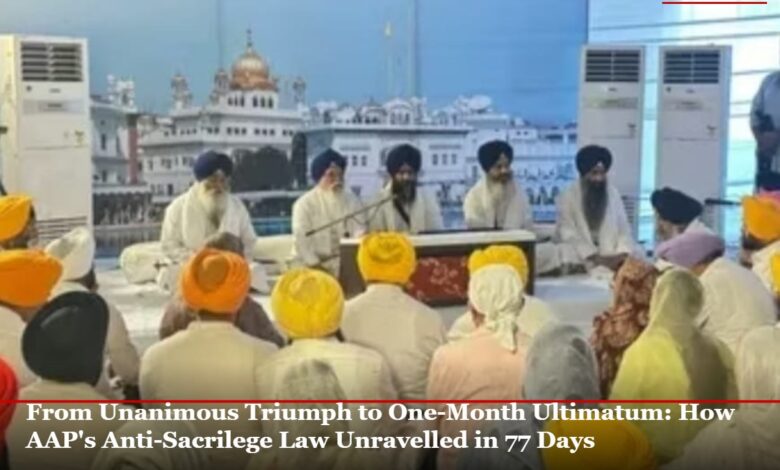
Anti-Sacrilege Law: The Jaagat Jot Sri Guru Granth Sahib Satkar Amendment Act was passed unanimously on April 13. On June 29, AAP accepted Akal Takht’s direction to suspend it. Here is how the law unravelled in 77 days.
North Desk Correspondent
Amritsar/Chandigarh, June 29
It took the Punjab government 77 days to go from unanimous legislative triumph to institutional climbdown.
On April 13, the Jaagat Jot Sri Guru Granth Sahib Satkar (Amendment) Act, 2026, was passed with great fanfare at a special session of the Punjab Assembly on Baisakhi. Every single MLA voted for it. AAP called it historic. On Monday, those same MLAs and ministers trooped into the Akal Takht secretariat in Amritsar, accepted a direction to suspend the law’s implementation, and agreed to re-amend it within a month.
This is the story of how that happened.
April 13: The Triumph
Anti-Sacrilege Law: The anti-sacrilege bill was passed at a special one-day session held on Baisakhi. It was passed unanimously — with support from AAP, Congress, BJP and SAD — after over three hours of deliberations. The symbolism was deliberate: Baisakhi.
The new law prescribed life imprisonment and a fine of up to Rs 25 lakh for acts of sacrilege committed through criminal conspiracy with the intent to disrupt peace or communal harmony. The Governor’s assent came within a week.
What was missing from the occasion: any consultation with the Akal Takht or the SGPC.
May 8: The First Warning
Anti-Sacrilege Law: The Akal Takht summoned Punjab Assembly Speaker Kultar Singh Sandhwan on May 8 and gave the government 15 days to make amendments in accordance with Sikh sentiments. Through Sandhwan, written objections from the Akal Takht were formally conveyed to the Punjab government and the Chief Minister’s Office on May 11.
The government’s response, according to the Jathedar: silence. The Jathedar later said the state government had adopted an “obstinate and arrogant attitude, completely ignoring the Akal Takht and Sikh sentiments.”
READ ALSO: Who Is Jagman Samra? The Canada-Based NRI at the Centre of the Bhagwant Mann Video Row
June 15: The Summons
Anti-Sacrilege Law: With the government having ignored the May objections, the Akal Takht escalated. Jathedar Giani Kuldip Singh Gargaj on June 15 directed all Sikh legislators, regardless of party affiliation, and Sikh ministers to appear before the highest temporal seat of Sikhs for their clarification. It was the same day the Akal Takht issued its edict declaring Mann “anti-Guru” and “anti-Khalsa Panth” over the viral video — making June 15 perhaps the worst single day for AAP in its Punjab tenure.
The Jathedar said the Akal Takht had no objection to strict punishment for those guilty of sacrilege — but that the provisions inserted into the law placed Guru Granth Sahib, the Sikh Sangat, granthis, pathis, gurdwara committees and sewadars within a legal framework in the manner of “accused persons,” amounting to direct government interference in Sikh affairs.
June 28: Kejriwal Arrives
Anti-Sacrilege Law: The day before the scheduled appearance, AAP national convenor Arvind Kejriwal flew into Amritsar. After a closed-door meeting with Sikh legislators and ministers, he stood alongside Mann at a press conference and projected confidence. Mann declared that the Akal Takht’s authority was supreme, that all MLAs and ministers would appear the next day, and that the fake video evidence would also be submitted. The optics were of a party in control of the narrative. The reality, as Monday would show, was different.
June 29: The Climbdown
Acting Jathedar Giani Kuldeep Singh Gargaj directed the Punjab government to immediately suspend the implementation of the Act and issued a one-month ultimatum to remove all religious and legal objections raised by the Akal Takht. The directions were accepted by ministers and MLAs present.
The Jathedar said he observed that the government had been “misguided” while drafting the legislation, and that those involved in preparing the legal draft lacked an understanding of Sikh traditions and Panthic conventions, resulting in avoidable controversy and confusion among the Sikh community.
The specific objections placed on record were pointed. The Jathedar said maintaining records and supervision of the publication of Birs falls exclusively within the jurisdiction of the SGPC and not the government. The Akal Takht also criticised the government’s use of the word ‘saroop’ instead of the traditional Sikh term ‘Bir’ in the legislation.
In response to the five calls made during the proceedings, all the MLAs and ministers agreed to re-amend the Act in accordance with Sikh sentiments.
What Happens Now
The Punjab government has one month — until around July 29 — to amend or suspend the law to the Akal Takht’s satisfaction. The Jathedar assured that the Akal Takht would extend full cooperation if the government amended the legislation in accordance with Sikh sentiments and established Panthic traditions.
But the political cost has already been paid. A law passed unanimously at a special Baisakhi session with all parties on board, has been effectively sent back to the drawing board by the highest Sikh temporal authority — 77 days after it was celebrated as a landmark achievement.
The question nobody in Chandigarh is answering yet: why did the government not act on the Akal Takht’s written objections when they were formally conveyed on May 11?
READ ALSO: AAP Ministers, MLAs to Appear Before Akal Takht: Six Things Bhagwant Mann Said
READ ALSO: Gurugram FIR Decoded: What It Says About the Bhagwant Mann Video Row
Follow North Desk on WhatsApp for the latest from Punjab, Haryana and Himachal Pradesh: https://whatsapp.com/channel/0029Vb7ccdxJENy2H87DBG3E



One Comment