Ambala boy who fell into borewell dead: How Nirvair Singh Fell Into 220-Foot Borewell — Explained
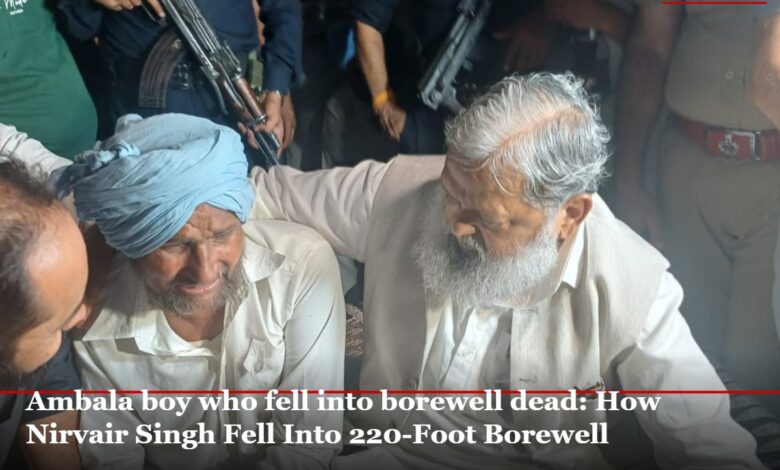
Ambala boy dead: An explainer on how 4-year-old Nirvair Singh fell into a 220-foot borewell in Haryana’s Ambala, why the 21-hour rescue was so difficult, and why such tragedies keep recurring.
North Desk Correspondent
Chandigarh, July 1
I remember covering the Prince rescue live, from the spot, in 2006 — a five-year-old boy trapped in a Kurukshetra borewell for 48 hours while half the country watched on television and prayed for him by name. Prince survived, and his rescue became one of those rare stories where an entire nation exhaled together. Nirvair Singh, four, wasn’t that lucky. Pulled out of a 220-foot-deep open borewell in Ambala’s Dhanaura village early Wednesday after a 21-hour operation involving the NDRF, SDRF, the Army and district authorities, he was declared brought dead at Ambala Cantonment’s Civil Hospital Wednesday morning. Here is what happened, and why an operation with this much manpower and machinery still couldn’t save him.
Ambala boy dies: But How the accident happened
Nirvair had gone to the fields with his father, Manjeet Singh, on Tuesday morning to deliver food to his grandfather, Karnail Singh, who had been working there since early morning. While his father joined the farm work, the child wandered off to play near a neighbouring plot. There stood an unused borewell, its mouth covered with nothing more than a jute sack. According to the family’s account, Nirvair was playing near the opening when the wet soil around it — loosened by water present in the well — gave way beneath him, and he slipped in. His father and grandfather heard the sound and rushed over; when their own attempts and those of nearby villagers failed, they alerted the authorities at around 7:30 am.
Why a 9-inch borewell makes rescue so difficult
District authorities confirmed the borewell was roughly 220 feet deep and only about nine inches wide — narrower than a large dinner plate. That width is the central problem in almost every borewell rescue: it’s too narrow for a rescuer to descend, so teams are left working with hooks, ropes and cameras lowered from above, trying to secure a child who cannot be reached or guided from below. Officials also flagged that water was flowing into the borewell, complicating both visibility and the child’s condition. When initial attempts with specialised equipment didn’t succeed, authorities kept a fallback plan ready: digging a parallel pit alongside the borewell to physically tunnel across and reach the child — the method used in most successful rescues of this kind elsewhere in the country.
Inside the 21-hour operation
Once alerted, Ambala’s district administration, police, the NDRF, the SDRF and the Indian Army were all mobilised, with heavy machinery brought in alongside specialised rescue kits. Deputy Commissioner Ajay Singh Tomar and the sub-divisional magistrate supervised through the day. At one stage during the rescue, Nirvair reportedly slipped further down the shaft, which likely added further hours to an already difficult operation.
Haryana Cabinet minister Anil Vij visited the site through the evening and met the family. It was only at around 3:40 am on Wednesday — nearly 21 hours after the fall — that Nirvair was finally brought out and rushed to hospital, where he was declared brought dead. His body has been sent for a post-mortem; officials say the presence of water in the borewell means the precise cause of death will only be confirmed after that examination.
Not Haryana’s first such tragedy
Prince’s rescue in Kurukshetra in 2006 became a national moment precisely because it was so rare — most such falls end differently. Barely a month before Nirvair’s death, a four-year-old boy in Punjab’s Hoshiarpur district fell into a newly dug borewell and was safely rescued after a nine-hour operation, trapped at a shallower depth of 20 to 30 feet. The Supreme Court laid down binding guidelines as far back as 2010, requiring borewells to be fenced and capped, abandoned ones to be filled in, and landowners to give district authorities 15 days’ written notice before any borewell is dug. Eighteen years after Prince, and sixteen after those guidelines, a sack thrown over a nine-inch pipe was all that stood between a four-year-old and a 220-foot fall.
Follow North Desk on WhatsApp for the latest from Punjab, Haryana and Himachal Pradesh: https://whatsapp.com/channel/0029Vb7ccdxJENy2H87DBG3E