Modi Meets Sant Niranjan Dass: Who Is He? Why Modi’s Visit Matters for Punjab Polls
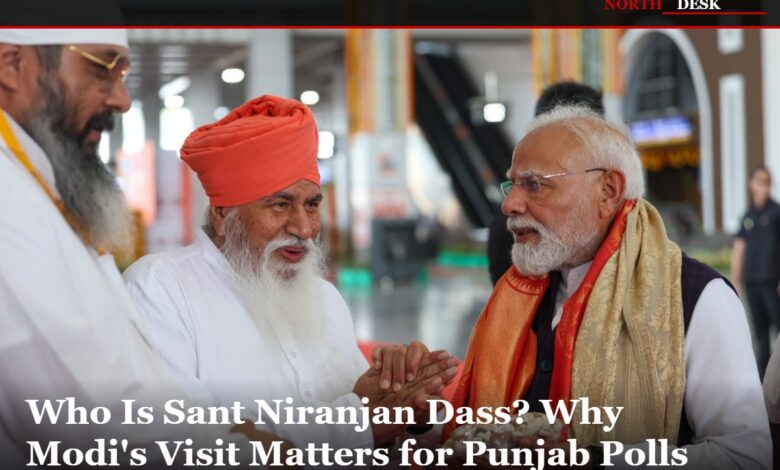
Modi Meets Sant Niranjan Dass: PM Modi met Dera Sachkhand Ballan’s Sant Niranjan Dass in Jalandhar. Here’s who he is and why the outreach signals a Dalit-vote play ahead of Punjab elections.
North Desk Correspondent
Chandigarh, July 18
Prime Minister Narendra Modi’s meeting with Sant Niranjan Dass in Jalandhar on Friday was framed, on the surface, as a courtesy call: a warm word for a respected religious figure amid a day of infrastructure launches. But the timing, the optics, and the man himself point to something more calculated: an opening move in what is shaping up to be a contest for Punjab’s Dalit vote ahead of the state elections due early next year.
Who is Sant Niranjan Dass
Sant Niranjan Dass is the Gaddi Nashin (spiritual head) of Dera Sachkhand Ballan, based in the village of Ballan near Jalandhar. He has led the Ravidassia community from that seat since 1994, and over three decades has built out the dera’s footprint well beyond religious functions: educational institutions, community infrastructure, and charitable healthcare facilities sit alongside its expanding network of religious centres in India and overseas. He also holds responsibility for the Ravidass temple at Seer Govardhan in Varanasi (the birthplace of Guru Ravidas) which gives him a foothold in the Prime Minister’s own constituency as well as Punjab. Earlier this year, he was conferred the Padma Shri in recognition of his social work.
Dera Sachkhand Ballan itself is arguably the most influential Ravidassia institution in Punjab, commanding loyalty across the Doaba belt — the Jalandhar-Hoshiarpur-Kapurthala-Nawanshahr region that has among the highest Scheduled Caste population shares of any region in India, and where the Ravidassia faith (distinct from, though historically linked to, Sikhism) has deep social roots.
Modi meets Sant Niranjan Dass: The meeting, in context
Modi meets Sant Niranjan Dass: Modi’s stop with Niranjan Dass came during a larger Jalandhar visit built around infrastructure: the inauguration of 75 redeveloped railway stations under the Amrit Bharat Station Scheme, the launch of a hydrogen train, and projects worth over Rs 5,470 crore. But it was reported plainly as outreach to the Dalit community, particularly given the approaching Punjab elections — not as an incidental stop on the itinerary. That a sitting Prime Minister carved out personal time to meet the dera head, rather than delegating it to a state minister, is itself the signal worth reading.
The contrast that makes this a story, not just an event
Modi meets Sant Niranjan Dass: What sharpens the angle is history. In 2016, Niranjan Dass was not allowed by Modi’s security detail to enter the Ravidass temple at Seer Govardhan in Varanasi during a brief Modi visit there (he was left waiting outside the pandal until the Prime Minister had already departed.) The episode drew public protests from BSP leaders in Jalandhar and condemnation from other dera heads, who called it an embarrassment for the wider sadhu samaj representing Dalit deras in the region.
That contrast — a dera chief once left standing outside a temple gate, now personally sought out and publicly praised by the same Prime Minister — is the real story here. It reflects how much the political value of this relationship has risen as Punjab’s electoral map has fragmented four ways between Congress, AAP, the Akalis and BJP, with the SC vote (roughly a third of Punjab’s electorate, and heavily concentrated in Doaba) increasingly seen as the swing bloc no single party can take for granted.
Why BJP is investing here specifically
BJP has struggled for a durable Dalit constituency in Punjab and has periodically tried to use Dera Sachkhand Ballan as a bridge — the Padma Shri award to Niranjan Dass earlier this year fits that pattern, as does Modi’s Guru Ravidas Jayanti visit to the dera in February. Friday’s meeting continues that sequence rather than standing alone. For BJP, an endorsement (even an implicit one) from the Ballan dera carries weight with a community that has historically split its vote between Congress and the Bahujan Samaj Party, and more recently AAP, without settling firmly behind any one party at the state level.
What will be interesting to see is whether Niranjan Dass or the dera leadership make any explicit political statement in the coming weeks, or continue to hold to studied neutrality, as has generally been their pattern.
And whether rival parties — Congress, AAP, or BSP, which has historically drawn on Ravidassia sentiment — respond with their own outreach to the dera or to Doaba’s Dalit constituencies more broadly.
Also, analysts will keenly watch whether this translates into concrete announcements (grants, recognition, infrastructure) tied to the dera or the wider Ravidassia community before the polls.
READ ALSO: PM Modi Flags Off India’s First, World’s ‘Most Powerful’ Hydrogen Train
Follow North Desk on WhatsApp for the latest from Punjab, Haryana and Himachal Pradesh: https://whatsapp.com/channel/0029Vb7ccdxJENy2H87DBG3E