A Bull, A Death, 18 Years of Silence: How the Supreme Court Ended One Widow's Long Wait in Sangrur
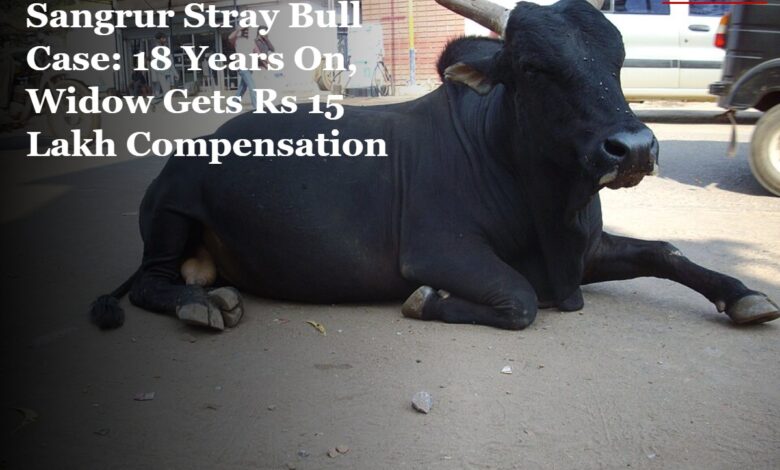
Sangrur Stray Bull Case: The Supreme Court ordered Rs 15 lakh compensation for a Sangrur widow whose husband was killed by a stray bull in 2007 — and revealed Punjab’s own scheme promises Rs 5 lakh for such deaths.
North Desk Correspondent
Sangrur/Chandigarh, August 1
Sangrur Stray Bull Case: On September 21, 2007, Vijay Kumar was walking down a road in Sangrur when a stray bull attacked him. He suffered a head injury, fell unconscious, and never fully recovered. His widow, Nisha, has spent the better part of two decades trying to get the Municipal Council of Sangrur to accept responsibility. On Friday, the Supreme Court finally gave her an answer — though not before exposing a gap in Punjab’s own law that raises an uncomfortable question: was she shortchanged by the very system meant to protect her?
Sangrur Stray Bull Case: The bare facts nobody disputed
Sangrur Stray Bull Case: There was never any real argument about what happened. Police recorded the incident the same year. Vijay Kumar himself, before he died, filed a compensation claim with the Deputy Commissioner, Sangrur, in 2010, asking for Rs 1 crore. The DC’s office turned him down — not because the incident wasn’t real, but because, in its own words, it “does not receive any fund which can be given as compensation.” He then sent a legal notice. When that got no response either, he moved the Punjab and Haryana High Court.
A single judge of the High Court examined the case in 2019, applied the same formula used to calculate compensation in motor accident claims, and awarded the family Rs 29.32 lakh with 6% annual interest, dating back to September 2012.
The Municipal Council appealed. In November 2025 — six years later — a Division Bench of the High Court threw the award out. Not on the facts, but on a technicality: it ruled that the case involved “disputed questions of fact” that a writ petition couldn’t decide, and told the family to start over in a civil court.
“Where does that leave the claimants? Remediless.”
Sangrur Stray Bull Case: That’s essentially what the Supreme Court bench of Justice Sanjay Karol and Justice Nongmeikapam Kotiswar Singh said when the case reached them. The incident happened in 2007. The High Court took until 2019 to rule the first time, and 2025 to reverse it. Sending the family to a civil court now — nearly two decades after Vijay Kumar was struck — would mean, in effect, no remedy at all.
The Court also pointed out something the High Court’s technical reasoning had skipped over: there was no real dispute about the facts to begin with. The bull attack was reported to police. It was never denied by anyone, including the Municipal Council. There was nothing left to “dispute” — the case simply needed a decision.
On that basis, the Supreme Court set aside the High Court’s order and restored the family’s right to compensation — though not using the High Court’s original Rs 29.32 lakh formula. Instead, accounting for the extraordinary delay and the severity of Vijay Kumar’s injuries before his death, it awarded a lump sum of Rs 15 lakh, to be paid within four weeks. The Court was careful to add that this figure was specific to this case and should not be treated as a precedent for others.
The twist: Punjab already has a compensation scheme — and it pays more than what this case got
Here’s where the judgment gets genuinely useful for anyone dealing with a similar case in Punjab today. Buried in the Court’s survey of state cattle laws is a detail that’s easy to miss but hard to ignore: Punjab already has bye-laws that fix compensation for stray-cattle victims — and they’ve been revised upward twice.
Under the Punjab Municipal (Registration and Proper Control of Stray Animals) Bye-Laws, 2006, municipalities were required to set up a fund to pay victims of stray cattle — but the amount was never fixed.
New bye-laws issued on October 12, 2020 finally put a number on it: Rs 1 lakh for a death, and a proportionate amount for permanent disability.
A further notification dated June 13, 2023 raised this to Rs 5 lakh for death and Rs 2 lakh for permanent incapacitation.
None of this applied to Vijay Kumar’s case, because his death happened years before these bye-laws existed — which is exactly why the Supreme Court had to invent a one-off number instead of simply applying the scheme.
The obvious question for anyone in Punjab dealing with this today: has any family in Sangrur, or anywhere else in the state, actually been paid under this scheme? Or does it exist only on paper, the way the 2006 fund did for over a decade before it was ever quantified?
A national problem hiding behind one case
Sangrur Stray Bull Case: The Court didn’t stop at Nisha’s case. It used the judgment to point to a country-wide pattern: stray cattle incidents kill or injure hundreds of people every year, and there’s no consistent mechanism anywhere in India to compensate victims. Citing government data, it noted that animal attacks killed over 1,100 people in 2018, over 1,400 in 2019, and over 1,300 in 2020 across India — Punjab’s own numbers rising from 16 deaths in 2018 to 42 in 2020.
The Court surveyed cattle-protection laws in 24 states and Union Territories and found the same story everywhere: laws exist to set up gaushalas and cattle shelters, but almost none of them address what happens to the human victims of stray or abandoned cattle.
It ended the judgment with five directions to the Centre and state governments:
States should actually enforce the cattle laws they’ve already passed.
A proper compensation mechanism should be created for people killed or hurt by stray cattle — whether they were on foot or in a vehicle.
All cattle should be tagged, to track ownership and health.
Owners who abandon animals once they’re no longer “useful” should be held accountable, and shelters should issue receipts when animals are handed over.
Every municipal corporation or department should have a designated officer responsible for tagging and record-keeping.
READ ALSO: Is Sanjeev Arora Sick Enough to Get Bail? Supreme Court Says No — For Now
Follow North Desk on WhatsApp for the latest from Punjab, Haryana and Himachal Pradesh: https://whatsapp.com/channel/0029Vb7ccdxJENy2H87DBG3E