SC PACL Township Order Explained: Who Gets Ownership in 8 Weeks, Who Gets 8% Refund?
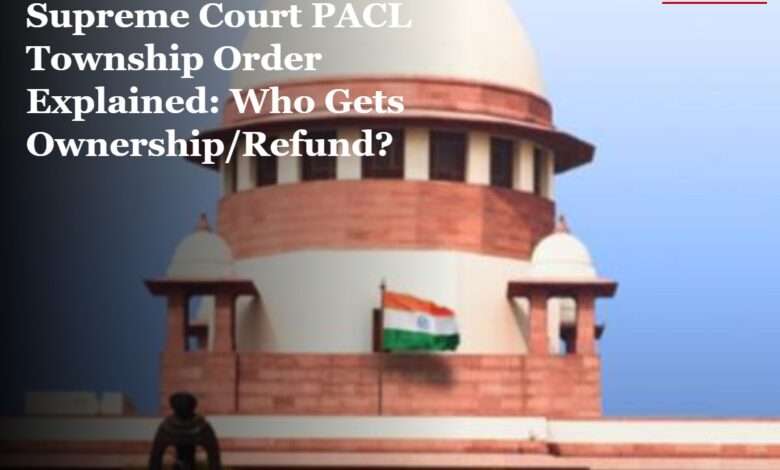
Supreme Court PACL Mohali Bathinda plot allottees order explained in Q&A: check 8-week NOC timelines, 8% interest refunds, and rules for cash buyers.
North Desk Correspondent
Chandigarh, November 20
After a decade-long legal freeze triggered by regulatory action against PACL Ltd (Pearls Group), the Supreme Court of India has laid down a binding, five-tier roadmap to settle claims of plot and unit allottees across Pearls City in Sectors 100 and 104, Mohali, and Pearl’s Township in Bathinda.
Delivered on Thursday, by a Bench of Justices Pamidighantam Sri Narasimha and Atul S. Chandurkar, the 40-page order adopts the audit-backed categorization of the Justice (Retd.) R.M. Lodha Committee—separating buyers with verifiable banking trails from cash purchasers and post-freeze entrants.
Here is a complete question-and-answer breakdown of what the Supreme Court ordered, who stands to gain, and what happens next:
Supreme Court PACL Township Order Explained:
Q1. How many residential units and buyers are covered by this Supreme Court order?
The order governs plot and unit allotments across three residential developments of PACL in Punjab:
Mohali (Sectors 100 and 104): A combined total of 2,032 units.
Bathinda: A total of 1,078 units.
To separate genuine bank-verified purchasers from unverified claims, chartered accountants appointed by the Justice Lodha Committee audited bank records following a February 2, 2016 cut-off date—the exact day the Supreme Court constituted the Lodha Committee to liquidate PACL assets and refund investors.
Q2. I paid the full amount through a bank before February 2, 2016, but never got a sale deed or possession. What happens now?
You fall under Category I (limb ii)—which covers 536 allottees across Mohali and Bathinda.
The Supreme Court directed the Recovery Officer appointed under Section 28A of the SEBI Act to issue Sale Certificates / No-Objection Certificates (NOCs) within eight weeks from November 19, 2026. For those who paid in full via banking channels without receiving physical possession or a sale deed, the Court explicitly ordered:
“We also direct the Recovery Officer to give the necessary possession certificate to those in limb (ii) of the Category I within the same time period.”
Q3. What must Category II buyers (who paid over 50% via bank) do to secure their plots?
There are 491 allottees in Category II—227 in Sector 100 Mohali, 138 in Sector 104 Mohali, and 126 in Bathinda.Their roadmap runs in strict stages:
1. Demand Statement (Within 8 Weeks): The Lodha Committee will issue each eligible allottee a statement showing the balance payable under their original agreement plus their contribution toward Internal Development Work.
2. Payment Window (30 Days): Allottees must deposit both sums through banking channels into the Committee’s designated account within 30 days of receiving the statement.
3. One-Time Grace Period: Those unable to pay on time may apply once to the Committee for an extension of up to 30 additional days by showing valid reasons. If they still fail to pay, their plot will be treated as unsold and they will receive a refund with 8% interest like Category III buyers.
4. NOC Issuance (Within 8 Weeks): Upon receipt of the balance, the SEBI Recovery Officer will issue Sale Certificates/NOCs within eight weeks.
(Note: Any Category II allottee who made part-payments through banking channels after February 2, 2016, will instead receive an audited refund with 8% interest for post-cutoff tranches.
Q4. Why did the Supreme Court refuse to let buyers who paid less than 50% keep their plots by paying current market or circle rates?
Several applicants—including Pearl City Mohali Residents Welfare Association (representing 93 allottees in Sector 100 who paid ₹15.87 crore and 65 allottees in Sector 104 who paid ₹9.28 crore), Pearl’s Township Plot Holders’ Welfare Association, Bathinda (16 allottees), Pinnacle Self Supporting Co-Operative Welfare House Building Society (allotted 5 acres in Sector 104), and M/s KLV Builders & Developers Pvt. Ltd. (which built 31 three-storey villas, 25 of which remain unsold)—urged the Court to let them pay the remaining balance at current circle or market rates.
The Bench rejected this request, observing that the Supreme Court had assumed extraordinary jurisdiction in 2016 primarily to restitute crores of small Ponzi investors and could not turn into a civil real-estate tribunal:
“We cannot afford to convert these proceedings into suits for specific performance or public law proceedings for restitution and rehabilitation… Having regard to the considerable passage of time, this Court cannot hazard a probable relief where plans and directions to make balance payments, resolution of existing claims and disputes over title, transfer of unencumbered property, and creation of fresh title, will all happen with certainty. The best this Court can do now is conclude the proceedings and ensure that the applicants are repaid the monies they invested, with reasonable interest.”
Consequently, all 199 Category III allottees will receive their audited principal back with 8% annual interest within three months of their plot’s auction.
Q5. What happens to people who paid PACL in cash? Have they lost all legal recourse?
Not entirely, though they get zero relief from the Lodha Committee. The Supreme Court rejected all applications by Category IV cash payers seeking plot allotment or refund from the auction pool.
However, the Bench clarified that its May 2, 2016 restraint order only barred civil courts from impleading the Justice R.M. Lodha Committee, its Chairman/members, or SEBI. Cash buyers remain free to approach competent civil courts by filing recovery or declaration suits directly against PACL Ltd, and the Court listed the matter further to clarify which contesting defendants may be impleaded
Q7. What if an allottee does not want the plot anymore or was left out of Category I?
Opt-Out Refund Option: The Lodha Committee’s approved framework allows allottees to surrender their plots and opt for a refund, payable within three months of auction completion.
Omitted Category I Claims: Addressing pending intervention applications (including those by applicants Mr. Navdeep Kumar and Dr. Surinder Kumar Bansal), the Supreme Court directed the Committee to verify fresh applications from buyers claiming they belong in Category I and pass appropriate orders subject to SEBI’s approval or objection.
Plot-Wise Checklists: The Supreme Court appended nine annexures listing the exact plot numbers placed in Categories I, II, and III across Sector 100 Mohali, Sector 104 Mohali, and Pearl’s Township Bathinda so affected families can verify their classification directly.
ALSO: Turban in Car, ‘Records’ in Hand: Does Nayab Saini’s Fierce Pitch Work in Punjab?
ALSO: Highways as Battlegrounds: How ‘Yatra Politics’ Is Shaping Punjab’s Run-Up to 2027
Follow North Desk on WhatsApp for the latest from Punjab, Haryana and Himachal Pradesh: https://whatsapp.com/channel/0029Vb7ccdxJENy2H87DBG3E