Right to Recall and Anti-Defection Law Explained Explained as Raghav Chadha, 6 others move to BJP
Even as people discuss Right to Recall and Anti-Defection Law, AAP has spray-painted ‘gaddaar’ on defectors’ walls and Punjab CM Mann has sought a President’s audience to recall six Rajya Sabha MPs. North Desk explains what the law actually says — and why the answers may surprise you.
Arvind Chhabra
Chandigarh, April 26, 2026
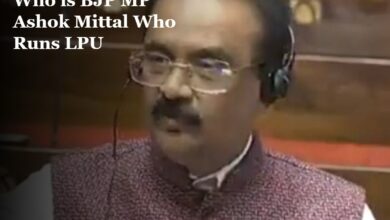
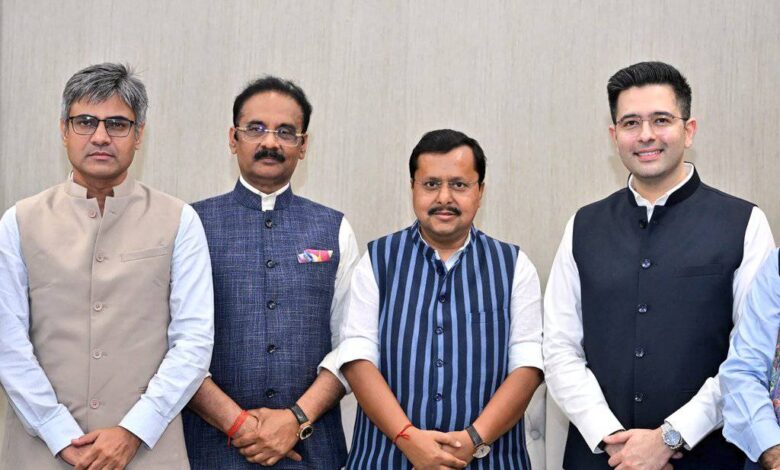
The Right to Recall and Anti-Defection Law–both have become a major point of discussion in political forums and drawing rooms. A day after seven Rajya Sabha MPs including Raghav Chadha — six of them elected from Punjab — walked out of the Aam Aadmi Party and announced a merger with the BJP, AAP workers were on the streets of Ludhiana and Jalandhar with spray cans, daubing ‘gaddaar’ (traitor) on the boundary walls of the properties of Ashok Mittal, Rajinder Gupta and Harbhajan Singh. In Delhi, AAP’s Rajya Sabha MP Sanjay Singh held a press conference and announced he would write to the Rajya Sabha Chairman demanding disqualification of all seven under the Tenth Schedule of the Constitution. And in Chandigarh, Punjab Chief Minister Bhagwant Mann sent a letter to President Droupadi Murmu seeking an appointment — to present, said his office, the case for “recalling” the defecting MPs.
It was a furious, multi-front response. But how much of it has legal weight, and how much is political theatre? North Desk examines the two central legal questions this episode has raised.
QUESTION ONE: CAN THE SIX PUNJAB MPs BE RECALLED?
The short answer is no. And not because of a technicality — but because no such provision exists anywhere in the Indian Constitution.
Talking to North Desk, Prof Rajinder Grewal, former director of University Institute of Legal Studies, Chandigarh, said : “Recall is not a provision available in the Constitution under any schedule at all. There is no question of recall.” He said it’s merely a “political slogan” to satisfy the egoes.
Rajya Sabha MPs are elected by state legislative assemblies through a process of proportional representation with a single transferable vote. Once elected, they serve a six-year term. Neither the state government that backed them, nor the party that fielded them, nor the President of India has any constitutional power to cut short that term on grounds of defection or changed political allegiance.
Bhagwant Mann’s letter to President Murmu is therefore not a legal remedy — it is a political statement. Its purpose is to signal to Punjab voters that the Mann government considers the defection an act of betrayal against the state, not merely against the party. As political messaging directed at a 2027 assembly election audience, it may be effective. As a constitutional instrument, it has no force.
QUESTION TWO: WAS THE MERGER ITSELF LEGAL?
This is where the story gets genuinely complicated — and where the most authoritative voice so far belongs not to AAP but to Kapil Sibal, the senior Supreme Court advocate and Rajya Sabha MP who has made a detailed argument that the merger of April 24 was constitutionally invalid from the outset.
To understand why, a brief history of the law is necessary.
THE 1985 LAW AND THE AAYA RAM PROBLEM
The Tenth Schedule of the Constitution — commonly called the anti-defection law — was inserted by the 52nd Constitutional Amendment in 1985, under Prime Minister Rajiv Gandhi. It was a direct response to decades of floor-crossing that had made Indian legislatures notoriously unstable. The phenomenon had a name — “aaya ram, gaya ram” — after a Haryana MLA who famously switched parties three times in a single day in 1967.
The 1985 law said simply: if you voluntarily give up your party membership, or if you vote or abstain against your party’s direction in the House, you lose your seat. But Parliament built in two escape routes. The first was a “split” — if at least one-third of a party’s legislators decided to form a separate group, they were exempt from disqualification. The second was a “merger” — if a party merged with another party, its legislators who went along were protected.
THE 2003 AMENDMENT: TIGHTENING THE SCREW — OR OPENING A DOOR?
The split provision was widely abused. Party managers would engineer defections in stages — a few members at a time — until the one-third threshold was crossed, with compliant Speakers delaying rulings on disqualification petitions throughout. Parliament responded with the 91st Constitutional Amendment in 2003, which deleted the split provision from the Tenth Schedule entirely. No split, however large, would now protect defectors.
But the merger provision remained. And its threshold was raised to two-thirds. On the face of it this was a tightening — two-thirds is harder to achieve than one-third. In practice, it created a cleaner and more legitimate-looking escape route for any group organised enough to count its numbers. Which is precisely what the seven AAP MPs appeared to do on April 24.
THE SIBAL ARGUMENT: SEQUENCE MATTERS
Here is where Kapil Sibal’s intervention cuts to the bone. Speaking at a press conference, Sibal argued that what the seven MPs did on April 24 does not qualify as a merger under the Tenth Schedule — because they skipped the first and most essential step.
The Tenth Schedule, Sibal explained, is explicit about sequence. A merger under its provisions requires, first and foremost, that the original political party itself decide to merge. The party’s organisational leadership must convene, pass a resolution, and formally resolve to merge with another political party — or to form a new one jointly with another party. Only after that party-level merger has taken place can the question of what happens to the party’s sitting MPs arise.
“The political party has to first decide to merge,” Sibal said, reading directly from the constitutional text. “A member of the House shall not be disqualified where his original political party merges with another political party.”
The Aam Aadmi Party as an organisation has done no such thing. AAP has not passed any resolution to merge with the BJP. AAP’s leadership or Arvind Kejriwal, the party’s national convener, has not agreed to any merger. What seven MPs did was arrive at a press conference and declare that they, as a legislative group, were merging with the BJP. Under Sibal’s reading of the Tenth Schedule, that is not a merger — it is a defection dressed in the language of merger.
AAP’s Sanjay Singh made a similar argument at his own press conference, citing the Supreme Court’s ruling in the Shiv Sena case as support for the position that no form of legislative split or merger has validity without the parent party’s involvement. “The anti-defection law clearly states that any kind of split, even if it involves a two-thirds majority, has no legal validity,” Singh said, adding that he would submit a petition to the Rajya Sabha Chairman and the Vice President seeking disqualification of all seven MPs.
WHAT HAPPENS NEXT
The petition, once filed, will go before the Chairman of the Rajya Sabha, CP Radhakrishnan. The Chairman acts as the presiding officer on anti-defection matters in the Upper House, in the same way the Speaker does in the Lok Sabha. He will have to rule on whether the seven MPs’ action constitutes a valid merger under the Tenth Schedule or whether it amounts to voluntarily giving up party membership — which would trigger disqualification.
That ruling, whatever it is, will almost certainly be challenged in the Supreme Court. Constitutional law experts note that the court has, in recent years, shown a willingness to examine the substance of merger and split claims rather than simply deferring to presiding officers — the Shiv Sena case being the most prominent recent example, though its facts were distinct enough that it cannot be read as a clean precedent here.
The BJP will argue that the two-thirds threshold was met and that the merger is valid. AAP will argue that the threshold question is irrelevant because the party-level merger — Step One — never occurred.
THE BIGGER PICTURE
There is an irony embedded in the 2003 amendment that its drafters may not have foreseen. By raising the merger threshold from one-third to two-thirds, Parliament intended to make defection harder. In doing so, it may have made large, organised defections more constitutionally defensible — provided the numbers are right and the paperwork is managed carefully.
Whether the AAP seven managed either of those conditions is now a question for the Rajya Sabha Chairman and, in all likelihood, the Supreme Court.
What is not in question — legally, at least — is the recall demand. The Constitution gives no party, no state government, and no President the power to take back a Rajya Sabha seat on political grounds. The gaddar graffiti will wash off the walls. The MPs will keep their seats until the courts say otherwise.