Gurjeet Singh Khalsa Descends From Patiala BSNL Tower After 560 Days as Punjab Sacrilege Law Enacted
North Desk Correspondent
SAMANA (PATIALA), APRIL 24
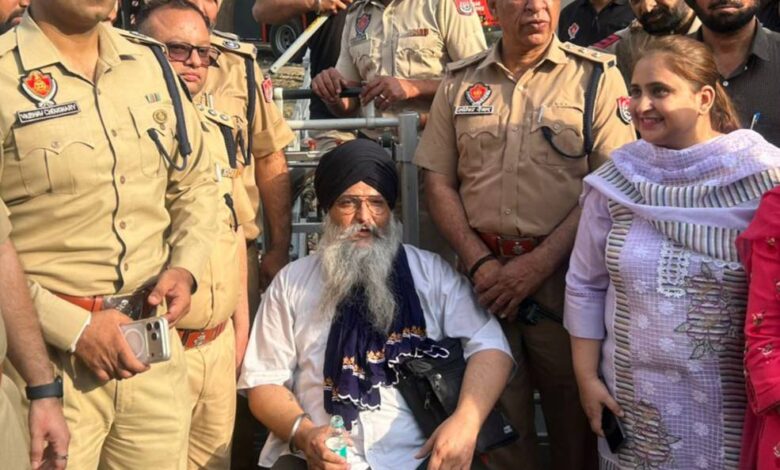
After 560 days on a 400-foot BSNL tower, farmer Gurjeet Singh Khalsa came down Friday morning the way he had always insisted he would — on his own terms, in ‘chardi kala’.
“I am in chardi kala,” said Khalsa, 43, as he descended with assistance from a nine-member rescue team comprising army, police, fire department and administrative officials who used a high-tech crane to reach the height of approximately 275 feet where he had been perched. He said his faith in his guru made it possible, and thanked supporters for standing by what he called a noble cause.
On a clear Friday early morning with low winds, the officials found the conditions ideal before they gave a go ahead to carry out the operation. The groundwork had been laid Thursday, when the joint team visited the site and assessed the logistics. The Punjab government had formally requested Army assistance on Wednesday.
Khalsa was taken to hospital for a medical check-up after his descent. He is expected to participate in the bhog ceremony of an Akhand Path Sahib being held near the protest site at Baba Banda Singh Bahadur Chowk, where the Dharam Yudh Morcha simultaneously called off its dharna Friday.
A Farmer’s Wager
Khalsa, a dairy owner and farmer from Kheri Nagaiyan village, had mounted the tower on October 12, 2024, after what he described as a personal breaking point over repeated sacrilege incidents in Punjab. Deeply hurt by accounts of desecration of religious scriptures, he decided his brother would manage the family dairy and farm while he took up what he saw as a spiritual struggle.
He left behind a son, Ashmeet Singh, who cleared his matriculation examinations last year while his father sat 400 feet above the ground in a makeshift tarpaulin shelter. Two caretakers brought him food and water once a day. He used a polythene bag to relieve himself. With no physical activity, his blood pressure and sugar levels fluctuated. He did not come down.
The Law That Brought Him Down
The trigger for Friday’s descent was a sequence of legislative events that unfolded over 11 days this month. The Punjab Vidhan Sabha passed the Jaagat Jot Sri Guru Granth Sahib Satkar (Amendment) Bill, 2026 during a special session on April 13. Governor Gulab Chand Kataria gave his assent on April 17. The law was notified on April 20.
Life term, 25 lakh fine as Punjab’s anti-sacrilege law gets governor’s assent
It was only after the governor’s nod, sources close to the Morcha said, that Khalsa agreed to come down.
The amended law stiffens punishment for sacrilege of religious scriptures — an upgrade from the 2008 legislation that activists had long argued was toothless. Khalsa himself had drawn a firm line on this distinction. As recently as a few weeks ago, when Punjab Vidhan Sabha Speaker Kultar Singh Sandhwan visited the protest site to persuade him to descend, Khalsa had refused. “I will only come down when the law is actually implemented on the ground,” he had said from atop the tower.
That caveat has not disappeared. It now hangs over what comes next.
560 Days, One Demand
The Dharam Yudh Morcha, which had been staging a dharna at Baba Banda Singh Bahadur Chowk since February 24 this year, is also wrapping up Friday. Morcha coordinator Gurpreet Singh had earlier said the administration’s proposal to lower Khalsa by rope from 100 feet using a crane had been rejected as unsafe. Khalsa had sent a voice message to six members of the coordination committee saying he would descend as he had climbed — on his own, chanting Waheguru. The administration ultimately reached him at 275 feet with human and mechanical assistance, meeting him partway.
The 560-day vigil drew sustained attention to an issue that successive Punjab governments had handled cautiously — the Bargari sacrilege case of 2015 and its political fallout still a live wound in the state’s religious and electoral memory. Khalsa’s protest gave the demand renewed urgency, and ultimately a new law.
Whether that law translates into action on the pending cases — Bargari, Burj Jawala, and others — is the question his supporters say they will now watch closely.


One Comment