The ‘Nau-Maas’ Reset: How the BJP-SAD Reunion Rewrites Punjab’s 2027 Electoral Arithmetic
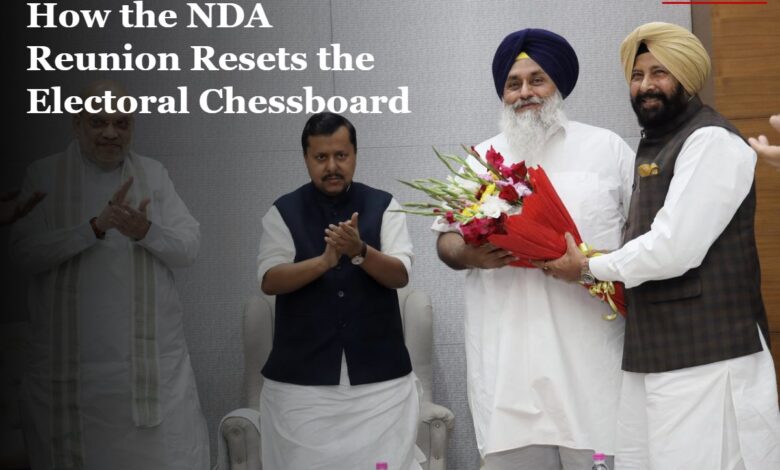
BJP, SAD Alliance Revived: Six years after splitting, BJP and Shiromani Akali Dal reunite for the 2027 Punjab Assembly polls with Sukhbir Singh Badal as NDA’s CM face. Read North Desk’s deep dive into the political arithmetic.
North Desk Correspondent
Chandigarh, November 24
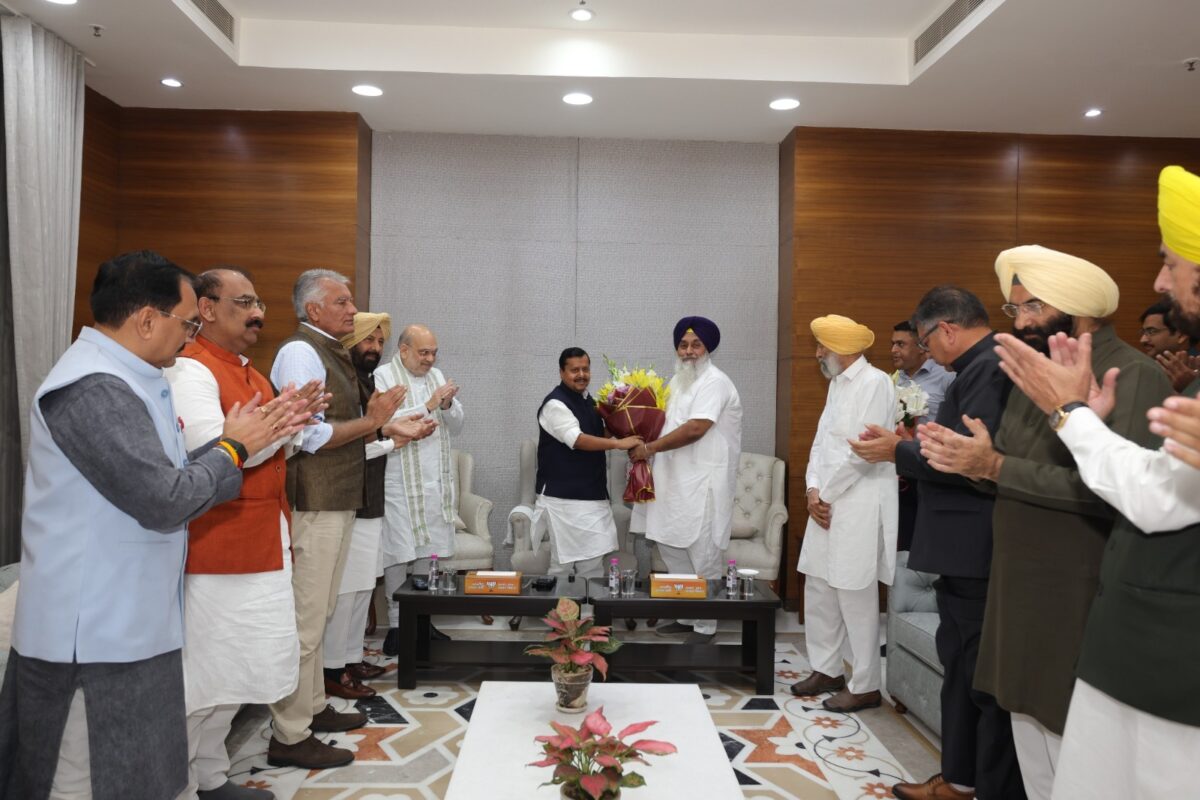
Six years after a bitter parting of ways over the now-repealed farm laws in September 2020, the Bharatiya Janata Party (BJP) and the Shiromani Akali Dal (SAD) have formally buried the hatchet. Announced on the auspicious occasion of Sri Guru Nanak Dev Ji’s Prakash Purab at the BJP headquarters in New Delhi by Union Home Minister Amit Shah, BJP National President Nitin Nabin, and SAD President Sukhbir Singh Badal, the revival of the National Democratic Alliance (NDA) in Punjab is far more than a routine pre-poll tie-up. It is a structural reset of Punjab’s political chessboard ahead of the 2027 Assembly elections.
For the past six years, the absence of the SAD-BJP coalition created a fragmented four-cornered contest in Punjab, allowing the Aam Aadmi Party (AAP) to sweep 92 of the 117 seats in 2022 on a consolidated wave while traditional votes split vertically. By bringing one of the NDA’s oldest founding partners back into the fold, the BJP and SAD have moved decisively to close that gap.
Why Naming the ‘Big Brother’ Early Matters
BJP, SAD Alliance Revived: In coalition politics, ambiguity over leadership often sabotages campaigns before they take off. Union Home Minister Amit Shah cut through months of speculation with two clear strokes: confirming that the alliance will contest all 117 Assembly seats together and declaring that the Akali Dal will play the “big brother” role, with Sukhbir Singh Badal as the NDA’s Chief Ministerial face.
By settling the Chief Ministerial question on day one and asking reporters to leave the finer details of seat-sharing to the central leadership, the alliance has achieved two immediate objectives:
- Preventing Cadre Confusion: Rural Akali workers and urban BJP cadres now have an unambiguous command structure rather than competing over top billing.
- Neutralising Factional Drift: Both parties have spent the past two years fending off splinter groups and rebel factions. A formal stamp from Amit Shah and Nitin Nabin signals to wavering leaders across Malwa, Majha, and Doaba that the central NDA machinery is firmly behind the united front.
Electoral Math of BJP, SAD Alliance: Bridging Urban-Rural Divide
BJP, SAD Alliance Revived: Punjab’s electoral sociology has historically rewarded coalitions that bridge its sharp demographic and geographic fault lines. Alone, the BJP demonstrated in the 2024 Lok Sabha elections that it could double its vote share to over 18.5% and emerge as the single largest party in several urban and semi-urban Assembly segments, yet it struggled to convert that momentum into rural seats without an agrarian partner. Conversely, the Shiromani Akali Dal retained its core Panthic and rural organisational network across villages, yet suffered from an erosion of urban Hindu and Dalit votes in the absence of the BJP.
The reunion directly addresses the structural weaknesses of both parties:
| Electoral Dimension | Standalone Challenge (2020–2026) | Combined NDA Advantage (2027) |
| Geographic Reach | BJP strong in urban/semi-urban pockets; SAD anchored in rural villages | Seamless transfer of votes across all 117 urban, semi-urban, and rural seats |
| Social Coalition | Split between rural Sikh peasantry and urban Hindu-Dalit voters | Restores the classic Hindu-Sikh social harmony plank championed by Parkash Singh Badal |
| Governance Pitch | Opposition attacks appeared fragmented across multiple parties | Unified “double-engine” narrative pairing central backing with regional roots |
| Anti-Incumbency | Anti-AAP and anti-Congress votes risked splitting three ways | Consolidates anti-incumbency directly against the Bhagwant Mann government |
Law, Order, and ‘Nasha’: The Narrative Blueprint
BJP, SAD Alliance Revived: Beyond arithmetic, the press conference revealed a tightly calibrated campaign narrative designed to corner the ruling Aam Aadmi Party. Rather than dwelling on past friction, both Amit Shah and Sukhbir Singh Badal anchored their pitch around three emotional and governance pillars:
- Security and Gangsterism: Framing Punjab as a sensitive border state where extortion, daylight shootings, and lawlessness have shaken investor and citizen confidence, Shah placed law and order at the very top of the alliance’s agenda.
- A 2029 Deadline on Drugs: Targeting one of AAP’s biggest unfulfilled promises, Shah set a specific target to eradicate the drug menace from Punjab by December 2029, backed by a three-month joint roadmap and a Common Minimum Programme.
- Addressing Panthic Sensitivities: By committing to joint discussions on the release of Bandi Singhs and clarifying that the Kartarpur Sahib Corridor was closed only due to security circumstances following Operation Sindoor and will reopen at an appropriate time, the BJP leadership moved to pre-empt criticism from hardline quarters.
The Road to Moga on December 8
BJP, SAD Alliance Revived: Sukhbir Singh Badal’s description of the tie-up as a nau-maas da rishta (an inseparable bond like nail and flesh), originally forged in 1996 by Atal Bihari Vajpayee, L.K. Advani, and Parkash Singh Badal, was aimed squarely at rekindling emotional loyalty among veteran cadres. That symbolism will reach its crescendo on December 8, when Prime Minister Narendra Modi travels to Moga for a mega rally marking Parkash Singh Badal’s birth anniversary.
With the BJP’s organisational depth in the cities and the Akali Dal’s cadre strength in the villages now aligned, the 2027 Punjab election has overnight transformed from a fragmented multi-cornered race into a high-stakes direct showdown. For the ruling Aam Aadmi Party and a factionalised Congress, the return of the NDA means the margin for error in Punjab has just vanished.
ALSO: BJP Sikh Outreach in Punjab: Why Winning Over the Community Remains a Work in Progress
ALSO: Turban in Car, ‘Records’ in Hand: Does Nayab Saini’s Fierce Pitch Work in Punjab?
Follow North Desk on WhatsApp for the latest from Punjab, Haryana and Himachal Pradesh: https://whatsapp.com/channel/0029Vb7ccdxJENy2H87DBG3E