Chamba Mother-Son Murder: 15 Years On, Supreme Court Says Case Against Step-Daughter Was Not Proved
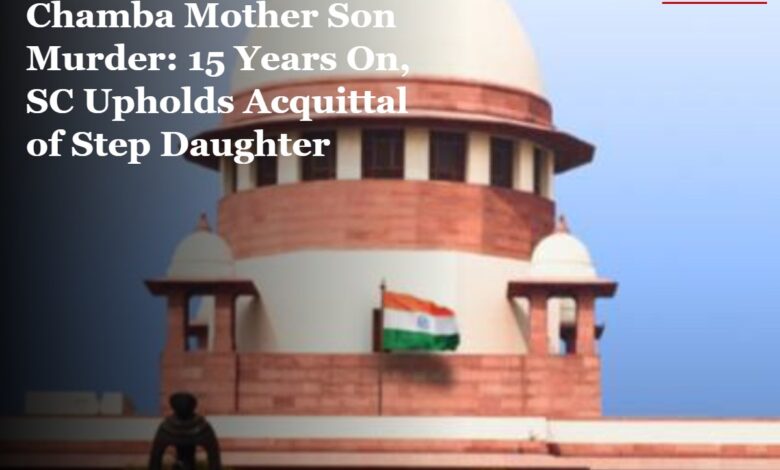
Chamba Mother Son Murder: Supreme Court upholds acquittal, flags lapses in Himachal Police probe into the 2011 killing of a mother and her minor son.
North Desk Correspondent
New Delhi/Shimla, October 14
Fifteen years after a widow and her young son were found strangled inside their locked home in Diur, Chamba, the Supreme Court has closed the last door on the prosecution’s case. In a judgment last week, a bench of Justices Manoj Misra and Vijay Bishnoi dismissed the Himachal Pradesh government’s appeal and upheld the High Court’s acquittal of Anchla alias Chanchla, the step-daughter of the dead woman’s late husband, who had been convicted of both murders by a Chamba sessions court in 2012.
The ruling is a verdict on the investigation as much as on the accused. Over 60 pages, the Court recorded what it called a series of investigational lapses, and held that none of the circumstances relied on by the prosecution was proved beyond reasonable doubt or formed a complete chain.
Chamba Mother Son Murder: The Court on the police
Chamba Mother Son Murder: The bench’s sharpest observations concern two prosecution witnesses, a Chamba taxi driver and a hotel worker, whose accounts placed the accused at Diur on the evening of August 31, 2011 and back in Chamba after midnight with a bleeding thumb.
The Court noted that the investigating officer gave no explanation of what led him to record their statements and, “despite repeated questions”, did not state the dates on which they were recorded. It reiterated that an investigating officer’s role “is to collect evidence and not to create one”, and held that the lack of explanation was enough to treat the two as witnesses “set up to create evidence for constituting a chain of circumstances”. The taxi driver, it noted, said police called him to the station about 9-10 days later, after the accused was already in custody.
Other gaps recorded by the Court
Chamba Mother Son Murder: Call records: The Call Detail Records of the dead woman’s phone and the accused’s phone carried no tower locations. The Court called their non-collection “a serious investigational lapse”, saying they could have shown whether the two phones were ever together and whether the dead woman’s phone was active after August 31. The CDR of the dead woman’s phone was never even exhibited, which the Court said creates an impression that the prosecution was “suppressing vital information”.
The lock and the keys: The prosecution said the house was found locked and the lock had to be broken. The Court held it was not established that the lock produced in court, against which a bunch of keys recovered at the accused’s instance was tested, was the one on the door’s latch. The seizure witness said the lock was “on the handle of the door”.
The mobile phone: The recovery of the dead woman’s phone, without a SIM, from the accused’s house was held doubtful, partly because the complete CDR and tower data were not produced.
The forensic trail: Palm-print photographs were sent to the Fingerprint Bureau in Shimla, but no report was produced and no explanation given. No member of the forensic team that collected the articles from the room was examined. No control sample from the cabinet was sent for testing. The Court also found it puzzling that blood stains on all other articles had degraded while one stain on a trunk or cabinet yielded a full DNA profile.
The arrest date: The arrest memo says September 10, 2011. The investigating officer deposed to September 11. The accused says September 9.
The DNA match
Chamba Mother Son Murder: The Court accepted the forensic report, since the scientific expert was never called for cross-examination and the defence had not shown the seals were tampered with. The blood from the trunk matched the accused’s DNA profile. But it held that this shows only that she was present in the room at some point. The prosecution’s own case was that she visited the house regularly. Her blood was not found on the clothes of the dead or on any cloth that might have been used to strangle them.
The father’s testimony
Chamba Mother Son Murder: The “last seen” circumstance rested on the dead woman’s father, Bhagi Ram, who reported the matter on September 7, 2011. The Court found his account could not be safely relied on alone. It noted that in court he said he saw the accused talking to the boy, which was absent from his earlier police statement, and that he did not report his daughter missing for 6-7 days despite living and running a shop nearby.
The Court said the explanation, that he thought she had gone on a pilgrimage to Mani Mahesh, was never tested by the police.
The medical evidence did not fix the time of death either. The autopsy on September 8 put death at 5-7 days earlier, so the Court said death after the night of August 31 was not ruled out.
Motive
The prosecution alleged the accused killed to take back property her father had bequeathed to the boy. The Court said no evidence of such a bequest was led. It also noted that her father had left five daughters from his first marriage, so she would not have been the sole beneficiary.
The case, from the beginning
Chamba Mother Son Murder: On September 7, 2011, Bhagi Ram told police that his daughter Mithilesh Kumari had been missing for 6-7 days, her house locked and a foul smell coming from it. Police entered and found two bodies: Mithilesh Kumari and her minor son, Bhupinder Singh. The autopsy found both died of asphyxia due to strangulation, and held the deaths homicidal. Mithilesh was the second wife of the late Amar Singh. Anchla is the daughter of his first wife.
The Chamba sessions court convicted Anchla under Section 302 IPC on November 7, 2012, finding the circumstances formed a chain pointing only to her guilt. The Himachal Pradesh High Court at Shimla reversed this on July 28, 2014, doubting the key witnesses and the lock evidence. The State appealed to the Supreme Court, which was decided last week.
The Supreme Court also set out the settled limits on interfering with an acquittal: it will intervene where the High Court’s view is perverse or ignores vital evidence, not merely because another view is possible. It found no such perversity here. It also restated the five-fold test for circumstantial cases, that the chain must be so complete as to leave no reasonable ground consistent with innocence.
Questions that remain
Chamba Mother Son Murder: The High Court had observed that the presence of third parties in the village around the time ought to have been thoroughly investigated, after the father’s family spoke of two men asking about the dead woman’s property days before the killings. The judgment does not indicate that any such inquiry followed.
With the accused acquitted, the record leaves open who was responsible for the deaths of Mithilesh Kumari and Bhupinder.
ALSO: Who Was Parvinder Singh Jhota? Anti-Drug Crusader Shot Dead on Camera
ALSO: Sonic Boom in Patiala: Explosion-Like Bang Sparks Late-Night Panic
Follow North Desk on WhatsApp for the latest from Punjab, Haryana and Himachal Pradesh: https://whatsapp.com/channel/0029Vb7ccdxJENy2H87DBG3E