NSE IPO Opens Amid Hype, But Falling GMP Raises Questions Over Listing Gains
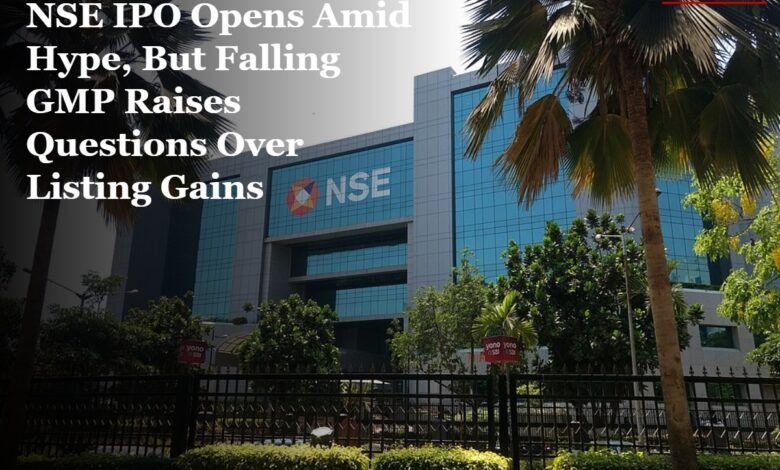
NSE IPO GMP: IPO opened last week and closes Monday amid heavy hype, but GMP has fallen sharply from its peak–in fact it’s at its lowest Monday mirning. A look at the numbers, the anchor book cut, and NSE’s FY26 financials.
By North Desk Bureau
NSE IPO GMP: Ahead of the National Stock Exchange’s much-awaited stock market debut, the grey market premium (GMP) that had fuelled expectations of a blockbuster listing has cooled sharply in the days leading up to the issue opening — even as the exchange’s own management describes investor demand as “unexpectedly large.”
The Rs 22,561.57 crore initial public offering opens for subscription on September 17 and closes on September 21, with allotment expected on September 22 and listing on the BSE tentatively set for September 24. The price band has been fixed at Rs 1,700 to Rs 1,785 per share, with a lot size of eight shares — meaning retail investors will need a minimum of Rs 14,280 to apply at the upper end.
The issue is entirely an Offer for Sale (OFS) of up to 12.64 crore equity shares by existing shareholders, including State Bank of India, Canada Pension Plan Investment Board, Aranda Investments (Mauritius), MS Strategic (Mauritius) Limited, New India Assurance, Bank of Baroda and General Insurance Corporation of India. Since there is no fresh issue component, NSE itself will not receive any proceeds from the IPO — the money goes entirely to the selling shareholders. The offer reserves up to 50 percent for qualified institutional buyers, at least 35 percent for retail investors, and the remaining 15 percent for non-institutional investors.
LIVE NSE GMP: At 10 am on September 21–the last date to apply–GMP is hovering around 2 to 3%
Around noon on September 19, GMP hovered around 5%
At 10 am on Friday, September 18, GMP was 7.96%.
On 17 September at 10 am, GMP was 7%, according to Investorgain
ALSO: The IPO That Cut Your Wealth in Half
NSE IPO GMP: What the GMP has actually done
NSE IPO GMP: Grey market premium — an unofficial, unregulated indicator of how IPO shares are trading in over-the-counter deals before listing — had touched a high of around Rs 310-320 in the days following SEBI’s final clearance for the issue around September 4-5.
Since then, tracked GMP quotes have shown a marked decline: down to roughly Rs 192 by September 10, a brief recovery to around Rs 218-220 on September 11, before falling further to Rs 160 on September 15 and around Rs 145 on the morning of September 16 — a drop of roughly 33.5 percent between September 11 and September 16 alone, according to figures compiled by market trackers.
By afternoon on September 16, some trackers were showing a partial recovery to the Rs 165-198 range, implying an indicative listing price of roughly Rs 1,950-1,983 — a premium of around 9-11 percent over the upper price band, against the far steeper gains the market had been pricing in earlier in the month.
Market watchers have attributed the cooling to a mix of factors: broader weakness in secondary-market sentiment, the start of the lock-in period for pre-IPO investors, and reassessment of valuation as the actual price band was set. It is important to note that GMP is not regulated by SEBI, operates entirely outside the formal market, and is not a guarantee of the eventual listing price — it can and does move significantly between now and the day shares actually list.
Anchor book trimmed despite “unexpectedly large” demand
NSE IPO GMP: The anchor investor bidding took place on September 16, a day ahead of the public issue opening. NSE’s Managing Director and CEO Ashishkumar Chauhan said ahead of the IPO that demand for the issue had been “considerably higher than expected.”
Notably, this came even as the anchor book itself was reduced — from an earlier expected size of around Rs 9,000 crore to a final allocation reported at approximately Rs 6,250 crore. The overall OFS size was also cut earlier in the process, from an initially planned 14.9 crore shares to the current 12.64 crore shares, which brought the total issue size down from around Rs 30,000 crore originally projected.
The financial backdrop: a profitable business with a down year
NSE’s FY26 numbers show both the scale of its business and the specific pressure it has come under. According to the Red Herring Prospectus, NSE reported total income of Rs 18,713.37 crore for the year ended March 31, 2026, against Rs 19,176.83 crore in FY25. Operating revenue for FY26 stood at Rs 16,601.31 crore, down 3.1 percent from Rs 17,140.68 crore the previous year.
Profit after tax came in at Rs 10,302.06 crore for FY26, a decline of roughly 15.5 percent from Rs 12,187.69 crore in FY25. For the quarter ended June 2026, NSE reported total income of Rs 5,252.17 crore and PAT of Rs 3,120.08 crore.
Despite the year-on-year dip, profitability metrics remain extremely high by global exchange standards — a net profit margin of around 55 percent and return on equity of roughly 33 percent. The company’s net worth stood at Rs 31,869.72 crore as of the end of FY26, up from Rs 30,165.05 crore a year earlier.
The FY26 decline has been attributed primarily to SEBI’s tightening of derivatives market rules — including true-to-label charges, a cut to a single weekly index expiry, and larger contract lot sizes — which cooled trading volumes in equity options.
This matters for NSE’s business model because options trading alone is reported to have contributed around 60 percent of FY26 operating revenue, with transaction charges overall accounting for close to 79 percent of operating revenue. That concentration means NSE’s earnings remain closely tied to the regulatory environment around derivatives trading, and to trading volumes more broadly.
On valuation, at the upper end of the price band NSE’s implied market capitalisation works out to roughly Rs 4.4 lakh crore, translating to a price-to-earnings multiple in the mid-40s on FY26 earnings — figures that market commentary has compared to rival BSE Ltd, which trades at a somewhat higher P/E of around 48 but with a market capitalisation roughly a third of NSE’s implied size.
As of June 30, 2026, NSE reported 13.237 crore unique registered investors and 26.136 crore registered investor accounts, along with 3,005 listed entities and over 1,300 trading members on its platform.
READ ALSO: The IPO That Cut Your Wealth in Half
The caveat
NSE IPO GMP: Brokerages including SAMCO Securities have issued “Subscribe” ratings on the issue, citing NSE’s market dominance — it commands close to 93 percent of India’s cash-market turnover — high profitability, and long-term growth potential.
At the same time, analysts tracking the GMP trend have flagged that a sustained premium above Rs 200 would signal continued expectation of a strong listing, while the sharper declines seen through mid-September point to cooling sentiment.
Neither reading, analysts caution, should be treated as a forecast: GMP reflects informal grey-market sentiment at a given moment, not an assured outcome, and actual listing-day performance will depend on subscription numbers once bidding opens, along with broader market conditions on the day.
ALSO: The Great IPO Rush of September: Why 11 Companies Are Racing to List in One Week
ALSO: One IPO’s GMP Is Soaring, Another Is Sinking Money — And More Are Lining Up This Week
Follow North Desk on WhatsApp for the latest from Punjab, Haryana and Himachal Pradesh: https://whatsapp.com/channel/0029Vb7ccdxJENy2H87DBG3E