How a Death Penalty Case Collapsed: Inside the HC's Acquittal in the Sonipat Sisters' Rape-Murder Case
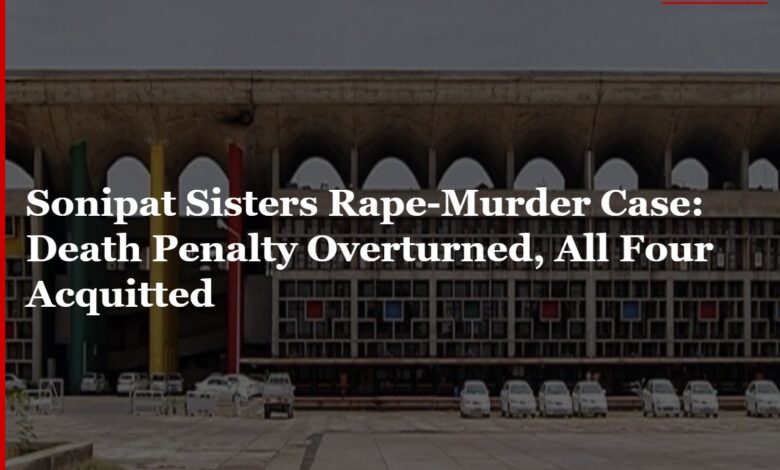
Punjab & Haryana High Court acquits four men on death row in the Sonipat sisters’ rape-murder case, citing contradictory testimony, a fabricated poison-bottle recovery, and DNA that matched none of the accused.
North Desk Correspondent
Chandigarh, August 27
On the morning of August 6, 2021, two minor sisters — aged 12 and 13, referred to by the Punjab and Haryana High Court as “Laado” and “Laadli” — were rushed to a Delhi hospital. Their mother told doctors a snake had bitten them at midnight. Both children died within hours of each other.
Three days later, that same mother filed a second complaint with a different version entirely: four men from the neighbouring rented rooms, she said, had gagged her, raped both her daughters, and force-fed them poison when the girls threatened to go to the police. An FIR followed. Four men — Arun, Phool Chand, Dukhan, and Ram Suhag — were arrested within a day.
By November 2023, a Sonipat trial court had convicted all four and sentenced them to death. On August 26, 2026, the High Court set aside every conviction and ordered their release. Here is why.
The mother told four different stories
The prosecution’s case rested almost entirely on the testimony of the victims’ mother. But her own statements didn’t hold together:
To the hospital and in her first police statement (Aug 6): snakebite, no allegation against anyone.
In her second complaint two days later (Aug 9): she named all four accused and described who raped whom.
Before a magistrate the very next day, under oath (Aug 10): she said she didn’t know any of the accused by name — except someone called “Sattu,” a name that doesn’t match any of the four men.
In court, during the trial: she denied making either of her written statements, denied knowing the accused, and refused to identify any of them over video link.
The High Court’s question is blunt: if she knew all four names by August 9, how could she not know them by August 10? Nobody — not the investigator, not the prosecution — ever explained who actually wrote either of her complaints; she only put her thumb impression on them.
A poison bottle that was already in police custody
Sonipat Sisters Rape-Murder Case: The forensic team’s own crime-scene report (dated August 11) recorded that a metal container of poison had already been seized by the investigating officer before their visit. Yet the accused’s “disclosure statements” — dated a day later, on August 12 — describe them voluntarily revealing the location of a poison bottle, which the police then “recovered.” The container also changes description, from metallic in the crime-scene report to plastic in the recovery memo.
Under Indian evidence law, a disclosure can only lead to a fresh discovery — something the police didn’t already know. Here, the fact was already on record before the accused supposedly disclosed it. The court called the entire disclosure trail on the poison fabricated.
Sonipat Sisters Rape-Murder Case: DNA that didn’t match anyone
Sonipat Sisters Rape-Murder Case: The FSL report was unambiguous: DNA from vaginal swabs of both victims and from a cloth (“parna”) allegedly used to gag the girls could not be matched to any of the four accused. The only DNA of female origin found on a separate recovered item didn’t help build a case against the men either.
Confessions that don’t add up
Of the four accused, only two mentioned the cloth in their individual disclosure statements — yet all four were shown “jointly” leading police to recover it, which the court said doesn’t meet the legal threshold. Medical examination of all four accused, conducted days after the alleged assault, found no fresh injuries — undercutting the trial court’s finding that the men bore injuries from the victims’ resistance. The marks the trial judge cited were, per the doctor’s own testimony, old scars.
Sonipat Sisters Rape-Murder Case: One of the four, Ram Suhag, had claimed throughout the trial that he was a minor at the time — 13 years old, per his Aadhaar card and school records. His plea challenging that rejection sat pending before the High Court for over a year, with the state’s response arriving roughly a year late, while he was tried, convicted, and sentenced to death as an adult. That petition was disposed of separately alongside this judgment.
The acquittal also leaves an unresolved question sitting under it: forensic evidence conclusively shows both girls were raped and died of poisoning. Nobody has now been held responsible for either.
ALSO: Hisar Trafficking Case: HC Warns SP, IO of Contempt Over ₹5 Lakh Bribe Bid
Follow North Desk on WhatsApp for the latest from Punjab, Haryana and Himachal Pradesh: https://whatsapp.com/channel/0029Vb7ccdxJENy2H87DBG3E




2 Comments