SKM Black Day April 1 2026: Farmers Back Workers Against Four Labour Codes — What the Protest Is About
North Desk Bureau
Chandigarh, April 1
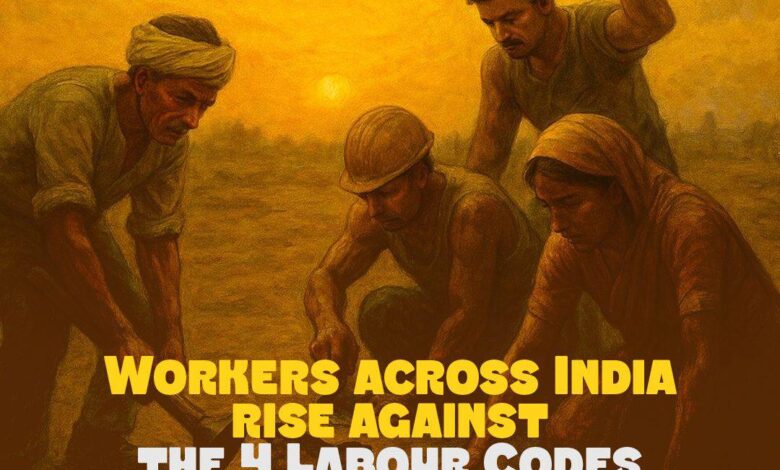
April 1 — the first day of the new financial year — will be observed as a Black Day across workplaces in India, with trade unions and the Samyukt Kisan Morcha (SKM) joining hands in protest against the four Labour Codes that the Modi government notified last November. The farmers’ body, which led the historic 2020-21 agitation against three farm laws, is lending its full weight to a workers’ movement that has been building since the codes came into force.
What is the Black Day about?
The platform of Central Trade Unions and Independent Sectoral Federations called upon workers to observe April 1, 2026 as a Black Day — the day prior to which the Union government declared as the date for notifying the Central rules for implementation of the four Labour Codes. The protest is to be observed in different formats including black badges and bands at workplaces, lunch-hour demonstrations, protest dharnas, and cycle or motorcycle jathas.
The timing is deliberate. The four Labour Codes came into force on November 21, 2025, absorbing and repealing 29 existing central labour laws. Critics argue the codes, while dressed up as reform, systematically strip workers of rights won over 150 years of organised struggle.
What are the four Labour Codes?
The government consolidated a patchwork of 29 labour statutes into four umbrella codes: the Code on Wages (2019), the Industrial Relations Code (2020), the Code on Social Security (2020), and the Occupational Safety, Health and Working Conditions Code (2020).
On paper, the government’s stated benefits include minimum wages for all workers, social security for gig workers, and equal pay for equal work. The government claimed every worker would get the right to timely wage payment, no unauthorised wage deductions, and no wage ceiling restrictions, while fixed-term employees would receive all benefits equal to permanent workers including leave, medical, and social security.
But trade unions and farmer bodies are not buying it.
Why are workers and farmers so angry?
The sharpest bone of contention is the Industrial Relations Code. It raises the threshold for standing orders from establishments with 100 workers to those with 300, meaning only companies above that size need government permission before layoffs, retrenchments, or closures. According to the Annual Survey of Industries, this exempts over 90% of India’s industrial units from scrutiny, effectively allowing employers to retrench workers at will.
Opponents to the code says it also imposes stricter regulations on strikes, requiring a 60-day notice and prohibiting strikes during the pendency of tribunal proceedings — conditions they say make the right to strike nearly meaningless in practice.
Then they point to the issue of fixed-term employment. Section 2(o) of the IR Code gives statutory recognition to fixed-term employment, allowing employers to hire workers for specific durations for any work — including core perennial tasks — and renew contracts repeatedly without committing to permanent tenure. Unions dismiss this as institutionalising contractualisation.
The codes emerge from a contentious legislative history, passed amid political turmoil and without tripartite consultations. The Indian Labour Conference — the apex mechanism where government, employers and workers deliberated policy — has not convened since 2015.
SKM’s angle: It’s about reservation, not just wages
The Samyukt Kisan Morcha’s statement to the media raises a point that goes beyond wages — reservation. The SKM argues that as contract-based employment becomes the dominant mode of recruitment, employers are effectively exempted from obligations to provide jobs to Scheduled Castes, Scheduled Tribes, OBCs, and minorities. With contractualisation legalised and promoted, the reservation framework — a constitutional guarantee — becomes hollow in practice.
The Central Trade Unions reminded workers that they had successfully built a resistance against the codes, including making the February 12 general strike a grand success, and called for preparedness for longer struggles ahead. Trade union leaders claimed nearly 30 crore workers participated in the February 12 Bharat Bandh, though the government disputed those figures.
The broader alliance: Farmers, workers, and opposition
This is not the first time SKM has walked shoulder-to-shoulder with trade unions. SKM and the Central Trade Unions jointly organised a National Day of Resistance on January 16 to oppose what they called a neoliberal assault on workers and farmers, pledging to resist the four labour codes, the Electricity Amendment Bill 2025, the Seeds Bill 2025, and the repeal of MGNREGA.
Farmer unions under SKM also called the interim India-US trade framework a direct threat to Indian agriculture, dairy, and rural livelihoods, arguing the framework contradicted repeated assurances by Commerce Minister Piyush Goyal that agriculture and dairy would be kept outside Free Trade Agreements.
Congress leader Rahul Gandhi extended his support to the February strike, writing that workers fear the four labour codes will weaken their rights while farmers believe the trade agreement will hurt their livelihoods. Punjab’s ruling Aam Aadmi Party also condemned the BJP-led Union government’s “anti-worker labour policies and anti-farmer economic decisions,” announcing its cadres would join the shutdown.
Not all unions are aligned, however. The National Front of Indian Trade Unions (NFITU) declined to join the protests, calling the action politically motivated and saying it had already submitted suggestions to the government and met the Union Labour Minister.
What happens next?
The SKM says this is not a one-day protest. The body has appealed to farmers, workers, and marginalised communities across India to gear up for a sustained pan-India struggle until the Labour Codes are repealed. Among the SKM’s other active demands are a law guaranteeing procurement of all crops at MSP based on the Swaminathan Commission’s C2+50% formula, withdrawal of the Electricity Amendment Bill 2025, restoration of MGNREGA, and scrapping of the New Seed Bill 2025. The farmer-worker alliance that first took shape at the borders of Delhi in 2020-21 signals that April 1 is not the end of anything, but the beginning of a longer fight