Liquor Langar Case: What Is the Maximum Punishment for Serving Alcohol Openly in Public?
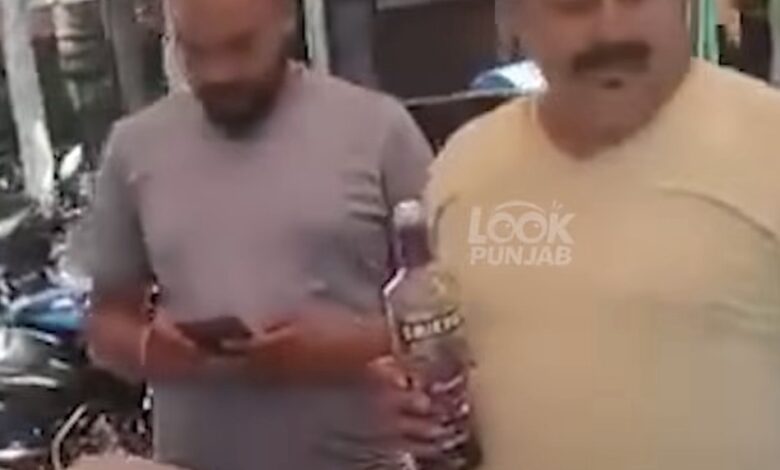
Liquor langar case: Chandigarh’s Sector 9 ‘liquor langar’ ends in arrest. Here’s what the Punjab Excise Act and BNS actually say about punishment — and why the answer may surprise you.
North Desk Correspondent
Chandigarh, May 25
A viral video. A vodka bottle poured over snow cones. An open-air crowd in Sector 9. And now, an FIR, an arrest, and a night in the lock-up.
The story of Rajesh Sachdeva — the 53-year-old proprietor of Liquor World wine shop in Sector 9, Chandigarh — and his now-infamous ‘liquor langar’ has gripped social media since the weekend. But the question many are now asking is a simple one: what can the law actually do to him?
The answer, as it turns out, is more complicated — and more revealing — than most people would expect.
Liquor langar case: WHAT THE FIR SAYS
Chandigarh Police have registered an FIR on the complaint of a police constable against Sachdeva under two provisions:
— Section 68 read with Section 1 of the Punjab Excise Act, 1914; and — Section 61(2) of the Bharatiya Nyaya Sanhita (BNS), 2023.
The allegation is that on May 23, 2026, Smirnoff Minty Jamun Flavoured Vodka was mixed into ice rolls — the snow cone-type treats now sold ubiquitously across North India — and served openly to the public outside his licensed premises at Sector 9 market.
Sachdeva was arrested and lodged in the police lock-up. Investigation is ongoing.
CHARGE ONE: SECTION 68 OF THE PUNJAB EXCISE ACT, 1914
This is the older of the two charges, and — here is where the story gets uncomfortable for those expecting a stern outcome — it is also the weaker one on paper.
Section 68 of the Punjab Excise Act is the law’s catch-all provision. It covers any act or omission that violates the provisions of the Act but is not specifically covered by any other section. And its maximum penalty? A fine of two hundred rupees.
That is not a typo. The base penal provision in one of India’s oldest excise laws, enacted in 1914 and not meaningfully revised in this regard, caps punishment for general violations at ₹200.
In practice, the police have cited it in shorthand as “68/1/14” — meaning Section 68 of Punjab Act 1 of 1914 — which is standard notation in Chandigarh and Punjab courts and simply identifies the parent statute, not additional sections.
The more consequential provision within the same Act is Section 61(1), which deals specifically with unlawful import, export, transport, manufacture, and possession of liquor, and carries a maximum sentence of three years’ imprisonment plus fine. Whether police choose to invoke Section 61(1) of the Excise Act in the chargesheet — as opposed to the current catch-all Section 68 — will be a key watch point as investigation progresses. That decision rests with the investigating officer and, ultimately, the prosecution.
CHARGE TWO: SECTION 61(2) OF THE BNS
The second charge in the liquor langar case— criminal conspiracy under the Bharatiya Nyaya Sanhita — is the more legally interesting one, and it explains why police have gone beyond the Excise Act alone.
Section 61(2) of the BNS defines criminal conspiracy as an agreement between two or more persons to do an illegal act, or to do a legal act through illegal means. Its application here rests on the fact that the ‘liquor langar’ was not a spontaneous act by one man with a bottle. It was, according to police, an organised promotional activity — a brand activation — involving at minimum the shop owner and a representative of a private company.
The full text of the relevant provision reads: a party to a criminal conspiracy, “other than a criminal conspiracy to commit an offence punishable with death, imprisonment for life or rigorous imprisonment for a term of two years or upwards, shall be punished with imprisonment of either description for a term not exceeding six months, or with fine or with both.”
Translated: since the underlying excise offence (as currently charged under Section 68) does not carry rigorous imprisonment of two years or more, the conspiracy charge here attracts a maximum of six months in jail, a fine, or both.
The BNS charge in the liquor langar case is also significant for a second reason: it allows police to widen the net. The shop owner has been arrested. The brand activation company — or Smirnoff’s promotional representative — has not yet been named publicly. The criminal conspiracy provision is the legal instrument that keeps that door open.
SO WHAT IS THE ACTUAL MAXIMUM SENTENCE?
Adding the two charges together, as the case currently stands:
Excise charge (S.68, Punjab Excise Act): maximum fine of ₹200. Conspiracy charge (S.61(2), BNS): maximum six months’ imprisonment and/or fine.
Taken together, the theoretical maximum right now is six months in jail and a nominal fine — for a promotional stunt that went viral nationally and was conducted a two-minute walk from the Chandigarh Police Headquarters and the UT Secretariat.
However, the liquor langar case is not closed. If, in the final chargesheet, the Investigating Officer upgrades the excise charge to Section 61(1) of the Punjab Excise Act — which explicitly covers unlawful possession and sale and carries up to three years in prison — the picture changes significantly. That decision will hinge on what the investigation reveals about whether the branded liquor was dispensed outside the shop’s licensed premises, whether proper stock records were maintained, and whether the promotional activity constituted an unlicensed sale of alcohol.
THE BAIL QUESTION
Regardless of which sections ultimately apply, both the Excise Act and the conspiracy charge in the liquor langar case as currently framed involve bailable offences. Section 72 of the Punjab Excise Act explicitly makes most violations under the Act bailable. Similarly, a BNS Section 61(2)(b) conspiracy — tied to an underlying offence that does not carry two years’ rigorous imprisonment — is bailable by definition.
In plain terms: Sachdeva can apply for bail as a matter of right, not discretion. He is not required to persuade a court. The question is only the terms.
THE COMPOUNDING OPTION
There is one further avenue that rarely makes news but is written into the law itself. Section 80 of the Punjab Excise Act empowers the Collector (senior excise officer) to compound offences under Sections 62, 65 and 68 of the Act — meaning the accused can simply pay a sum of money to the Collector, have the case closed, and walk away without a criminal conviction. Whether the administration chooses to exercise this option, or whether public outrage makes it politically untenable, is another question.
ALSO: LIQUOR LANGAR!: Chandigarh’s Sector 9 Gets a ‘Liquor Langar’ — and a Rude Awakening
Follow North Desk on WhatsApp for the latest from Punjab, Haryana and Himachal Pradesh: https://whatsapp.com/channel/0029Vb7ccdxJENy2H87DBG3E




One Comment