Punjab Truth Commission Explained: What It Is, Who Wants It, Why Now
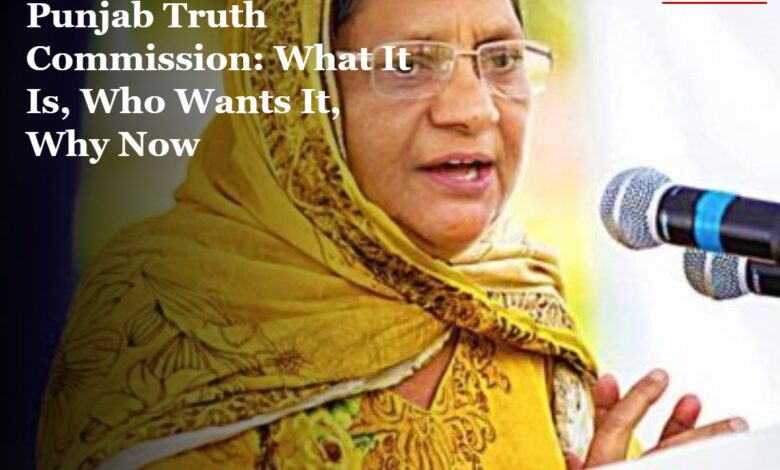
Punjab Truth Commission: A Truth, Accountability & Reconciliation Commission for Punjab is suddenly being demanded by three different groups. What is it, who’s asking, who’s promised one before, and what’s stopping it — explained.
North Desk Correspondent
Chandigarh, July 14
What exactly is a “Truth Commission”?
Punjab truth commission or just a Truth Commission— sometimes called a Truth and Reconciliation Commission (TRC) — is a body set up to investigate and publicly document a period of past state violence or civil conflict, without necessarily prosecuting anyone. It’s distinct from a criminal trial or even a standard judicial commission of inquiry: its output is usually a public fact-finding report, not convictions. The model traces to South Africa’s post-apartheid TRC in the 1990s, and has since been used in Argentina, Chile, Rwanda, Sierra Leone, Canada, and several other countries recovering from periods of internal conflict or systemic abuse.
Why is Punjab Truth Commission suddenly a live issue in Punjab?
Punjab Truth Commission: This week’s renewed demand isn’t a new idea reaching Delhi for the first time; it’s Punjab returning, for the third documented time since 1996, to a promise that has never once been kept, by any party that has held power in the state since.
It’s riding entirely on the Satluj/Punjab 95 controversy. The film’s release and abrupt removal from ZEE5 in early July reopened public debate over the 1980s–90s militancy period, and within two weeks, three separate constituencies have each called for some version of a truth-telling commission — each with a different idea of what it should cover.
READ ALSO: 5 Panthic Groups to Centre — Release Punjab 95 Uncut, Find The Missing DSP
Who exactly has raised the demand; is it just the five Panthic groups?
No, it’s actually three separate calls, and they don’t agree on scope:
Five Panthic organisations (Shiromani Akali Dal Punarsurjit, United Akali Dal, International Panthic Dal, Begampura Khalsa Raj Party, Panthic Azad Group) submitting memorandums to the Union Home Minister on July 14, demanding a “Punjab Truth, Accountability & Reconciliation Commission” covering 1982 (start of the Dharam Yudh Morcha) to 1995 (Khalra’s disappearance), framed around police excesses against the Sikh community.
Paramjit Kaur Khalra, Jaswant Singh Khalra’s widow, has separately asked Akal Takht Jathedar Giani Kuldeep Singh Gargaj to constitute a “People’s Commission” to establish the actual numbers of enforced disappearances, unidentified bodies, and alleged fake encounters from 1984 through the militancy years, a religious-body-led commission rather than a government one.
Her appeal is timed to a separate Akal Takht-called congregation at Harike Pattan, also on July 14, a different event from the Panthic groups’ memorandum submission, though both are landing on the same date.
The All India Terrorist Victims’ Association, representing families who lost relatives to militant violence in the same period, wants a Truth, Accountability and Reconciliation Commission of its own — but one documenting the “other side”: civilians killed by militants, and what it says are undelivered rehabilitation promises to those families.
So there are effectively three demands using overlapping language, pointed at three different bodies (Union Home Ministry, Akal Takht, and — implicitly — the Centre again), asking for three different historical accountings.
Has anyone in government actually promised this?
Punjab Truth Commission: Yes — and this is the promise every current demand is being measured against. Ahead of the February 1997 Punjab assembly election, the Shiromani Akali Dal–BJP alliance’s manifesto explicitly promised a special commission of inquiry, headed by a retired judge, to probe the causes of Punjab militancy and police excesses since 1980. Separately, and more specifically, the Akali Dal’s own 1996 campaign promise (invoked again this week by AAP’s Baltej Pannu and referenced in a widely circulated statement from Khalra’s widow, Paramjit Kaur) was to set up a “Truth Commission” naming and prosecuting the officers responsible for the illegal disappearances and killings of Punjabi youth during the militancy years.
Parkash Singh Badal became Chief Minister in March 1997. The Punjab Truth Commission was never constituted. According to Paramjit Kaur Khalra’s own account, when the family sought Badal’s help after Jaswant Singh Khalra’s disappearance, he advised them to focus on their children’s education instead. Several officers named in rights groups’ documentation were promoted rather than investigated during Badal’s tenure. Independent human rights reporting from that period, including Amnesty International, recorded the promise as one of several unmet commitments (alongside repeal of TADA cases and police accountability measures) made by the incoming 1997 government.
The Punjab Truth Commission promise’s failure to materialize is also what produced India’s one real non-state precedent: with no government commission forthcoming, the World Sikh Council, led by retired Supreme Court judge Justice Kuldip Singh, announced its own “People’s Commission” in 1998 to probe both militant and state atrocities during the period: a civil-society body with no statutory power, but the direct ancestor of the kind of Akal Takht-anchored “People’s Commission” Paramjit Kaur Khalra is now asking Jathedar Giani Kuldeep Singh Gargaj to convene.
So the honest answer is: a Truth Commission for Punjab has been promised once, by the very Akali Dal that Giani Harpreet Singh’s breakaway faction descends from politically — and broken once, nearly thirty years ago. That history is precisely why AAP’s media handlers are using it now to deflect the current demand back onto SAD, and precisely why it belongs in this story rather than as a footnote.
What are the practical hurdles to actually setting one up?
Punjab Truth Commission: Several. There’s no dedicated legal framework in India for a TRC: it would have to be built either as a government-notified commission of inquiry (which has real but limited legal powers) or as a non-statutory body with only moral authority, like the SGPC-anchored “People’s Commission” Paramjit Kaur Khalra is proposing. Second, jurisdiction is contested — the Panthic groups are petitioning the Centre, while the Paramjit Khalra’s proposal goes through the Akal Takht, a religious rather than governmental authority. Third, and most immediately visible in this week’s news: the scope fight. Any commission covering “the militancy period” runs straight into the same dispute playing out over Satluj itself — whether the story to be told is state excess against Sikhs, militant violence against civilians, or, as most historians would frame it, both at once. Union minister Ravneet Singh Bittu’s public challenge to the Satluj filmmakers to produce documentary evidence for their claims is effectively a preview of the evidentiary fight any commission would have to referee before it could write a single finding.
| Year | Event |
| 1996 | Akali Dal manifesto promises a Truth Commission to prosecute officers behind militancy-era disappearances |
| March 1997 | Badal becomes CM; commission never constituted; some named officers promoted |
| 1998 | World Sikh Council (Justice Kuldip Singh) launches independent “People’s Commission” — no statutory power |
| 2015–17 | Bargari sacrilege case — Congress promises justice in 2017 manifesto; largely unfulfilled (separate but parallel pattern) |
| 2017 | Dr Dharam Vira Gandhi’s private member’s bill for a Punjab Truth, Justice and Reconciliation Commission — doesn’t pass |
| 2023 | Justice Sanjay Kishan Kaul recommends a truth and reconciliation mechanism for J&K in the Article 370 verdict — different region, cited as precedent |
| July 2026 | Three fresh, competing demands: five Panthic groups (to MHA), Paramjit Kaur Khalra (to Akal Takht), All India Terrorist Victims’ Association (to Centre) |
Follow North Desk on WhatsApp for the latest from Punjab, Haryana and Himachal Pradesh: https://whatsapp.com/channel/0029Vb7ccdxJENy2H87DBG3E
KHALRA FILES on North DESK:
READ ALSO: The DSP Convicted For Killing Khalra Cannot Be Found At His Address
READ ALSO: Jaswant Singh Khalra Had Named His ‘Killer’ To An Ex-Judge Before Abduction
READ ALSO: Cops Disposed Of Jaswant Singh Khalra’s Body. Then They Had Whisky, Dinner
READ ALSO: The Cop Who Fed Khalra His Last Meals…And Whose Words Convicted His Killers
READ ALSO: Three Of Khalra’s Convicted Killers Are Out On Bail Right Now — Here’s Why
READ ALSO: Jailed in Same Cell Who Saw Everything–The Story of Khalra Witness Kulwant Singh


3 Comments