Diljit Dosanjh’s Satluj: Here’s what Jaswant Singh Khalra Film Shows — in 10 points
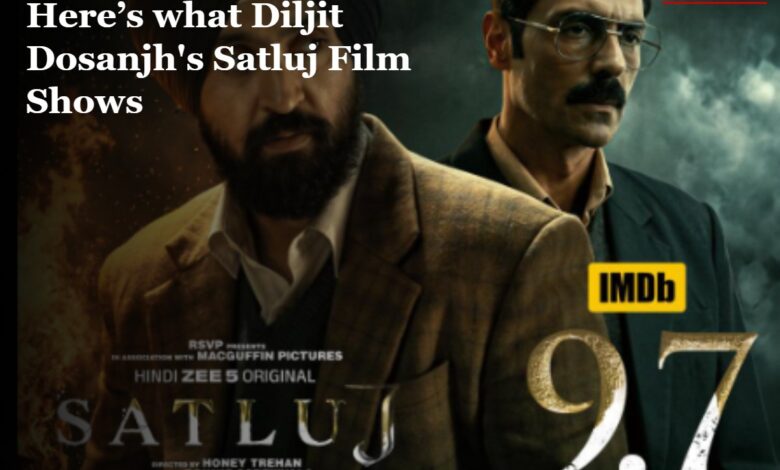
Diljit Dosanjh’s Satluj film on Jaswant Singh Khalra, vanished from ZEE5 within 48 hours. A bit like Punjab’s disappeared. Here’s the film vs the real case, fact by fact.
Arvind Chhabra
Chandigarh, July 6
Diljit Dosanjh’s Satluj film has disappeared. It’s not a metaphor. The Diljit Dosanjh film about Jaswant Singh Khalra, the man who spent his life trying to account for Punjab’s disappeared, was itself pulled off ZEE5 within 48 hours of release. No reason was given. It’s an irony the film’s own subject would have recognised immediately: in Khalra’s Punjab, things and people vanished, and nobody explained why.
North Desk watched Satluj in the window it was available, to see for ourselves what the censor board spent three years and 127 cut demands trying to soften, and what, if anything, in the finished film explains why it was pulled off Indian screens within 48 hours of release.
What the film shows: 10 points
- Diljit Dosanjh’s Satluj film opens with a night sequence that starts almost casually: a group of Punjab Police constables, having been drinking, are shown disposing of bodies from a staged encounter. One of them, getting married, wants a promotion; his fiancée has told him she’ll marry him only once he makes inspector. Moments later, a senior officer shoots a woman dead in front of him (she turns out to be the mother of someone who had already “disappeared”). The killing is folded into his promotion track without a second thought.
- The pattern recurs through the film. Families who ask questions about the missing become targets themselves. In one instance, an entire family — mother and wife included — is wiped out and the killings are logged as a genuine encounter. The film is direct about the mechanics: police vehicles moving silently through empty roads at night, become a visual refrain for violence carried out where no one is watching.
- Jaswant Singh (Dosanjh), a bank officer, is pulled into the story searching for a friend’s missing mother. What looks like an isolated disappearance unravels into a pattern once he starts examining cremation ground registers: bodies logged and burned as “unclaimed” without families ever being informed.
- One of the film’s quieter, more devastating scenes shows him going through these records and slowly registering just how large the numbers are. His inquiry takes him to the Rajasthan border, where residents describe bodies arriving down the river from Punjab and ask, pointedly, whether they’re expected to keep drinking that water.
- Two officers embody the institutional wall Khalra runs into. “Sugga,” a Tarn Taran SSP, carries out killings without any apparent hesitation and remorse, and is unmoved by mothers pleading for their sons and husbands. “Bitta,” the state police chief modelled on the era’s real DGP, dismisses human rights criticism by pointing to the Gulf War and the Chechen conflict, where activists were “making noise” too. At a militant surrender ceremony, he calls rights activists foreign puppets, and when pressed on the disappeared, tells reporters they haven’t vanished at all and that they’re simply working abroad in Europe.
- The Punjab Chief Minister’s (he’s named Anant Singh for CM Beant Singh’s character) assassination is shown, and some people have objected on social media to what they call is a rather ‘uplifting’ song playing in the background.
- Khalra is eventually picked up himself, held first at a police station, then moved to an abandoned godown. He’s tortured for refusing to cooperate or retract his findings, and is shown at one point being produced before the DGP directly; other officers present are sent out of the room, leaving only the SSP and the DGP alone with him. He is killed shortly after.
- A probationer SPO (Special Police Officer used to be direct recruit at a lower level) who was present through much of this (a character who later has an unusual scene talking to Jaswant’s ghost) turns CBI witness, becoming central to the eventual prosecution.
- Arjun Rampal plays the CBI officer leading the investigation into what happened to Khalra, structuring much of the film’s second half as a procedural unravelling of the cover-up. Convictions follow for the officers directly involved, but only after the CBI officer witnesses his case witnesses being eliminated or made to disappear.
- The SSP, watching the political ground shift under a new chief minister and a new DGP (with even his old patron “Bitta,” by then retired, unwilling or unable to help) dies in an apparent suicide before the case against him is complete. The DGP is never charged.
What the record shows
The real case tracks the Diljit Dosanjh’s Satluj film closely, with names changed.
Jaswant Singh Khalra was a bank manager in Amritsar who began investigating unexplained cremations after colleagues went missing during Punjab’s militancy years. Sifting through municipal records, he found logs of unidentified bodies burned by police across four districts. He alleged over 25,000 people had been illegally killed and cremated; a CBI probe would later confirm 2,097 unlawful cremations in Tarn Taran district alone. The Supreme Court and National Human Rights Commission both validated his findings.
On September 6, 1995, Khalra was abducted from outside his Amritsar home by Punjab Police personnel and taken to Jhabal police station. Witnesses later testified he was murdered between September 24 and 25. Police denied ever detaining him.
The film’s “Sugga” is drawn from Ajit Singh Sandhu, then SSP of Tarn Taran, named as the principal accused in Khalra’s abduction. Sandhu had a long record predating the Khalra case: he was separately implicated in the 1989 abduction and killing of Kuljit Singh Dhatt, and in numerous “encounter” killings later disputed by victims’ families as staged executions.
The Supreme Court ordered the Punjab government to transfer him out of Tarn Taran during the Khalra investigation; the state was slow to comply. Sandhu was arrested, released on bail, and died on May 23, 1997. He was found on a railway track, ruled a suicide by police, though a suicide note in Punjabi was recovered at the scene. Rights groups and witnesses have long disputed the suicide finding, and at least one former DGP has publicly raised doubts about whether the body was even his.
Diljit Dosanjh’s Satluj film :The film’s chief is drawn from Kanwar Pal Singh Gill, Punjab’s DGP through most of the counterinsurgency period. Witnesses named Gill as a conspirator in Khalra’s abduction. He was questioned in connection with the broader counterinsurgency campaign, but was never charged or convicted in the Khalra case.
Nine police officials were recommended for prosecution by the CBI in 1996. None were charged for a decade. In 2005, six were convicted: two received life sentences, four received seven-year terms, later enhanced to life imprisonment by the Punjab and Haryana High Court in 2007, and upheld by the Supreme Court.
READ ALSO: Diljit Dosanjh & Cockroach Janata Party: Why CJP Spokesperson is ‘Upset’ With Diljit
The disappearance that hasn’t ended
Diljit Dosanjh’s Satluj film :Sandhu is dead. Gill was never charged, and died in 2017 without ever facing prosecution in the case that named him. Six lower-ranking officers went to prison. And thirty years on, families of those who vanished during the insurgency are still waiting for confirmation of what happened to them.
Now the film that told their story has vanished too — quietly, without explanation, exactly the way Punjab’s police once made people disappear.
The disappearance of Diljit Dosanjh’s Satluj
Diljit Dosanjh’s Satluj film : Satluj began its journey in 2022 under the title Ghallughara, a historic term for the massacres of Sikhs in 1746, 1762, and 1984. The Central Board of Film Certification took six months to clear it, demanding 21 cuts and a mandated title change to Punjab ’95. Producer RSVP appealed in the Bombay High Court. Around the same time, the film was withdrawn from its planned premiere at the Toronto International Film Festival in 2023, with a source telling Variety that political considerations were behind that decision.
Over the next three years, the cut demands climbed to 127. Director Honey Trehan refused to release a compromised version. The film sat in limbo until July 3, 2026, when it finally streamed uncut on ZEE5, this time under a third title: Satluj, after the river that runs through Punjab.
Diljit had a premonition. In an Instagram Live before the release, he told fans he expected the film to be taken down within days and urged them to download it while they could. He was right. By July 5, ZEE5 had pulled Satluj from its Indian catalogue “till further notice,” citing only “current developments”. No further explanation. The film remains live on ZEE5 Global for international audiences.
Follow North Desk on WhatsApp for the latest from Punjab, Haryana and Himachal Pradesh: https://whatsapp.com/channel/0029Vb7ccdxJENy2H87DBG3E

5 Comments