Jaswant Singh Khalra Witness: The Cop Who Fed Khalra His Last Meals…And Whose Words Convicted His Killers
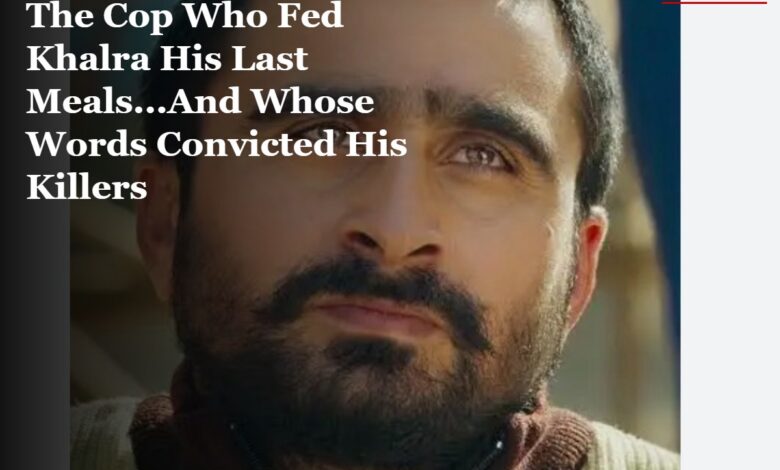
Jaswant Singh Khalra witness Kuldip Singh was a lowly SPO who served Khalra his last meals in custody — and stayed silent for years. Here’s his story, from the court and police records itself.
Arvind Chhabra
Chandigarh, July 6
Satluj has disappeared from Indian screens. But one man in its true story disappeared first — into silence, for two and a half years, while the case that would eventually convict Punjab Police officers sat waiting for him to talk.
His name was Kuldip Singh. He wasn’t a police officer in any real sense — just a Special Police Officer (SPO), a temporary, informally recruited probationer hoping to be made permanent one day. It never happened. And yet this is the man whose word the Supreme Court would later lean on to send Jaswant Singh Khalra’s killers to prison for life.
READ ALSO: Kulwant Singh: How The man Jailed On Fake Charge Became Key Witness in Khalra case
As Satluj sits pulled from ZEE5 with no explanation given, North Desk digs up old records to find him. Because his story, more than anyone’s, shows how thin the line was between this case being solved and this case disappearing along with Khalra himself.
READ ALSO: Three Of Khalra’s Convicted Killers Are Out On Bail Right Now — Here’s Why
Jaswant Singh Khalra Witness: A meal-server with a front-row seat to a killing
Jaswant Singh Khalra witness: Kuldip Singh was attached as an SPO to Satnam Singh, the SHO of Jhabal police station (remember the whole action took place in Amritsar and Tarn Taran districts of Punjab), and functioned effectively as his bodyguard. When Khalra was brought to Jhabal on September 6, 1995, it was Kuldip Singh who was assigned to serve him his meals — and told, in no uncertain terms, to keep what he saw to himself.
Over the following days, he watched Khalra deteriorate. The judgment records his account plainly: Khalra grew “weak and fragile” and bore scratch marks from repeated beatings. He described SSP Ajit Singh Sandhu and other officers arriving at the station more than once, taking Khalra into a room, and beating him while telling him to stop his activities.
According to court records, on one occasion, Khalra was taken to Sandhu’s residence in Tarn Taran, where senior officials including the then Director General of Police himself spoke to him in a closed room before he was returned to the lock-up.
READ ALSO: Punjab Truth Commission Explained: What It Is, Who Wants It, Why Now
Then came the night that ended it. Officers arrived again. They went into the room where Khalra was held. Kuldip Singh — the meal-server, the errand-runner and the lowest man in the room — was sent out to fetch hot water. As he stepped away, he heard two gunshots.
He rode in one of three vehicles that carried Khalra’s body to Harike that night, where it was thrown into the canal.
Silence, priced in survival
Jaswant Singh Khalra Witness: Here is the detail that makes his story more than a footnote: he said nothing for years. The Supreme Court’s judgment states his reasoning without softening it: he stayed silent “because of fear till Ajit Singh Sandhu, SSP, was alive,” fearing for his own life if he spoke while his superior still held power.
He didn’t come forward when the CBI first investigated in late 1995. He didn’t come forward when the chargesheet was filed against nine officers in October 1996, with Sandhu named as the principal accused.
Sandhu died in 1997, in a death recorded as suicide before he could even be formally charged. Only in March 1998 — two and a half years after Khalra’s murder — did Kuldip Singh finally give the CBI his account of what had happened inside that room.
His timing tells its own story. He wasn’t protected by rank, uniform, or institutional standing. The only thing that made speaking survivable was outliving the man he was most afraid of.
READ ALSO: Jaswant Singh Khalra Had Named His ‘Killer’ To An Ex-Judge Before Abduction
What the defence threw at him
Jaswant Singh Khalra Witness: His account did not go unchallenged. Defence counsel argued in the Court that he was an accomplice whose uncorroborated word shouldn’t stand, that he’d changed his version across statements, that he even filed a complaint alleging Khalra’s widow had paid him ₹50,000 to testify. His account of Khalra’s detention, the court itself noted, found no corroboration in any police station record or vehicle log — because the men who controlled those records were the men he was testifying against.
The Supreme Court weighed all of it and still upheld the conviction, invoking a principle it stated directly: in custodial death cases, direct evidence rarely exists because policemen “bound by the ties of brotherhood” protect their own, and courts must weigh such testimony with care rather than dismiss it for lack of corroboration.
Jaswant Singh Khalra Witness: Kuldip Singh’s account of the illegal detention, killing, and disposal of the body, the Court held, could safely be relied upon precisely because it matched the rest of the circumstantial evidence — even if imperfect on its own.
Nine officers were originally chargesheeted. Ajit Singh Sandhu escaped trial only by dying first. Of the rest, some died, one was discharged, one was acquitted on appeal — leaving five convicted, later enhanced to life imprisonment, a sentence the Supreme Court finally upheld in 2011, sixteen years after Khalra vanished. Kuldip Singh’s testimony got the case there.
Where Satluj takes a liberty
The film gives Kuldip Singh’s character a cleaner motive than the record does: the CBI officer played by Arjun Rampal offers him regularisation in the police in exchange for testifying, a tidy piece of screenwriting with a clear cause and effect.
The record is messier and more human. Kuldip Singh’s grievance over never being made permanent predates the CBI’s involvement entirely — a wound from the department itself, not a reward dangled by investigators. There’s no promise in the court records of the CBI offering him a job for his statement; if anything, the defence used his old resentment against the police to call his motives suspect, not noble. The truth isn’t a clean bargain. It’s a low-ranked man, already failed once by the institution he served, choosing years later, only after his tormentor was dead, to fail it back.
Related Stories: Khalra Body Disposal: Cops Disposed Of Jaswant Singh Khalra’s Body. Then They Had Whisky, Dinner
READ ALSO: Three Of Khalra’s Convicted Killers Are Out On Bail Right Now — Here’s Why
Kulwant Singh: How The man Jailed On Fake Charge Became Key Witness in Khalra case
Jaswant Singh Khalra Had Named His ‘Killer’ To An Ex-Judge Before Abduction
Diljit Dosanjh & Cockroach Janata Party: Why CJP Spokesperson is ‘Upset’ With Diljit
Follow North Desk on WhatsApp for the latest from Punjab, Haryana and Himachal Pradesh: https://whatsapp.com/channel/0029Vb7ccdxJENy2H87DBG3E




9 Comments