E20 Petrol Mileage Loss: 3-5% Drop or Vehicle Damage? What Car and Bike Owners Should Actually Worry About
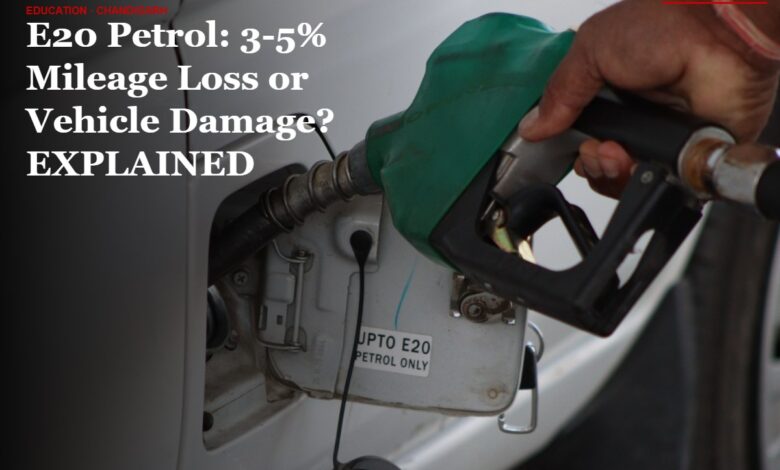
E20 Petrol Mileage Loss? E20 petrol is now mandatory at every pump in India. Government says mileage drops 3-5% with no damage; Kejriwal disputes it. Here’s what Punjab and Haryana vehicle owners need to know.
North Desk Correspondent
Chandigarh, July 12
E20 Petrol Mileage Loss? Petrol vehicle owners across Punjab and Haryana like the rest of country have a straightforward question that’s getting buried under political noise: is E20-blended fuel, now mandatory at every pump in the country, actually going to hurt their mileage or their engine?
Since April 2026, all petrol sold in India must contain 20% ethanol, meeting a minimum Research Octane Number of 95, under rules requiring BS-VI vehicles to meet E20 emission standards. There is no opt-out pump. Whether a car was bought last month or in 2018, whatever goes into the tank at a Punjab or Haryana filling station today is E20.
That mandatory shift is why the political fight over E20 (led nationally by AAP chief Arvind Kejriwal, whose Punjab unit has circulated his statements as party position) matters directly to ordinary vehicle owners, not just as a Delhi political story.
E20 Petrol Mileage Loss: The competing claims
Kejriwal visited a Delhi petrol pump and service station on July 11, telling reporters that vehicle owners he spoke to consistently reported declining mileage and mechanical complaints, and accused the government of ignoring genuine public grievances by branding critics as anti-national. In the days before that, he wrote to 29 automobile manufacturers — including separate letters to Maruti Suzuki, Toyota Kirloskar and Hero MotoCorp — asking them to reconcile a contradiction: at a government-organised press conference on July 4, representatives of those three companies said E20 was safe even for pre-2023 vehicles with only a 3-5% mileage dip, while their own owner manuals cap ethanol content at E10 (10%) for older vehicles and advise reverting to pure petrol if performance drops.
The Ministry of Petroleum and Natural Gas responded with a detailed Q&A defending the programme. Its central points:
Mileage impact: The government acknowledges “in some vehicles there may be a 3-5% reduction in fuel economy,” but argues this is offset by a higher octane rating, smoother acceleration and cleaner combustion.
No damage claims, backed by scale: Maruti Suzuki serviced 2.84 crore vehicles in FY 2025-26, including 1.5 crore older vehicles never certified for E20, and reported no E20-linked corrosion, abnormal wear or component damage. Hero MotoCorp reported similar experience.
On the manual discrepancy: The ministry says an “E10 compatible” label reflects the fuel standard in force when a vehicle was certified — not a permanent safety ceiling — and that years of testing by ARAI, SIAM and IOCL under a NITI Aayog-led inter-ministerial committee preceded the E20 rollout.
Why there’s no separate E10/E20 choice at the pump: Running parallel supply chains for pure petrol, E10 and E20 across India’s more than one lakh retail outlets would be logistically unworkable, the ministry says, unlike niche premium fuels sold at a price premium.
READ ALSO: SIR Punjab Explainer: What Is the Special Intensive Revision of Voter Rolls
What this means practically for a vehicle owner
E20 Petrol Mileage Loss? Cut through both sides, and the closest thing to an undisputed number is this: even the government’s own figure puts mileage loss at 3-5% for most vehicles — the manufacturers who appeared at the July 4 press conference cited the same range. Independent media reporting has cited a wider range of 2-12% depending on vehicle and driving conditions, though that figure has not been attributed to either the government or manufacturers directly.
On damage (as opposed to mileage) the government’s evidence rests heavily on field data from Maruti and Hero showing no unusual warranty claims at scale. Kejriwal’s camp has not produced comparable data of its own showing actual damage; his argument rests on the gap between what manufacturers said publicly and what their manuals state, plus anecdotal complaints gathered from vehicle owners.
For an older, pre-2023 petrol vehicle whose manual specifies E10 as the maximum: there is currently no alternative fuel available at any pump, so the practical question is less “should I switch” and more “should I expect a service issue.” On that point, manufacturers are, for now, standing behind their vehicles’ warranties even while running on E20.
The bottom line: A modest mileage dip is the one point both sides effectively agree on. Whether it stops there, or extends to mechanical wear over the longer term as Kejriwal alleges, remains contested.
Follow North Desk on WhatsApp for the latest from Punjab, Haryana and Himachal Pradesh: https://whatsapp.com/channel/0029Vb7ccdxJENy2H87DBG3E
READ ALSO: Cops Disposed Of Jaswant Singh Khalra’s Body. Then They Had Whisky, Dinner
READ ALSO: The Cop Who Fed Khalra His Last Meals…And Whose Words Convicted His Killers
READ ALSO: Three Of Khalra’s Convicted Killers Are Out On Bail Right Now — Here’s Why





3 Comments