At 8.25%, EPF Interest Rate Is Now India’s Highest ‘Safe’ Return, And It Doesn’t Stop the Day You Quit
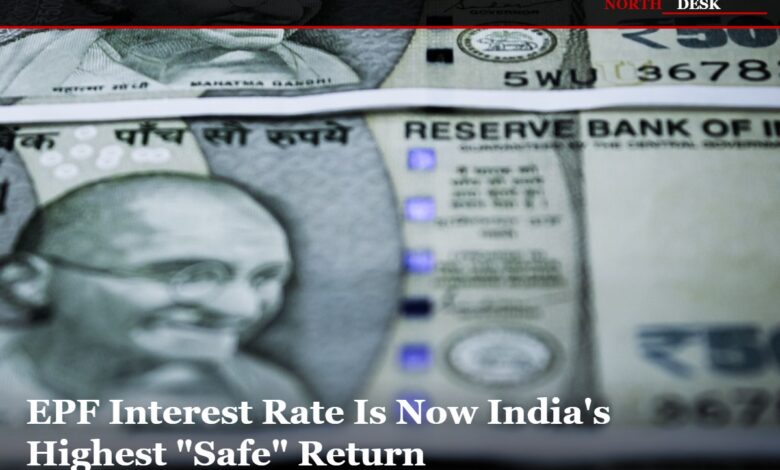
EPF interest rate 2026: At 8.25%, your EPF balance is quietly outperforming SCSS, Sukanya Samriddhi, NSC and every major bank FD. And no, it doesn’t stop earning the moment you switch jobs.
North Desk Bureau
Chandigarh, July 2
Most salaried Indians think of their EPF as a forced, forgettable deduction — money that disappears from every payslip and shows up again only at retirement. Few realise that this “boring” retirement account is currently paying more than almost every other safe, government-backed investment available to them.
The number that matters: 8.25%
EPF interest rate: The Employees’ Provident Fund Organisation’s Central Board of Trustees fixed the EPF interest rate for FY 2025-26 at 8.25% at its meeting in March 2026, chaired by Union Labour Minister Mansukh Mandaviya. The Finance Ministry has since given its concurrence, and the rate — the third year running at this level — is being credited to over seven crore subscriber accounts this month.
To put that in context: this is a full recovery from the 8.10% rate of 2021-22, which was itself a four-decade low, down from 8.5% the year before. Since then, the rate has held steady or crept up, and now sits at a level few comparable instruments can touch.
How it stacks up against the government’s other high-interest schemes
For the July-September 2026 quarter, the Finance Ministry kept small savings rates unchanged from the previous quarter.
THE NUMBERS:
Senior Citizen Savings Scheme (SCSS): 8.2%
Sukanya Samriddhi Yojana (SSY): 8.2%
National Savings Certificate (NSC): 7.7%
Post Office Monthly Income Scheme (POMIS): 7.4%
Kisan Vikas Patra (KVP): around 7.5%
SCSS and SSY are usually cited as the top-paying government-backed instruments — the ones that need you to be a senior citizen or be saving for a daughter’s future to access. EPF, open to over seven crore ordinary salaried employees with zero special eligibility, is paying more than both.
How it stacks up against bank fixed deposits
EPF interest rate: Public sector banks are currently the weakest option. SBI and Bank of Baroda are offering FD rates roughly between 6.25% and 6.60% on their popular tenures. Private banks do a little better — HDFC and Axis are in the 6.25% to 7.40% range depending on tenure, and HDFC’s best rate currently sits around the 18-21 month bracket. Even senior citizens, who typically get a rate bump of about half a percentage point, are generally topping out near 7.10% at the big banks.
The only FDs that beat EPF come from small finance banks and NBFCs — some are quoting up to 8.10-8.30% for general depositors and as high as 8.75% for senior citizens.
But these come with a real trade-off: deposit insurance under DICGC only covers up to ₹5 lakh per depositor per bank, and small finance banks and NBFCs carry meaningfully more credit risk than a public sector bank or a government-backed scheme. EPF, by contrast, is sovereign-backed with no such ceiling on the safety of the principal.
The myth: “My PF stops earning once I quit my job”
EPF interest rate: This is the part most people get wrong, and it costs them money — either through unnecessary panic-withdrawals or through simply not knowing their old PF account is still working for them.
The belief that interest stops after three years of no contributions is a leftover from a 2011 rule that briefly imposed exactly that condition. But a 2016 amendment to the EPF Scheme rewrote the trigger for when an account is classified as “inoperative” — the point at which interest actually stops. It’s no longer tied to leaving a job at all.
Under the amended rule, an account only becomes inoperative on retirement after crossing the specified age threshold, or on permanent migration abroad. In practice, most guidance now pegs this to 58, the official retirement age under the scheme.
What this means in plain terms: if you quit a job, don’t withdraw your PF, and don’t transfer it to a new employer, it keeps earning the full declared interest rate — 8.25% this year — for as long as you’re short of retirement age, contributions or no contributions. An old PF account from a job you left five years ago is not dead money. It is still compounding at a rate better than your bank FD.
Why this matters right now
The EPFO has just notified the EPF Scheme 2026, replacing the 1952 framework, alongside the broader EPFO 3.0 digital push and simplified withdrawal rules. None of this changes the interest rate or how it accrues — the notification specifically leaves interest, contribution rates and existing withdrawal logic untouched. So the maths above holds regardless of which “version” of the scheme your account sits under.
The bottom line for anyone job-hopping or sitting on an old PF account:
Before rushing to withdraw a dormant EPF balance from a previous employer, it’s worth asking whether that money is actually doing better sitting where it is than it would in a fresh FD. Right now, for most people, the answer is yes.
READ: ₹50 Lakh in Innova: Capt Amarinder’s Minister Sunder Sham Arora Plea Dismissed in Bribery Case
READ: Akal Takht 7 Objections to Punjab’s Anti-Sacrilege Law — Explained
Follow North Desk on WhatsApp for the latest from Punjab, Haryana and Himachal Pradesh: https://whatsapp.com/channel/0029Vb7ccdxJENy2H87DBG3E




3 Comments