The Story Of ASI Amarjit Singh: From Life Term For Killing KHALRA To Acquittal…After Bail For Daughter’s Wedding
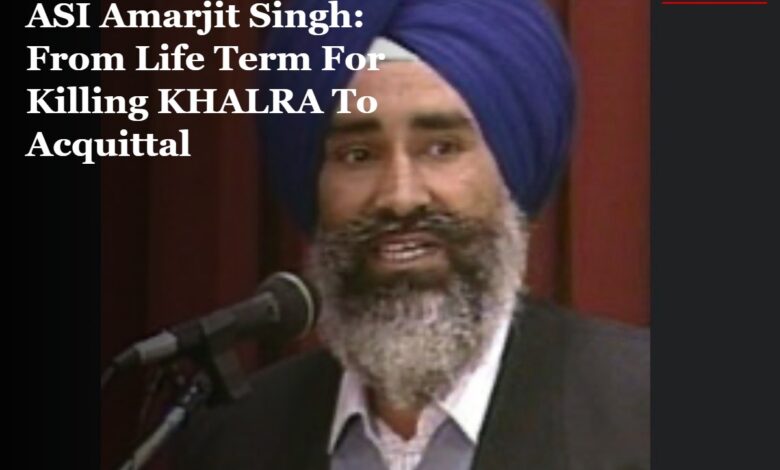
ASI Amarjit Singh was convicted of murdering Jaswant Singh Khalra and sentenced to life in 2005. He got parole twice, bail to marry off his daughter, then walked free on appeal in 2007 — the only one of six convicts to be acquitted.
Arvind Chhabra
Chandigarh, July 14
In September 1995, a bank manager and human rights activist named Jaswant Singh Khalra was dragged out of his house in Amritsar by men in police uniforms. He was never seen alive again. His crime, in the eyes of Punjab Police, was that he had documented something the force wanted buried: that thousands of young Sikh men picked up during the insurgency years were being killed and secretly cremated as “unclaimed” bodies, their deaths never recorded anywhere. Khalra had the receipt books from the cremation grounds to prove it: records of firewood issued for bodies nobody came to claim. He went public. Weeks later, he was gone.
That case has been back in the news in 2026 because of Satluj, a film based on Khalra’s life that was pulled from ZEE5 amid political controversy. The takedown has reignited public attention on what actually happened to the men who killed him, and where they are now.
North Desk has covered several threads of this story: the convicted DSP who can no longer be found at his registered address, the witness whose testimony sent Khalra’s killers to jail, and more. This is about the one convict who isn’t in that picture — because he isn’t a convict anymore.
Who was in the dock
Six Punjab Police officials were tried by a CBI court in Patiala for Khalra’s abduction and murder: DSP Jaspal Singh, ASI Amarjit Singh, and four others — SHOs Satnam Singh, Surinderpal Singh and Jasbir Singh, and Head Constable Prithipal Singh. (A seventh accused, DSP Ashok Kumar, died during the decade-long trial; another, Rachhpal Singh, was discharged for lack of evidence against him.)
Amarjit Singh’s specific role, as laid out in the case files: on October 24, 1995 — while Khalra was being held illegally, tortured, in a police lock-up — Amarjit Singh and Rachhpal Singh moved him by Maruti Gypsy from Police Station Kang to Police Station Harike, on the orders of DSP Jaspal Singh, specifically so the illegal detention wouldn’t show up in police records. Weeks later, Khalra was killed and his body thrown into the Harike canal to make sure it was never found.
ASI Amarjit Singh: Convicted of murder
In November 2005, after a trial that had run for roughly ten years, a court in Patiala delivered the verdict. Of the six men in the dock, only two, DSP Jaspal Singh and ASI Amarjit Singh, were convicted of murder itself, under Section 302 read with Section 34 IPC. The judge held that they were the ones who had “finally eliminated” Khalra and disposed of his body to escape punishment, and sentenced both of them to life imprisonment, on top of separate concurrent terms for kidnapping, illegal confinement and criminal conspiracy. The judge was explicit in denying them any leniency: these were men who had sworn to uphold the law, and had instead tortured an innocent man to death and dumped him in a canal.
The other four — accused of conspiring in the abduction, but not directly charged with the killing — got off comparatively lightly at trial: seven years each.
Life term, then a wedding
ASI Amarjit Singh had been out on bail through the entire ten-year trial and, by his own submission to the court, had “never misused” that concession. Once convicted, that changed: he was now a life-term murder convict, in custody.
But not for long, and not continuously. CBI and court records show he was granted parole twice within a year of his conviction — once in April–May 2006, once in October–November 2006 — and, again, reported back to custody both times without incident.
Then, in December 2006, his lawyers moved a fresh application: his daughter Parminder Kaur’s wedding had been fixed for February 17, 2007, to a groom settled in the United States, and the date couldn’t be moved to line up with his next scheduled parole. The petition — filed in the same appeal in which he was fighting his own life sentence for murder — laid it out in strikingly domestic terms: a copy of the wedding invitation card was attached as evidence; a certificate from his native village’s gram panchayat in Gurdaspur district confirmed there was “nobody in the family” to arrange the wedding in his absence; and the application noted he had one son and four daughters, all already married except this one. He asked the High Court for three weeks of bail to perform his daughter’s marriage.
It’s a striking image to sit with: a man doing life for helping kill and dispose of a human rights activist, moving through a High Court’s bail machinery to make sure his daughter’s wedding to an NRI groom went ahead on schedule — while Khalra’s own family had spent a decade fighting simply to get his killers named and tried.
Then, in 2007, he walked out for good
ASI Amarjit Singh’s appeal against his conviction (the same one his bail applications were filed in) was decided by a Division Bench of the Punjab and Haryana High Court in 2007. His defence had argued, among other things, that the trial court had leaned on witnesses who were themselves human rights activists and therefore “interested” parties; that there had been no identification parade; that statements recorded under Section 161 CrPC had been wrongly treated as substantive evidence; and that the conspiracy finding rested on “conjectures and surmises” rather than hard proof.
Whatever combination of those arguments the High Court accepted, the result was unambiguous: ASI Amarjit Singh was acquitted. Of the six original accused, he is the only one who is, today, a free man with no conviction standing against him.
The High Court’s order that year didn’t stop there. Acting on a revision petition filed by Khalra’s widow, Paramjit Kaur, the same bench enhanced the sentences of the other four convicts — Satnam Singh, Surinderpal Singh, Jasbir Singh and Prithipal Singh — from seven years each to life imprisonment. DSP Jaspal Singh’s own life sentence for murder was upheld.
In 2011, the Supreme Court rejected the final appeals of those five remaining convicts, closing the door on their attempts to overturn the verdict.
READ ALSO: Punjab Truth Commission Explained: What It Is, Who Wants It, Why Now
Where things stand now
Jaspal Singh, the other man convicted of Khalra’s murder, is still formally a life convict — though he was let out on interim bail in 2023 and, as North Desk has reported, could not even be found at the address on his own jail records when police went looking for him this month. The four men whose sentences were enhanced to life in 2007 remain convicts of that 2011 Supreme Court verdict. Amarjit Singh alone has nothing pending against him at all.
Follow North Desk on WhatsApp for the latest from Punjab, Haryana and Himachal Pradesh: https://whatsapp.com/channel/0029Vb7ccdxJENy2H87DBG3E
KHALRA FILES on North DESK:
READ ALSO: The DSP Convicted For Killing Khalra Cannot Be Found At His Address
READ ALSO: Jaswant Singh Khalra Had Named His ‘Killer’ To An Ex-Judge Before Abduction
READ ALSO: Cops Disposed Of Jaswant Singh Khalra’s Body. Then They Had Whisky, Dinner
READ ALSO: The Cop Who Fed Khalra His Last Meals…And Whose Words Convicted His Killers
READ ALSO: Three Of Khalra’s Convicted Killers Are Out On Bail Right Now — Here’s Why
READ ALSO: Jailed in Same Cell Who Saw Everything–The Story of Khalra Witness Kulwant Singh
READ ALSO: Punjab Truth Commission Explained: What It Is, Who Wants It, Why Now





9 Comments