Dog Dressed as Krishna: High Court Cites Gita, Mahabharata to Rule on FIR
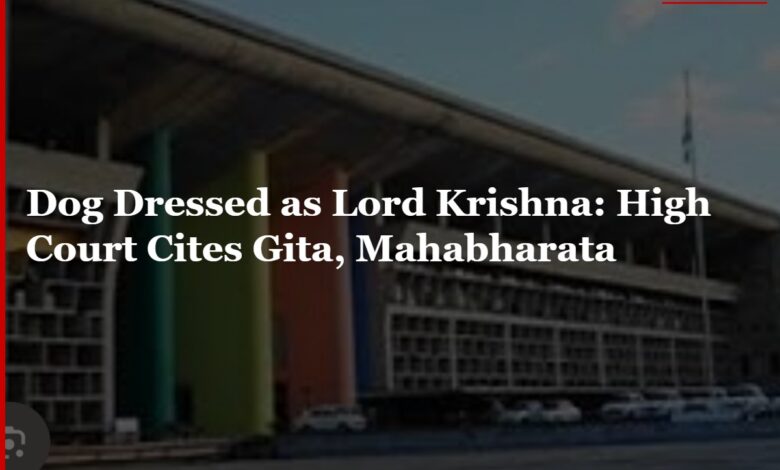
Dog Dressed as Krishna FIR: Punjab & Haryana High Court quashes Hoshiarpur woman’s FIR over her dog dressed as Lord Krishna on Janmashtami, ruling no offence under Section 298 BNS — with a judgment citing the Gita, Mahabharata and Aztec mythology.
North Desk Correspondent
Chandigarh, July 3
A Janmashtami WhatsApp status has ended in a Punjab and Haryana High Court judgment that reads part legal ruling, part comparative-religion essay — invoking the Bhagavad Gita, the Mahabharata, Kal Bhairava, Shinto spirits and Aztec mythology before quashing an FIR against a Hoshiarpur woman who dressed her pet dog as Lord Krishna.
Justice Subhas Mehla allowed the petition filed by the woman, quashing the FIR registered in September 2024 at Police Station Talwara under Section 298 of the Bharatiya Nyaya Sanhita (BNS), along with the final report filed before the trial court in January 2025.
Dog Dressed as Krishna: The complaint
The FIR was registered on a complaint by a private complainant who identified himself as a youth leader of the Shiv Sena, alleging that the accused had hurt Hindu religious sentiments by dressing her pet dog in a yellow cloth, crown and other ornaments to resemble Lord Krishna, and posting the photograph as her WhatsApp status on Janmashtami.
During investigation, the woman, a bank manager, told police she had been married for six years and remained without children, which was why she loved her pet dog “as her own child.”
She said she dressed the dog with a Krishna crown two to three days before the festival, photographed it, and posted the image as her WhatsApp status without realising it would hurt anyone’s sentiments. Police filed a final report under Section 193 BNSS before the trial court in January 2025.
Two legal grounds
Stripped of its extensive philosophical discussion, the court’s actual ruling rests on two findings.
First, on the ingredient of “object”: Section 298 BNS (the successor to Section 295 IPC) penalises destruction, damage or defilement of a place of worship or “any object held sacred by any class of persons.”
The court held that the word “object” must be read ejusdem generis with “place of worship” — meaning the provision applies only where the object in question is located in a place of worship or carried in a religious procession. The crown, yellow cloth and other ornaments used on the dog, the court held, do not meet this description.
Second, on intent: the court found no mens rea — neither an intention to insult, nor knowledge that the act was likely to be seen as insulting. It leaned on the Supreme Court’s ruling in a case where a magazine cover depicting MS Dhoni as Krishna was quashed on the ground that insults offered “unwittingly or carelessly” without deliberate malicious intent fall outside the analogous Section 295A IPC.
The court also cited Priya Prakash Varrier v. State of Telangana (2019) and, on the standard for assessing offence to sentiment, imported the Supreme Court’s “community standard test” from Aveek Sarkar v. State of West Bengal (2014) — a case that arose under the separate obscenity provision, Section 294 IPC, but which the court used here to argue that criminal liability cannot rest on the subjective hypersensitivity of an individual complainant rather than the perception of an “ordinary prudent person.”
The wider discussion
Before reaching these findings, Justice Mehla’s order runs to several pages of discussion on divinity and animals across traditions — the Gita’s verse on sages viewing a Brahmin, a cow, an elephant and a dog with “equal vision”; the Mahabharata’s account of Yudhishthira refusing to abandon a dog at heaven’s gate, only for it to reveal itself as Dharma; the dog as Kal Bhairava’s vehicle; and parallel references to Anubis in Egyptian mythology, kami in Shinto belief, and Xolotl in Aztec religion. The order concludes with a line from the Ramcharitmanas — “jaaki rahi bhaavna jaisi, prabhu moorat dekhi tinha jaisi” — that a person perceives the divine according to their own inner disposition.
This discussion does not form part of the operative legal test applied in the case; the actual quashing turns on the two grounds above.
The court also held that the petitioner’s act was protected under Article 19(1)(a) (freedom of expression) and Article 25 (freedom of conscience and religion) of the Constitution, and noted that the limited, private nature of a WhatsApp status — as opposed to open platforms — weighed against any inference of intent to cause wider offence.
Counsel for the petitioner had also argued that the FIR was politically motivated, pointing to the complainant’s identification as a party youth leader and invoking category (5) of the Supreme Court’s State of Haryana v. Bhajan Lal (1992) guidelines on abuse of process. The court’s order does not record a specific finding on this claim, resting the quashal instead on the absence of the offence’s essential ingredients.
READ ALSO: Sikh Helmet Exemption: Bombay HC Ruling & Global Rules Explained
READ ALSO: Who Is Jagman Samra? The Canada-Based NRI at the Centre of the Bhagwant Mann Video Row
Follow North Desk on WhatsApp for the latest from Punjab, Haryana and Himachal Pradesh: https://whatsapp.com/channel/0029Vb7ccdxJENy2H87DBG3E




2 Comments