Sikh Helmet Exemption: Bombay HC Ruling & Global Rules Explained
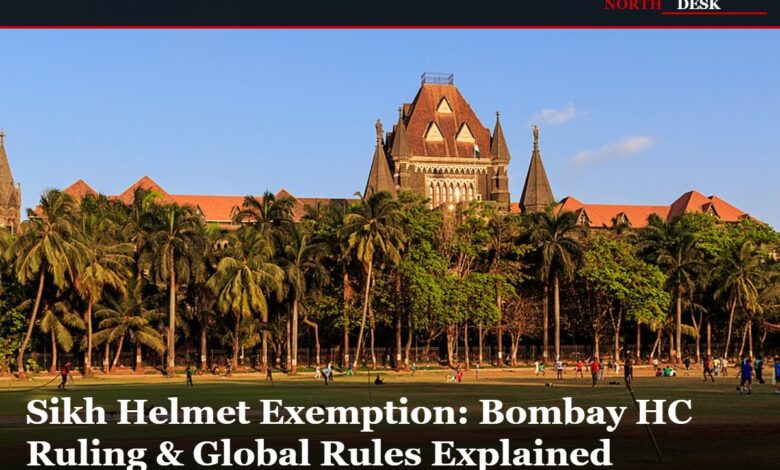
Bombay High Court upholds Sikh helmet exemption for turban wearers. Know the full judgment, controversies, and helmet rules for Sikhs in India, UK, Canada, Australia & worldwide
North Desk Correspondent
Chandigarh, July 2
The Nagpur Bench of the Bombay High Court has upheld the long-standing exemption for turban-wearing Sikhs from mandatory helmet use, reigniting debates on the balance between religious rights and road safety.
Justices Urmila Joshi-Phalke and Nivedita P. Mehta dismissed a petition challenging the proviso to Section 129 of the Motor Vehicles Act, 1988. The court ruled that the exemption is a “reasonable classification” under Article 14 of the Constitution, not arbitrary discrimination or class legislation.
Sikh Helmet Exemption: The case and the order
Sikh Helmet Exemption: The petitioner, Kirtesh Vikas Chaudhari, a 23-year-old law student from Nagpur, filed the writ petition arguing that the exemption for Sikhs violates the right to equality. He contended that the law creates special privileges, making non-Sikhs offenders for the same act and lacking constitutional support.
Chaudhari sought a declaration that Sections 129 and 194(d) of the MV Act are unconstitutional.
The Union of India defended the provision, stating it is a reasonable classification aligned with the Act’s safety objectives. The bench agreed, noting that the turban worn by Sikh men serves a similar protective role in the context of the law. It observed: “Exemption given to the Sikhs is not on the basis of caste or creed or religion.” The court cited precedents from the Supreme Court and other High Courts to conclude that Article 14 permits reasonable classifications with a rational nexus to the law’s purpose.
The petition was dismissed as “misconceived,” with the rule discharged.
READ ALSO: Who Is Jagman Samra? The Canada-Based NRI at the Centre of the Bhagwant Mann Video Row
Recent Controversies
Sikh Helmet Exemption: The issue has seen periodic flare-ups. In recent years, strict enforcement drives in some states have led to complaints from the Sikh community about harassment and demands for uniform national guidelines. Advocacy groups have pushed for better awareness among traffic police regarding the exact scope of the exemption (limited to proper turbans).
Internationally, campaigns in Australia for exemptions have faced resistance from road safety bodies, while some European countries (e.g., Germany) have rejected similar pleas, prioritising universal safety standards. In India, debates often surface during helmet enforcement campaigns, with questions raised about gender dimensions (e.g., exemptions primarily benefiting turbaned men) and calls for voluntary adoption of protective turbans or alternative headgear.
The Global Picture: Exemptions Rooted in Faith
Several countries accommodate the religious significance of the turban:
United Kingdom: Exemption since 1976.
Canada: Available in provinces like British Columbia, Alberta, Manitoba, and Ontario (with conditions such as regular turban use and age requirements).
Singapore and Malaysia: Exemptions in place.
New Zealand: Limited exemptions in certain scenarios.
Australia: Patchy; some past bicycle exemptions, but most states now enforce universal motorcycle helmet rules with ongoing advocacy.
In contrast, strict enforcement without exemptions applies in places like Germany.
In India: Uniform Central Law, Varied Enforcement
Section 129 of the MV Act mandates helmets for all two-wheeler riders, with a clear proviso exempting turban-wearing Sikhs. Punjab and Haryana High Court has clarified that the exemption applies “only to those wearing a proper turban” (not patka or similar), mainly for men. Non-turbaned Sikhs must wear helmets. While the central law is uniform, enforcement is generally more understanding in North India, particularly Punjab.
The Debate: Faith, Safety, and Equality
The exemption upholds religious freedom while road safety experts stress helmet efficacy. Many in the community emphasize personal responsibility and innovations like reinforced turbans.
As the Bombay HC observed, the law seeks a practical balance.
READ: Akal Takht 7 Objections to Punjab’s Anti-Sacrilege Law — Explained
Follow North Desk on WhatsApp for the latest from Punjab, Haryana and Himachal Pradesh: https://whatsapp.com/channel/0029Vb7ccdxJENy2H87DBG3E


One Comment