Chandigarh Cyber Fraud: Fake Gas Company Call Drains Couple’s ₹7.5 Lakh Savings
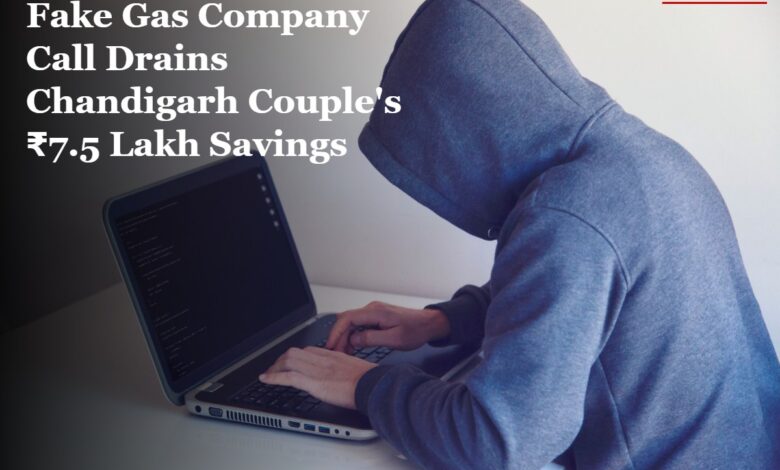
Chandigarh Cyber Fraud: A ₹1 “test payment” during a fake Adani Gas documentation call led to an unrequested credit card and ₹7.56 lakh vanishing from a couple’s account in under an hour. Here’s how the scam worked.
North Desk Correspondent
Chandigarh, July 15
Inder Dev Singh picked up the phone the way most people his age do: expecting a bill, a bank reminder, maybe a wrong number. It was June 25, and the man on the line said he was calling from Adani Gas, Gujarat. There was a problem, he explained, with the pipeline documentation for the Singh household in Sector 51. Nothing serious. It just needed to be completed today, if possible, over video, because the voice call kept breaking up.
It was the kind of call thousands of Indian households get every week about gas connections, KYC updates, electricity dues. Singh, 73, did what anyone trying to be a responsible homeowner would do. He gave the caller another number to reach him on — one that belonged to his wife.
Within minutes, a WhatsApp video call came through. A man on the other end walked them through the “documentation,” and at the end of it, said something so small it barely registered as a request: to confirm everything was in order, could they just complete a ₹1 payment through a QR code?
READ ALSO: ASI Amarjit Singh: From Life Term For Killing KHALRA To Acquittal
The Rs 1 game
Chandigarh Cyber Fraud: Singh’s first attempt failed — a technical glitch, or so it seemed. The caller sent a second QR code, this time to his wife’s phone. On June 26, the payment of one rupee went through, routed via her bank’s UPI handle, while the video call was still live and the fraudster was still watching.
It is worth sitting with how deliberately small that number is. Not ₹500. Not ₹50. One rupee — just enough to confirm the payment channel worked, just small enough that nobody hangs up over it. It was never about the rupee. It was about getting a working QR code, a working UPI ID, and a working link into an elderly woman’s bank account, all handed over willingly, on camera, by two people who thought they were finishing paperwork about their gas connection.
The arrival of card
Chandigarh Cyber Fraud: Four days later, on June 30, an ICICI Bank credit card arrived at their door. Neither of them had applied for it. They activated it — people often do, unthinkingly, the way you accept a courier without asking who sent it — but never used it. It sat in a drawer for a week.
Then, on July 6, while checking her email, the woman found two alerts from ICICI Bank. Her unused, unrequested credit card had just been charged ₹48,870 and ₹49,000 — transactions she hadn’t made. Her husband called the bank’s helpline immediately and managed to get both declined. It felt, for a moment, like a crisis contained.
Chandigarh Cyber Fraud: How the scam unfolded
It wasn’t. When she logged into her savings account that same evening, out of caution, she found the real damage had already been done — not through the card, but through her bank account directly, in a rapid sequence of transactions that had started that same morning while she had no idea anything was wrong.
Chandigarh Cyber Fraud: Between 11:36 AM and 12:30 PM on July 6 — less than an hour — nine separate UPI transactions moved out of her ICICI savings account. Not to one destination, but to five different banks’ credit cards: ₹1,21,650 to an Axis Bank card, ₹57,500 and ₹64,864 to two SBI cards, ₹43,999 to an HDFC card, ₹29,499 to an RBL card, ₹41,149 to an IDFC First card. Every single one of them was routed through the same intermediary — Airtel Payments Bank — before landing on someone else’s credit card balance.
A ₹2,00,000 transaction was flagged and held back long enough that she was able to reject it the next morning, on a verification call from the bank. Two final payments, ₹90,000 and ₹10,000, went not to a credit card at all but straight to a UPI ID under the name “Rajiv Kumar.”
By the time the dust settled, ₹7,56,532 — the couple’s savings, accumulated over decades — had moved out of her account in less time than it takes to finish a cup of tea.
Chandigarh Cyber Fraud: What makes this case worth more than a single cautionary headline is the machinery underneath it, which the family’s complaint to Chandigarh Police lays bare in granular detail. This wasn’t a lone fraudster improvising. It was a pipeline: a small trust-building payment to open the channel, an unsolicited credit card to create a second point of entry, and a laundering route through a payments bank into other people’s credit cards — an efficient way to scatter stolen money across five different banking institutions before anyone can trace or freeze it.
It also raises a quieter, more uncomfortable question that the family’s complaint doesn’t dwell on but that the facts force into view: why was a 73-year-old woman with no record of applying for a credit card issued one, unprompted, by ICICI Bank — one that would, within days, become the exact instrument through which fraudsters tried to draw down her funds a second time? A “documentation” call from a fake gas company shouldn’t be able to end with a bank shipping a physical credit card to your door.
The police have lodged an FIR under sections of the Bharatiya Nyaya Sanhita covering cheating and forgery, and begun investigations. Whether that trail leads anywhere is, for now, an open question. What isn’t in question is how fast it happened, and how ordinary every single step looked from the inside — a phone call about gas paperwork, a video call to fix bad reception, a payment of one rupee to confirm everything was fine.
Follow North Desk on WhatsApp for the latest from Punjab, Haryana and Himachal Pradesh: https://whatsapp.com/channel/0029Vb7ccdxJENy2H87DBG3E
READ ALSO: Dera Sacha Sauda Violence Case: How Forensics Sank Haryana’s Kaithal Dera Violence Case




One Comment