Dera Sacha Sauda Violence Case: How Forensics Sank Haryana’s Kaithal Dera Violence Case
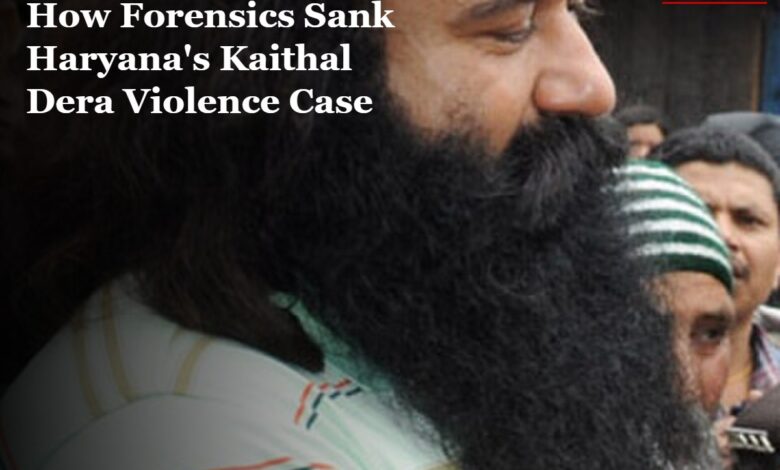
Dera Sacha Sauda Violence Case: Nine years after mob set fire to a Kaithal power office in the aftermath of Gurmeet Ram Rahim’s conviction, the case that was supposed to prove arson collapsed on the State’s own lab report
Arvind Chhabra
Chandigarh, July 15
A mob of 14-15 men allegedly stormed the UHBVN sub-divisional office at Kalayat in Kaithal district on the afternoon of August 25, 2017. They were armed with lathis, dandas, gandasis and bottles of petrol, police said. Officials fled. Computers, printers and furniture were destroyed. The office was set ablaze. The Fire Brigade had to be called in. And the case against the accused looked straightforward.
Nearly nine years later, the Punjab and Haryana High Court has dismissed the State of Haryana’s appeal against the acquittal of the accused. One major reason for their acquittal was the report of the Haryana Police’s own Forensic Science Laboratory found on the burnt evidence.
The forensic gap at the centre of Dera Sacha Sauda Violence Case
Dera Sacha Sauda Violence Case: The prosecution’s entire arson theory rested on the claim that the mob doused the office in petrol before setting it alight. But the FSL report from Madhuban, examined during trial, detected no traces of kerosene, petrol, diesel or any inflammable residue on the burnt articles recovered from the site.
A Division Bench of Justices Vinod S. Bhardwaj and Sukhvinder Kaur called this “circumstance of considerable significance,” noting that the absence of forensic corroboration “materially dents the prosecution case” — since the mischief-by-fire charge depended specifically on the claim that inflammable substances were used.
No recoveries at the spot, no photographs, no identification parade
The order in the Dera Sacha Sauda Violence Case lists a string of investigative gaps beyond the forensic mismatch:
- Although the accused were allegedly carrying petrol bottles and weapons during the incident, nothing was recovered at the scene. The police’s explanation was that the men threw the weapons away before being caught. But it was dismissed by the court as “inherently improbable” and not credible.
- A police witness who claimed to have chased the assailants for nearly a kilometre while repeatedly phoning superiors, never photographed or filmed them despite having a mobile phone on him. He also gave two conflicting statements under Section 161 CrPC — one attributing a gandasi to accused Shiv Kumar alias Babar, the other, given after he was declared hostile in court, attributing a danda to him instead, along with a fresh, unsupported claim that a Rest House had also been vandalised.
- No Test Identification Parade was conducted at any stage, even though the witnesses had no prior acquaintance with the accused. The accused were identified for the first time in court — nine years after the incident.
- None of the prosecution witnesses named the accused in the original FIR. Respondent Balbir Singh’s implication rested solely on a co-accused’s disclosure statement that led to no independent recovery — legally inadmissible on its own. Shiv Kumar’s name did not appear in the original complaint or in the statement of the exempted investigating officer.
- Case property allegedly recovered from one accused (Dharampal) was found signed by another (Jasbir), with no explanation offered, and the property itself was never produced in court.
A side note on local politics
One identifying witness, turned out to be the cousin of the local Sarpanch against whom accused Shiv Kumar had earlier filed RTI applications. Separate documents on record pointed to a dispute involving a protest to arrest that same Sarpanch. The court treated his testimony “with caution” as that of an interested witness.
The sedition line, and the bigger picture
The Bench also held that the Section 124-A charge could not stand: sloganeering against the government, however hostile, does not by itself amount to disaffection or hatred in an “elected democracy.” That finding has understandably drawn attention as a free-speech precedent. But read against the rest of the order, it’s almost incidental: the case was already unravelling on facts before it reached the law.
As the Bench put it, the prosecution never crossed the line from the accused “may have been” involved to the legal standard of “must be involved.”
The nine-year journey from a burning office in Kalayat to a High Court affirming acquittal ends not with a debate about dissent, but with a case that, on the State’s own evidence, was never proven to have happened the way it was charged.
Follow North Desk on WhatsApp for the latest from Punjab, Haryana and Himachal Pradesh: https://whatsapp.com/channel/0029Vb7ccdxJENy2H87DBG3E
READ: PM’s Punjab, Haryana Visit Under Shadow of Khalistan Threat
READ ALSO: Three Of Khalra’s Convicted Killers Are Out On Bail Right Now — Here’s Why


2 Comments